
Jesus’ Baptism: Where Was Jesus Baptized and by Whom? (Verses)

Written by Marko Marina, Ph.D.
Author | Historian
Author | Historian | BE Contributor
Verified! See our guidelines
Verified! See our editorial guidelines
Date written: October 20th, 2025
Disclaimer: The views and opinions expressed in this article belong to the author and do not necessarily match my own. - Dr. Bart D. Ehrman
There are thousands of Christian denominations in the world today, and each of them has some form of initiating ritual that can be traced back (at least theologically) to Jesus’ baptism. This single event, narrated in the New Testament, has had enormous influence on the development of Christian practice and identity.
But what actually happened at the Jordan River 2,000 years ago? Where was Jesus baptized, and how do the earliest accounts describe it? These questions aren’t merely of devotional concern; they are historical questions, and historians approach them with the same critical tools they use for any ancient tradition.
Throughout this article, we’ll consider the different ways the Gospels narrate the event, compare their distinctive emphases, and ask what we can know about the baptism as a historical occurrence.
Our exploration will move in stages. We’ll begin by surveying the New Testament accounts, then examine each narrative in greater depth: first Mark, then Matthew, then Luke. We’ll also compare their similarities and differences in a side-by-side table.
From there, we’ll turn to what historians say about the baptism itself. Did it really happen, and if so, why would Jesus have submitted to it? Finally, we’ll draw our reflections together in a conclusion that highlights the ongoing significance of this moment, both for scholars and non-scholars, despite their theological views!
However, before we begin exploring where Jesus was baptized, by whom, and what was the significance of that event, we must set our basic terms and definitions.
In Second-Temple Judaism, ritual washings were a common means of purification, symbolizing cleansing before God and readiness for worship. John the Baptist adopted and radicalized this practice, transforming it into a baptism of repentance in anticipation of God’s coming judgment.
In the decades that followed Jesus’ death and the conviction that he had been raised from the dead, baptism took on new meaning for his followers. It was redefined as the rite of entry into the Christian community, a symbolic participation in Jesus’ own death and resurrection, and a sign of new life.
Now that we’ve set our definitions and terms, we can move forward with our journey into the earliest accounts of Jesus’ baptism: The Synoptic Gospels!
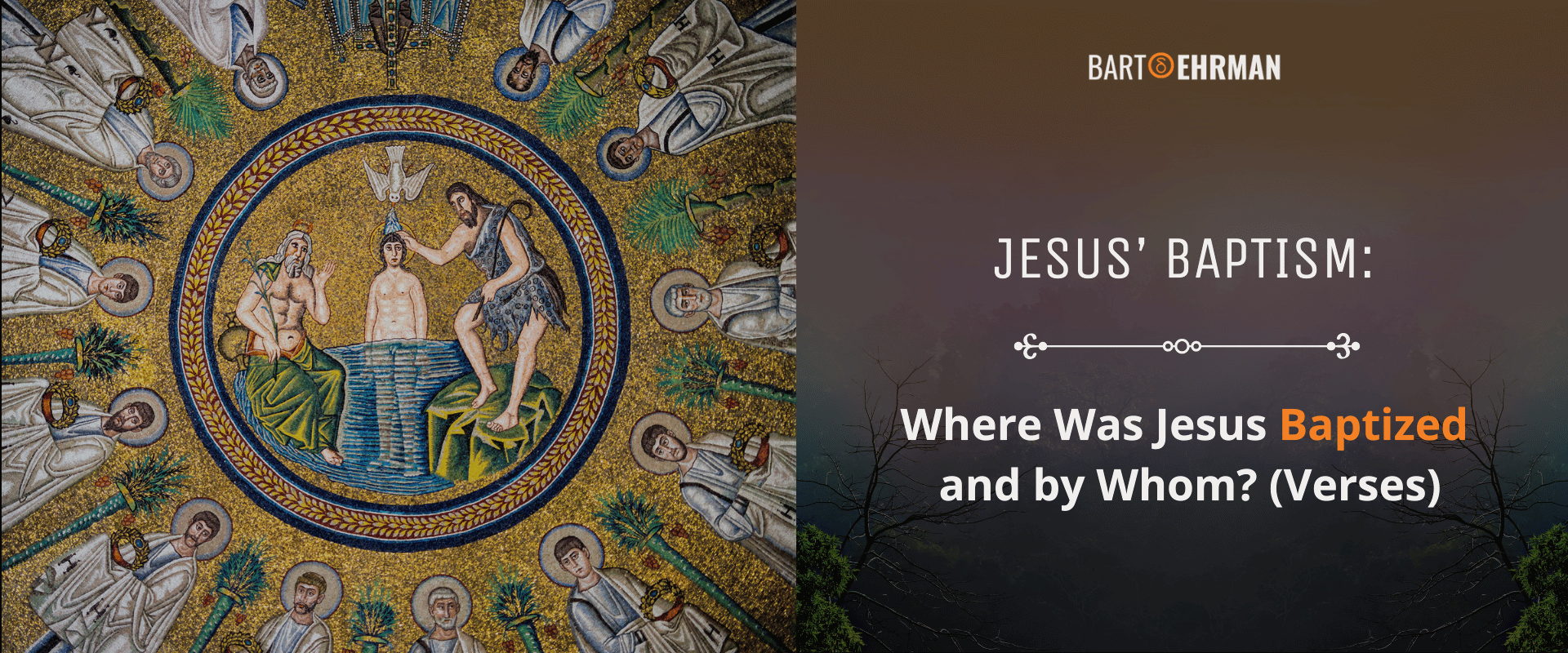
Narratives of Jesus’ Baptism in the New Testament: A Broad Overview
The story of Jesus’ baptism appears directly only in the Synoptic Gospels (Mark, Matthew, and Luke). In contrast, the Gospel of John, composed near the end of the 1st century, doesn’t provide a straightforward account of the event.
Instead, John alludes to it only indirectly, emphasizing John the Baptist’s testimony about seeing the Spirit descend on Jesus. This difference already shows us that the earliest Christian storytellers didn’t all treat baptism in the same way.
In the Synoptic tradition, however, the central features are consistent. Jesus comes to John the Baptist at the Jordan River. There, he undergoes baptism, and, immediately afterward, the heavens open, the Spirit descends upon him, and a divine voice affirms his unique status as God’s Son.
Each Synoptic Gospel, as we’ll soon see, presents these elements in its own way, sometimes with additions or omissions, but the overall shape of the narrative remains recognizable.
Now that we have glimpsed this event from a bird’s-eye perspective, it’s time to move closer to the text itself. In the next section, we’ll examine the earliest written Gospel and consider how it presents the story of Jesus’ baptism in particular detail.
Jesus’ Baptism in the Gospel of Mark
The earliest written account of Jesus’ baptism appears in the Gospel of Mark, composed around 70 C.E. but drawing on traditions that circulated decades earlier. Mark’s version is striking in its brevity and power.
In just a few verses (Mark 1:9-11), the evangelist recounts Jesus’ arrival from Nazareth, his baptism by John in the Jordan, and the dramatic vision of the heavens torn apart, the Spirit descending like a dove, and the voice from heaven declaring Jesus to be God’s beloved Son.
Scholars widely recognize that Mark’s narrative sets the theological agenda for later retellings: its apocalyptic imagery, compressed form, and emphasis on divine revelation shape how Matthew and Luke will reinterpret the scene in their own ways.
The heart of Mark’s account lies not in the baptism itself but in the apocalyptic vision that follows. The heavens aren’t simply “opened” (as in Matthew and Luke) but violently “torn apart,” echoing Isaiah 64:1’s plea for God to rend the heavens and come down.
This image signals an irreversible breach between heaven and earth: God’s Spirit is now permanently unleashed into the world. The Spirit’s descent “like a dove” evokes Genesis 1:2, when God’s Spirit hovered over the primordial waters, suggesting that Jesus’ baptism inaugurated a new creation.
The heavenly voice combines three scriptural strands — Psalm 2:7 (“You are my Son”), Isaiah 42:1 (“in you I have taken delight”), and perhaps Genesis 22 (the “beloved son” Isaac) — thereby fusing royal, prophetic, and sacrificial motifs into one climactic affirmation of Jesus’ identity.
Yet, as Joel Marcus notes in his Commentary:
(Affiliate Disclaimer: We may earn commissions on products you purchase through this page at no additional cost to you. Thank you for supporting our site!)
The baptism itself is described laconically; we hear nothing of Jesus’ personal relationship with John, of his motivation for joining in John’s baptism, or of his feelings during the experience. Early Christians, indeed, were rather embarrassed by John’s baptism of Jesus, both because of the possible implication of Jesus’ sinfulness (cf. 1:4) and because of his apparent subordination to John the Baptist.


Mark handles this tension by downplaying the baptismal act itself and focusing instead on the vision granted to Jesus alone. Unlike later accounts, Mark emphasizes the privacy of this moment: only Jesus sees the heavens torn open and hears the divine voice.
As it turns out, this reticence coheres with the so-called “Messianic secret” in Mark. And if you want to know more about the Messianic Secret and its historical significance, you might be interested in Bart D. Ehrman’s eight-lesson course The Genius of Mark: Jesus the Secret Messiah. In it, he explores this powerful theme at the heart of Mark’s Gospel and shows how it shaped early Christian understandings of Jesus beyond the simplistic answers often given.
In sum, Mark’s narrative of Jesus’ baptism functions less as a biographical detail and more as a revelatory scene of cosmic and theological significance. It marks the tearing open of heaven, the descent of the Spirit, and the divine acclamation of Jesus as Son.
Having explored Mark’s vivid and foundational portrayal, we turn now to Matthew’s account, which reshapes this material in telling ways, introducing particular emphases and, just as importantly, intriguing omissions.

Jesus’ Baptism in the Gospel of Matthew
The baptism of Jesus in Matthew 3:13-17 is both dependent on Mark and yet distinctly Matthean in shape and emphasis. As in Mark, Jesus comes to Jordan and is baptized by John, but Matthew reshapes the scene in several ways.
The most obvious and significant addition is the brief dialogue between John and Jesus (vv. 14-15). John objects, insisting that he needs to be baptized by Jesus, but Jesus replies that “it is fitting for us to fulfill all righteousness.”
This insertion almost certainly reflects the embarrassment of the early Church at the idea of the sinless one undergoing a baptism of repentance.
Craig A. Keener, in his Commentary, claims it’s “not unreasonable” that John would “admit Jesus' greater status” because it “fits the narrative's logic.” However, most scholars (as we’ll see later) remain unconvinced.
In any case, by foregrounding this exchange, Matthew acknowledges the potential problem while turning it into an opportunity to affirm Jesus’ role as the obedient Son who enacts God’s will.
The phrase “to fulfill all righteousness” is dense with Matthean theology. “Fulfill” (plēroō) in this Gospel almost always signals the bringing to completion of the divine plan set forth in Scripture, and “righteousness” consistently refers to right conduct in accordance with God’s will.
Thus, Jesus’ baptism isn’t a concession to sin but an act of obedience that realizes prophetic expectation. The plural “us” in his statement links Jesus and John as collaborators in this fulfillment: John, by baptizing, and Jesus, by submitting, together enact the divine script.
Notably, these are the very first words Jesus speaks in Matthew’s Gospel, giving them programmatic force. In other words, Jesus’ mission begins with a declaration that his life will be about fulfilling God’s will.
After John consents, Matthew moves quickly to the visionary and revelatory dimensions of the scene. As Jesus comes up from the water, “the heavens were opened” (v. 16). Unlike Mark’s violent imagery of heavens being torn apart, Matthew’s passive verb frames the event as a disclosure of divine reality, an apocalyptic unveiling rather than a rupture.
The Spirit of God, says Matthew, descends upon Jesus “like a dove.” It’s a phrase that likely recalls Genesis 1:2 and the Spirit hovering over the waters at creation. For Matthew’s readers, this evokes new creation: just as God’s Spirit once animated the world, so now the Spirit inaugurates a new age through Jesus.
The emphasis, however, isn’t adoption but empowerment. By shifting Mark’s wording from “into him” to “upon him,” Matthew underscores the Spirit’s role in equipping Jesus for messianic service, in line with Old Testament patterns where the Spirit “comes upon” chosen figures for a divine mission.
The climax of the narrative comes with the heavenly voice: “This is my beloved Son, in whom I have taken delight” (v. 17). Here, Matthew makes another deliberate redactional change. Whereas Mark has the voice address Jesus directly (“You are my Son”), Matthew broadens the scope so that the declaration is audible to others.
This public dimension fits Matthew’s tendency to highlight the manifestation of Jesus’ identity from the outset, rather than concealing it as Mark does with his “messianic secret.”
Furthermore, the scriptural echoes in Matthew’s account of Jesus’ baptism are rich and multilayered! Psalm 2:7 contributes the royal sonship motif, Isaiah 42:1 evokes the Servant who brings justice and receives God’s Spirit, and the word “beloved” may allude to Genesis 22 and Isaac, the beloved son offered in sacrifice.
In their Commentary, William Davies and Dale Allison Jr. conclude:
There are four major Matthean themes to be discerned in 3.13-17: Jesus as Son, Jesus as servant, Jesus as the inaugurator of the new exodus and new creation, and Jesus as the one who fulfills all righteousness... With regard to the second, Jesus is the one in whom God is pleased, that is, he is the servant. In that capacity he not only brings OT prophecy to fulfilment, receiving the Spirit (3.17; 12.18), taking up infirmities (8.17), and giving his life as a ransom for many (20.28) – he is also the paradigm of the righteous sufferer... As for the third theme, although we have not found in the dove or in ‘Son’ evidence of a new exodus motif, it would be wrong to exclude the idea altogether from Matthew’s story of the baptism. This is because 3.13-17 is followed immediately by the temptation narrative, in which Jesus the Son repeats the experience of Israel in her desert wanderings. In other words, 3.13-17 is coloured by what comes after, and this suggests a new exodus.
Jesus’ Baptism in the Gospel of Luke
Unlike both Mark and Matthew, the Gospel of Luke devotes an extended section to John the Baptist as the forerunner of Jesus (3:1-20). Luke situates John’s appearance with a solemn synchronism of rulers, anchoring him firmly in world history, and then depicts him as a prophet commissioned by God’s word.
His role is interpreted through Isaiah 40:3-5: the voice crying in the wilderness to prepare the way of the Lord. Luke also expands John’s ministry with material found only here: the ethical exhortations to the crowds, tax collectors, and soldiers (3:10-14).
These instructions aren’t radical demands but common-sense exhortations to honesty, generosity, and integrity. As Michael Wolter notes, John’s activity is functional.
His task is to form a people “ready for the Lord.” And significantly, Luke ends this section with Herod’s imprisonment of John (3:19-20), thereby moving John offstage before the baptismal scene.
This redactional decision is striking. By narrating John’s imprisonment in advance, Luke carefully separates the forerunner from the Messiah. John prepares the way, but once Jesus appears, he vanishes from the narrative.
The consequence is that Luke’s account of Jesus’ baptism no longer focuses on the act itself or on John’s role in performing it. Instead, the baptism becomes a temporal backdrop to what really matters: the divine revelation that follows.
Wolter observes:
The tension that arises through the Lukan manner of narration is obvious. In the sequence of the time of the narrative John is already in prison, whereas with regard to the time of what is narrated, it is presupposed that he is still active (v. 21), though he is not present as a narrative figure – Luke omits the Markan reference that Jesus was baptized ‘by John’ (Mark 1.9).
Luke, in short, never explicitly states that John baptized Jesus.
The baptism itself is narrated with extreme brevity: “When all the people had been baptized, and when Jesus also had been baptized and was praying…” (3:21). The ritual act is almost an aside, subordinated to the description of what happens next.
Unlike Mark’s vivid “coming up from the water,” Luke highlights instead that Jesus was praying. This is the first of many places in Luke’s Gospel where decisive moments in Jesus’ life occur in connection with prayer.
The emphasis has shifted: the baptismal water isn’t the climax, but rather the setting for God’s initiative. What follows is a threefold theophany narrated as objective events, not private visions. Heaven is opened, the Holy Spirit descends “in bodily form like a dove,” and the heavenly voice proclaims Jesus’ identity.
Luke’s version, then, transforms the baptismal story into a disclosure of Jesus’ identity and mission. The Spirit’s descent in visible, almost tangible form signals empowerment for ministry, echoing creation imagery from Genesis 1:2.
By making the voice a public pronouncement (“You are my beloved Son, in you I am well pleased”), Luke underscores the universal significance of the moment. The baptismal act fades almost entirely into the background; the focus rests squarely on God’s revelation.
In this way, Luke distances Jesus from John, deals with the potential problem of John being superior to Jesus, stresses Jesus’ filial relationship with God, and presents the event as the true inauguration of Jesus’ mission.
Jesus’ Baptism: Scripture (Comparative Table)
When it comes to describing Jesus’ baptism, the Synoptic authors are like three journalists covering the same headline event: they agree on the essentials but each files a story with its own spin, emphases, and omissions.
To see just how Matthew, Mark, and Luke differ, it helps to line their accounts up side by side. Let’s take a look!
Feature | Mark | Matthew | Luke |
|---|---|---|---|
Passage | Mark 1:9-11 | Matthew 3:13-17 | Luke 3:21-22 |
John named as baptizer of Jesus | Yes (“…baptized by John in the Jordan,” 1:9) | Yes (3:13-15; explicit, with dialogue) | No (omitted); John already placed offstage (3:19-20) |
Location (Jordan) | Explicit (1:9 “in the Jordan”) | Explicit (3:13, “to the Jordan”; 3:16 “from the water”) | Not named in vv. 21-22 (but 3:3 speaks of the Jordan region for John’s baptizing) |
Narrative focus | Vision granted to Jesus immediately after baptism | Explanatory dialogue + public acclamation | Prayer + objective theophany; ritual minimized |
“Immediately” (εὐθύς / εὐθέως) | Yes | Yes | No |
Heaven phenomenon | “He saw the heavens being torn open” (σχιζομένους, 1:10) | “The heavens were opened” (ἀνεῳχθῆσαν; 3:16) | “The heaven was opened” (ἀνεῳχθῆναι; 3:21) |
Spirit | “the Spirit like a dove descending upon him” (1:10; εἰς/ἐπί variants) | “Spirit of God descending like a dove and coming upon him” (3:16) | “Holy Spirit descended upon him in bodily form, like a dove” (σωματικῷ εἴδει… 3:22) |
Voice from heaven (wording) | “You are my beloved Son; in you I am well pleased” (2nd person, 1:11) | “This is my beloved Son, in whom I am well pleased” (3rd person, 3:17) | “You are my beloved Son; in you I am well pleased” (2nd person, 3:22) |
Who perceives? | Jesus (explicit: “he saw”); voice to Jesus | Jesus sees the Spirit (3:16), but the voice addresses others (“This is…”) | Described as objective events (heaven opened; Spirit visible “in bodily form”); voice to Jesus |
Distinctive redactional features | Heavens torn (eschatological rupture); private vision; no prayer | Anticipates embarrassment via dialogue; “fulfill all righteousness”; publicized declaration | John removed before baptism scene; Jesus praying; “in bodily form” unique to Luke |
As much as exegesis and narrative analysis are interesting, as a historian, I’m always brought back to the central question: Did Jesus’ baptism actually happen? Was this event, with all its theological embellishments, rooted in history, or was it a story created to express later Christian convictions?
To explore that, we need to move from the literary comparisons of the Gospels into the domain of historical-critical inquiry.
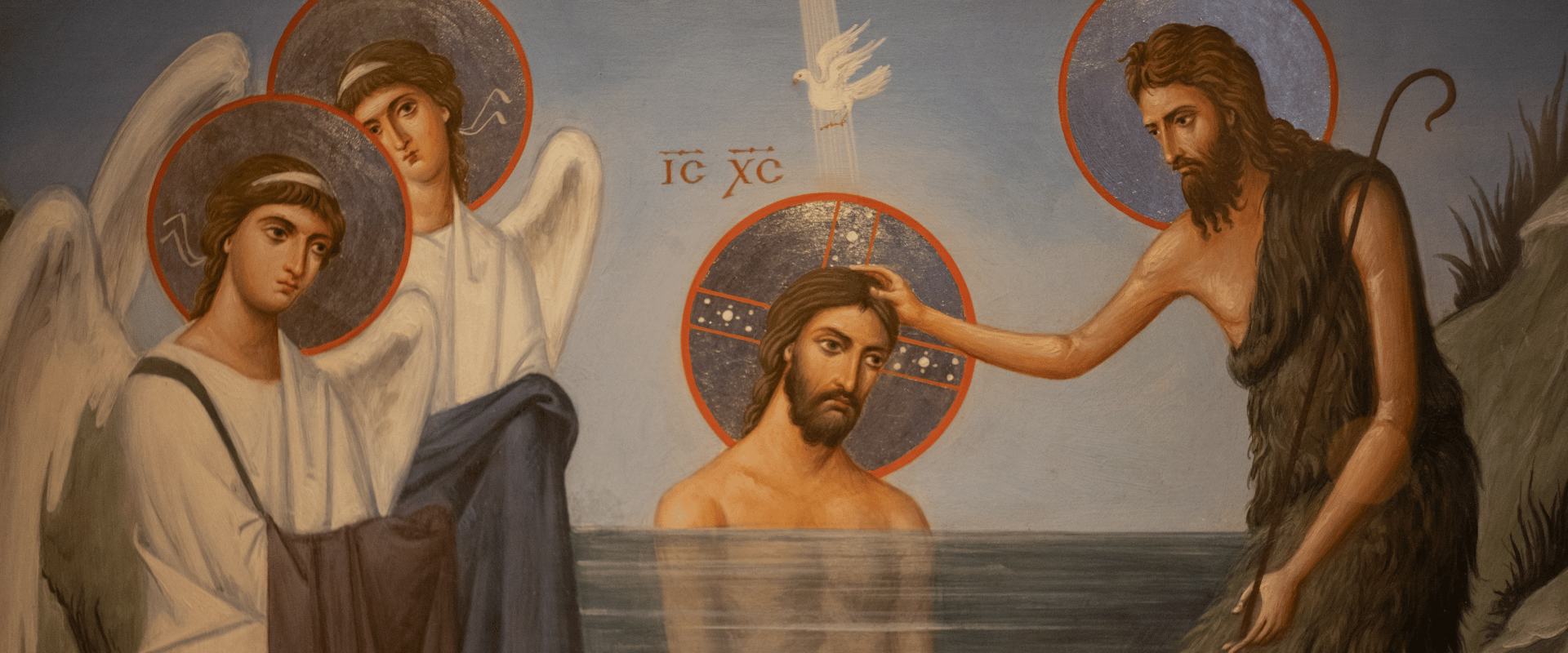
Was Jesus Really Baptized?
For well over 150 years, historians have sought ways to distinguish the authentic core of Jesus’ life from the later theological embellishments of the Christian tradition.
This effort, known as the quest for the historical Jesus, has generated a number of methods, but one of the most influential frameworks came through the so-called “criteria of authenticity,” popularized in the mid-20th century by Norman Perrin.
These criteria aren’t infallible, but they offered scholars a set of rules of thumb for evaluating whether particular sayings or deeds attributed to Jesus were likely to be historical or whether they were more plausibly later theological constructions.
Among these criteria, a few stand out as especially important. The criterion of multiple attestation observes whether a tradition appears in more than one independent source.
The criterion of dissimilarity considers whether a saying or action makes sense against both Jewish and early Christian expectations; if it doesn’t serve either agenda easily, it may be authentic.
Perhaps most famously, the criterion of embarrassment notes that traditions which were awkward or difficult for the early church are unlikely to have been invented by them. Other criteria exist, but these three have often carried the most weight in historical Jesus research.
So, how does Jesus’ baptism look from the historical perspective if we consider the criteria of authenticity? The gist of this event almost certainly goes back to the historical Jesus.
First and foremost, it’s attested in multiple independent sources: Mark, Q (preserved in Matthew and Luke), John (by implication, even if not narratively described), and Acts.
Furthermore, this event passes the powerful test of embarrassment. E. P. Sanders, in The Historical Figure of Jesus, explains:
That he accepted John’s baptism is virtually certain. The gospels and Acts reveal that John had a sizable following, and the authors were a little embarrassed at having to admit that their hero, Jesus, had been at first a follower of the Baptist... According to Matthew 3:14, John protested when Jesus came to be baptized, saying that Jesus should baptize him... We doubt things that agree too much with the gospels' bias, we credit things that are against their preference. This rule cannot be applied mechanically, since some things that actually happened suited the authors very well, but it will stand us in good stead here... In view of this, it is most unlikely that the gospels or earlier Christians invented the fact that Jesus started out under John. Since they wanted Jesus to stand out as superior to the Baptist, they would not have made up the story that Jesus had been his follower. Therefore, we conclude, John really did baptize Jesus.
Similarly, Helen K. Bond affirms the point:
That Jesus was baptized by John is certain. The close connection between baptism and the removal of sin led to a certain embarrassment on the part of the earliest Christians in admitting that Jesus underwent the rite... This very embarrassment, however, confirms the historicity of the event. As a man of strong religious convictions and yearnings, almost certainly from his youth, it is quite probable that Jesus would have sought out the Baptist. Like many others, Jesus may have attached himself to the Baptist’s circle of disciples; he would have heard John’s ethical and apocalyptic teaching and, after an appropriate period of preparation, offered himself for baptism.
Such scholarly consensus underscores how difficult it would be to deny the historicity of the event itself, even if the precise details remain elusive.
We can even follow the trajectory of this embarrassment throughout the earliest Christian literature. French scholar Daniel Marguerat, in his book Vie et destin de Jésus de Nazareth (Life and Destiny of Jesus of Nazareth), explains:
“The Gospel of Mark placed the Baptist at the head of his account (Mark 1:1-8), and the Sayings Source preserved the memory of his preaching (Luke 3:7-18). However, one can see a progressive Christian domestication of the character [une progressive domestication chrétienne du personnage] In Matthew 3:13-15, John is scandalized that Jesus asks him for baptism, since he is the one who should be baptized by Jesus; the same Matthew deletes the mention of a baptism ‘for the forgiveness of sins.’ In Luke 3:21, Jesus is baptized without the name of the Baptizer being mentioned. In the fourth Gospel, the baptism of Jesus has disappeared altogether; John designates him to his disciples as ‘the Lamb of God who takes away the sin of the world’ (John 1:29). In the apocryphal gospels, this domestication reaches its peak: Jesus protests that he has committed no sin requiring baptism, and John kneels before Jesus, imploring him to baptize him.” (my translation)
Of course, one permanent issue remains: Where exactly does the line fall between authentic historical memory and later theological elaboration? Joel Marcus rightly emphasizes that the accounts as we have them are deeply shaped by Scripture (Isaiah, Genesis, Psalms) and by early Christian convictions about Jesus’ messianic status.
That is one of the reasons why I find myself increasingly persuaded by the methodological cautions of scholars such as Dale C. Allison Jr., who argues that instead of attempting to separate history and theology verse by verse, we should focus on identifying larger themes, rhetorical patterns, and enduring events.
In the case of Jesus’ baptism, the historical kernel is clear! Jesus submitted to John’s baptism at the outset of his ministry. But the surrounding features are much more problematic.
And while some scholars, like Craig Keener, argue that Matthew’s dialogue between John and Jesus “fits the narrative logic,” narrative fit doesn’t necessarily imply historical authenticity; it can just as easily reflect Matthew’s theological agenda to portray Jesus’ superiority.
Conclusion
In the end, the baptism of Jesus remains one of the few episodes in the Gospels that historians regard as virtually certain.
It’s a multiple attested event, it provoked theological discomfort among the earliest Christians, and yet it endured at the heart of the tradition. At the same time, the way the event is narrated varies substantially from Gospel to Gospel.
Mark emphasizes private revelation and apocalyptic rupture, Matthew reframes the act as the fulfillment of divine righteousness, and Luke shifts the focus almost entirely away from the ritual to highlight prayer and God’s disclosure.
For historians, then, this event is both a window into Jesus’ life and a case study in how memory is preserved, reshaped, and theologically reimagined. And who baptized Jesus? That Jesus came to John and submitted to baptism seems beyond serious doubt.
While that is the case, theologians will almost certainly continue to debate its spiritual significance which isn’t that bad, I guess!