
Jacob and Esau: The Ultimate Origin Story

Written by Marko Marina, Ph.D.
Author | Historian
Author | Historian | BE Contributor
Verified! See our guidelines
Verified! See our editorial guidelines
Date written: October 14th, 2026
Disclaimer: The views and opinions expressed in this article belong to the author and do not necessarily match my own. - Dr. Bart D. Ehrman
The story of Jacob and Esau is one of the many narratives in the Hebrew Bible, or Old Testament, that illustrates the profound cultural and religious significance of this collection of texts.
The Hebrew Bible is justifiably regarded as one of the most influential works in the history of Western civilization.
Its stories, characters, images, and moral conflicts have shaped religious traditions, literature, art, political thought, and everyday language for centuries.
Many of its narratives have become so deeply embedded in our cultural imagination that even people with little direct familiarity with the Bible often recognize their basic themes and motifs.
Stories of creation, betrayal, sacrifice, rivalry, exile, and reconciliation continue to provide some of the conceptual language through which later societies have reflected on human relationships and collective identity.
The Jacob and Esau story belongs firmly within this wider cultural inheritance.
At first glance, it’s an intimate family story, centered on two brothers and the tensions that develop between them. Yet, as is so often the case in Genesis, the significance of the narrative extends far beyond the immediate lives of its characters.
Questions of ancestry, inheritance, identity, conflict, and belonging gradually give the story a much broader horizon.
To understand why Jacob and Esau became such important figures within the biblical tradition, we must first locate their story within the Book of Genesis, then follow the narrative itself, and finally examine the larger historical and theological meanings that came to be associated with these two famous brothers.
However, before we drift into the story of Jacob and Esau, I’d like to tell you more about a course that takes us behind the finished text of Genesis itself.
In Joel Baden’s 10-lecture course, The Bible by Committee: How the Pentateuch Was Really Written?, the Yale scholar examines the repetitions, tensions, and competing versions that led generations of scholars to question the traditional idea that the Pentateuch was written by a single author.
Rather than simply giving you the conclusion, Baden walks through the evidence passage by passage, from the two creation accounts and the flood narratives to Sinai and the wilderness traditions, showing how scholars identify different sources and reconstruct the complex compositional history behind the text.
If you want to understand not only what Genesis says, but how the book may have come together in the first place, this course offers an especially illuminating next step.
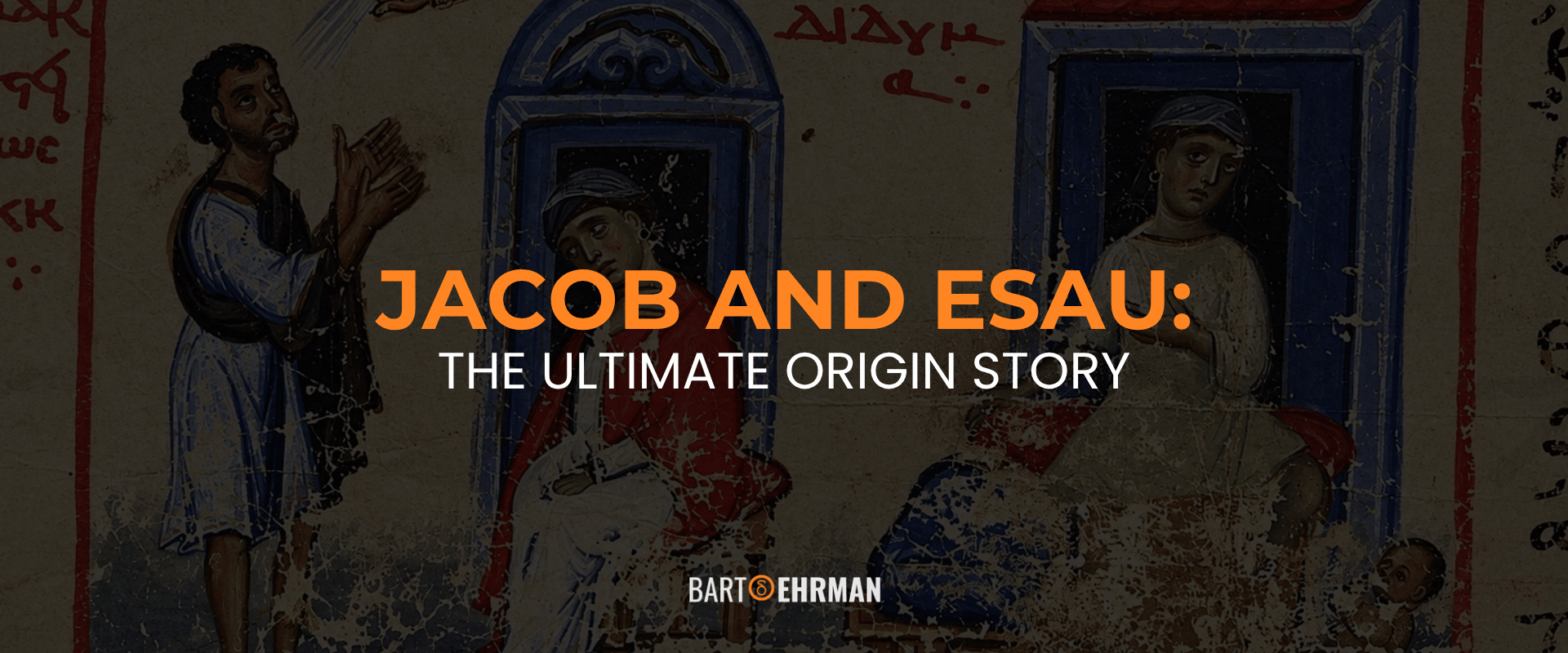
Jacob and Esau in the Book of Genesis
In Introduction a l’Ancien Testament (The Introduction to the Old Testament) Christoph Uehlinger notes:
(Affiliate Disclaimer: We may earn commissions on products you purchase through this page at no additional cost to you. Thank you for supporting our site!)
“Like most literary monuments, the Bible gathers the greatest number of readers in its opening pages, known as the ‘history of origins.’ How many people have set out to read the Bible one day, wanting to start at the beginning – that is to say, Genesis – only to give up after two or three books, or even just a few chapters? The first chapters of Genesis therefore possess an indisputable advantage over all the others, in that they are essential reading. These are texts that everyone has read and that everyone believes they have more or less understood.” (my translation)


His observation captures something important about Genesis. Its opening narratives have acquired an extraordinary cultural visibility, partly because they stand at the beginning of the biblical collection and partly because they address questions of ultimate origins: the beginnings of the world, humanity, human conflict, and eventually the people of Israel.
From the perspective of comparative ancient literature, however, Genesis begins in an unusual way.
Many creation traditions from the ancient Near East included accounts of how the gods themselves came into existence, what scholars call a theogony.
Genesis offers no such story. Its God is already present in the opening verse and does not emerge from an earlier generation of divine beings.
This absence is theologically significant. The cosmos isn’t presented as the product of conflict among competing deities, while the sun, moon, sea, and other features of the natural world are not themselves divine powers.
Instead, the authors and editors of Genesis present the entire created order as ultimately dependent upon one God. In this respect, the opening chapters establish a theological framework that distinguishes Israelite traditions from many of the mythological systems preserved by neighboring cultures.
Readers who continue beyond these famous opening chapters encounter another major part of Genesis: the ancestral or patriarchal narratives.
Beginning with Abraham and continuing through Isaac, Jacob, and Joseph, these stories shift the focus from the origins of the cosmos and humanity to the origins of Israel and its relationships with surrounding peoples.
It’s within this larger narrative world that Jacob and Esau first appear.
Their story begins in Genesis 25 with the pregnancy of Rebekah and continues across several later chapters, eventually becoming intertwined with the wider account of Jacob’s life.
The story of Jacob and Esau therefore belongs not to the primeval history of Genesis 1–11, but to the book’s extended exploration of ancestry, family, inheritance, and the beginnings of Israel’s collective identity.
Genesis itself, however, shouldn’t be understood simply as the work of a single author writing down a continuous history from creation onward.
Although Jewish and Christian tradition long associated the book with Moses, contemporary scholarship generally regards Genesis as a composite work whose present form emerged through a prolonged process of composition, transmission, and editorial activity.
Scholars continue to debate the precise dates and literary layers involved, but there is broad agreement that the book preserves traditions from different periods and settings that were eventually brought together into a larger narrative.
This is an important context for approaching Jacob and Esau, because their story forms part of a carefully shaped ancestral history whose significance extends beyond the experiences of two individual brothers.
Having located the story of Jacob and Esau within Genesis and within the larger collection known as the Hebrew Bible or Old Testament, we can now turn to the narrative itself.
Jacob and Esau Story: Summary
In his famous study Feudal Society, Marc Bloch observed:
The conception of life to which the gestes gave expression was, in many respects, only the reflection of that of their public: in every literature a society contemplates its own image. Yet, along with the memory of old events, distorted and imperfect though it was, traditions genuinely derived from the past had filtered down; and the traces of these we shall encounter over and over again.
The story of Jacob and Esau is one of those narratives that has passed through centuries of cultural and social transmission.
In Genesis, it begins before the brothers are even born. Rebekah, the wife of Isaac, becomes pregnant with twins after a period of infertility, and the pregnancy is marked by struggle within her womb.
When the children are born, Esau, Jacob’s biblical twin, emerges first, red and covered with hair. Jacob follows, grasping his brother’s heel.
As the boys grow, their lives take different paths: Esau becomes a skilled hunter and a man of the open country, while Jacob is described as a quiet man who remains among the tents. Isaac favors Esau, while Rebekah favors Jacob.
Their rivalry first becomes explicit when Esau returns from the field exhausted and asks Jacob for some of the food he is preparing. Jacob agrees on the condition that Esau surrender his birthright, and Esau sells his birthright to his younger brother in exchange for bread and lentil stew.
The conflict intensifies years later when the elderly Isaac, believing that his death may be near, decides to bestow his blessing on Esau.
After overhearing Isaac’s instructions, Rebekah devises a plan that allows Jacob to take his brother’s place.
Wearing Esau’s clothes and covering his hands and neck with goatskins, Jacob approaches his nearly blind father and receives the blessing intended for the elder son.
When Esau returns and discovers what has happened, he reacts with grief and anger and resolves to kill Jacob after Isaac’s death. Rebekah therefore sends Jacob away to her brother, Laban, in Haran, where he remains for many years, marries, has children, and accumulates substantial wealth.
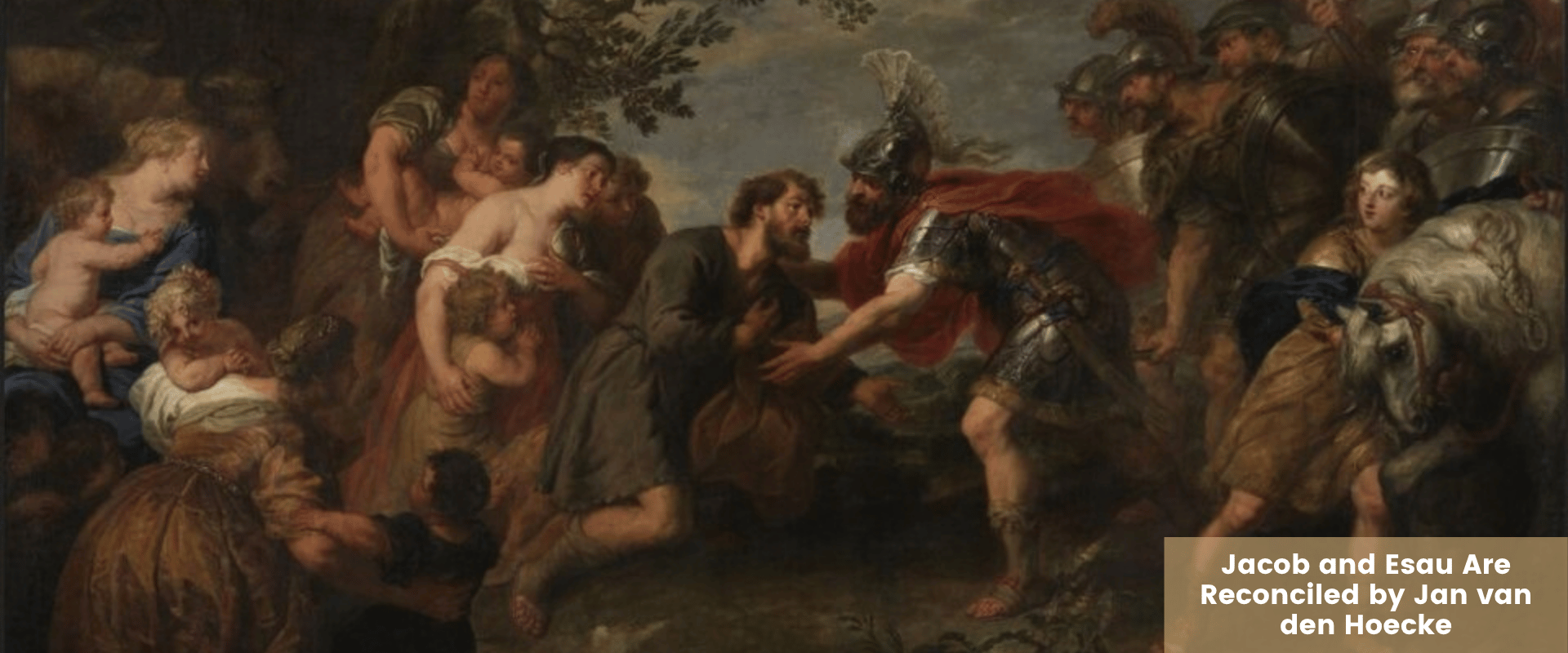
Eventually, Jacob decides to return home. Fearing his brother’s reaction, he sends gifts ahead of him and prepares carefully for their meeting. Yet when the two brothers finally encounter one another, Esau runs toward Jacob, embraces him, and weeps with him.
Their reconciliation brings the long period of immediate conflict to an end, and Genesis later records Esau’s descendants in a genealogy identifying him with Edom.
Now that we have described the story of Jacob and Esau as Genesis presents it, we can move from narrative into the realm of analysis and exegesis. Let’s take a look at the way contemporary scholarship sees this profound story of the two brothers!
NOW AVAILABLE!
Finding Moses: What Scholars Know About The Exodus & The Jewish Law
Riveting and controversial, the "FINDING MOSES" lecture series takes you on a deep dive into the stories of Moses, the exodus, and a whole lot more...
What Does the Story Mean? Jacob, Esau, Israel, and Edom
How should we, as historians and readers interested in the historical and literary context, understand the story of Jacob and Esau?
One useful starting point is to recognize that Genesis presents the brothers simultaneously as individual characters and as ancestors of peoples.
This dual function is already explicit in Rebekah’s pregnancy, when she is told that “two nations” are in her womb, and that the elder will serve the younger. Bill T. Arnold, in his Commentary on Genesis, notes that this oracle anticipates not only the rivalry between the brothers but also the later relationship between Israel and Edom.
The narrative therefore works on more than one level. At the level of family drama, Jacob and Esau are sharply contrasted: Esau is impulsive and willing to surrender his birthright for immediate satisfaction, while Jacob is calculating, shrewd, and determined to secure advantage.
Yet Genesis doesn’t offer a simple contrast between a virtuous Jacob and a wicked Esau. Jacob exploits his brother’s vulnerability and later participates in an elaborate deception of his father, while Esau, despite his anger, eventually receives Jacob with remarkable generosity.
The result is a morally complex story in which divine election, human ambition, family favoritism, and personal responsibility remain tightly intertwined.
The theme of blessing deepens this complexity. In Genesis 27, Isaac’s blessing is a formal and effectively irreversible patriarchal act.
Arnold emphasizes that such blessings functioned as performative utterances: once spoken, they could not simply be withdrawn. Jacob therefore does more than deceive an elderly father.
To be more precise, he acquires the blessing that establishes him as the dominant heir within the family and links him to the covenantal promises associated with Abraham. Yet the narrative doesn’t allow Jacob to enjoy that advantage without consequence. His deception produces hatred, exile, and years of separation from home.
When he finally returns, Genesis presents reconciliation with Esau as a necessary part of his return to the promised land.
Jacob approaches his brother in complete submission, repeatedly calling Esau “my lord” and himself “your servant,” and sends a massive gift ahead of him in an attempt to make amends.
Significantly, when the brothers meet, it’s Esau who runs forward, embraces Jacob, kisses him, and weeps.
Jacob later describes his gift with the same Hebrew word, berakhah, “blessing,” used for what he had earlier taken from Esau. The gift cannot literally undo the stolen patriarchal blessing, but it functions as Jacob’s attempt at restitution and reconciliation.
This reconciliation is also important at the national level.
Just before meeting Esau, Jacob receives the name Israel, and Arnold stresses the geopolitical force of this transformation: just as Esau is identified with Edom, Jacob becomes Israel.
The brothers thus stand behind two neighboring peoples whose later relationship could be both intimate and hostile.
However, Genesis doesn’t end their story with permanent enmity. Jacob and Esau reconcile, but they do not merge. Esau returns to Seir, while Jacob continues toward Canaan, so the narrative preserves both kinship and separation.
That is precisely what makes the story such a powerful origin narrative: it offers an account of how two peoples could be understood as brothers, linked by common ancestry, while still possessing distinct territories, identities, and historical trajectories.
In this sense, the story of Jacob and Esau turns family memory into a framework for understanding political geography and collective identity.
While Jacob and Esau belong primarily to the world of the Hebrew Bible, traces of their story have, to borrow Bloch’s phrase, filtered down into the New Testament period. Let’s take a closer look at that!
From Edom to Idumea: Esau’s Descendants and the New Testament World
In The Book of Genesis: A Biography, Ronald Hendel writes:
A book does not have a life in the most literal sense, because it is not an organic life-form. A book is an object, made of paper – or in the early life of Genesis, papyrus or parchment. We can only say that it has a life in an extended sense, as part of our past and present. The book of Genesis is alive because it is a formative part of the human life-world, and it has been so for a long time… Ever since its birth, the book of Genesis has attracted interpreters of every stripe. For various reasons – including its laconic style, its complex compositional history, and its religious content – it requires interpretation. From our first glimpse of Genesis as a book in the public domain, it is an interpreted text.
Hendel’s observation is especially helpful when thinking about Jacob and Esau because their story didn’t remain confined to Genesis.
The identities associated with the two brothers continued to be remembered, reformulated, and applied to changing historical circumstances long after the ancestral narratives themselves had taken shape.
The story of Jacob and Esau is therefore a good example of the many “lives” a biblical narrative can acquire.
Genesis itself explicitly identifies Esau with Edom, but by the Persian and Hellenistic periods, the historical geography associated with the Edomites had changed substantially.
Edomite populations had moved northward and westward into areas south of Judea, and this region eventually came to be known in Greek as Idumea.
The transition from Edom to Idumea shouldn’t be imagined as a simple renaming of an unchanged people occupying an unchanged territory. Jacob L. Wright reminds us that archaeological and epigraphic evidence instead points to population movement, interaction, and considerable coexistence between Judeans and Idumeans.
Nearly two thousand Aramaic ostraca from Persian-and Hellenistic-period Idumea, for example, reveal a socially mixed environment rather than a neatly segregated continuation of the world presupposed by Genesis.
A major change came in the late 2nd century B.C.E., when the Hasmonean ruler John Hyrcanus conquered Idumea and incorporated its inhabitants into the expanding Judean state.
Jewish historian Josephus reports that the Idumeans were permitted to remain in their territory on the condition that they accept circumcision and Jewish customs.
Whatever complexities surrounded that process, by the 1st century B.C.E. Idumeans could participate within Jewish society while retaining an identifiable regional or ancestral designation.
This is important because ancient identity didn’t operate according to the rigid ethnic categories familiar from modern nation-states. To put it bluntly, a person in this period could simultaneously be described as Jewish and Idumean. In other words, the categories weren’t necessarily mutually exclusive.
That historical development brings the world associated with Esau into direct contact with the New Testament period through the family of Herod the Great.
Herod’s father, Antipater, belonged to an Idumean family, and ancient sources therefore remembered the Herodian dynasty’s Idumean background.
As Peter Richardson and Amy Marie Fisher explain:
Herod was an Idumean... His family origins lay in the desert in the tribe of Edom, as it was known in earlier times, a tribe facing endemic conflict with Israel. A parenthetic explanation in Gen. 25:30 describes enmity between Jacob and Esau, the eponymous progenitors of Israel and Edom. The myth of an early brotherly relationship contained an element of reality: their origins were somewhat similar, both were nomadic peoples from the Arabian plateau, both settled in areas adjacent to the Rift Valley during the second millennium bce. While Israelites were mostly west of the Jordan and Edomites mostly east of the Jordan and south of the Dead Sea, gradually Edomites moved westward, occupying areas in the northern Negev and southern Judea.
Herod himself, however, ruled as king of Judea and participated in the Jewish political and religious world of the late Second Temple period.
The connection to Esau must therefore be stated carefully: the New Testament doesn’t present Herod as a genealogical descendant of Esau, nor does Matthew explicitly interpret Herod through the Jacob-Esau story.
Rather, the connection is historical and traditional. Genesis identifies Esau with Edom; the later region and population known as Idumea developed out of the historical world associated with Edom; Herod emerged from that Idumean milieu.
Thus, when Herod appears in Matthew’s infancy narrative as king of Judea, we encounter not a direct continuation of Genesis’ family drama, but one of its much later historical afterlives.
Conclusion
The story of Jacob and Esau is, in the end, far more than a tale of sibling rivalry.
Within Genesis, it operates simultaneously as a family drama, a meditation on inheritance and blessing, and an origin story for Israel and Edom.
Its later reception only deepened that significance, as the identities associated with Esau and Edom continued to evolve through the Persian, Hellenistic, and Roman periods, eventually intersecting with the world of Herod the Great and the New Testament.
What makes the story so enduring is precisely this combination of intimacy and scale: a conflict between two brothers becomes a way of thinking about ancestry, political geography, collective identity, and historical memory. Genesis may begin with the origins of the world, but in Jacob and Esau it shows just as powerfully how communities explain the origins of themselves and of the peoples around them.
NOW AVAILABLE!
Finding Moses: What Scholars Know About The Exodus & The Jewish Law
Riveting and controversial, the "FINDING MOSES" lecture series takes you on a deep dive into the stories of Moses, the exodus, and a whole lot more...