
Jacob and Esau: Deception, Blessing, and the Cost of a Birthright

Written by Marko Marina, Ph.D.
Author | Historian
Author | Historian | BE Contributor
Verified! See our guidelines
Verified! See our editorial guidelines
Date written: January 10th, 2026
Disclaimer: The views and opinions expressed in this article belong to the author and do not necessarily match my own. - Dr. Bart D. Ehrman
There is a long and remarkably rich tradition of stories about brothers in the Bible. Stories marked by rivalry, conflict, loyalty, and betrayal. From the very first fratricide in the tale of Cain and Abel to later reflections on brotherhood in the New Testament, biblical authors repeatedly return to the fraught dynamics that can arise between siblings.
These narratives are rarely simple morality tales. Instead, they probe questions of inheritance, divine favor, family loyalty, and the human cost of competition within the most intimate of relationships.
Among these accounts, the story of Jacob and Esau stands out as one of the most unsettling and enduring. It’s a narrative filled with tension and ambiguity, in which familial affection coexists with deception, and divine blessing seems entangled with morally troubling behavior.
For many modern readers, the story raises uncomfortable questions: Why does the narrative unfold as it does? How should one understand the apparent imbalance between actions and outcomes?
This article approaches Jacob and Esau in the Bible from a historical and literary perspective, aiming to situate the narrative within its broader biblical context and to explore how scholars have interpreted its complexities.
Rather than rushing to moral judgment or theological resolution, the goal is to allow the story to speak on its own terms before examining how and why it functions as it does within the Book of Genesis.
However, before we begin to explore the nuances of Jacob and Esau in the Bible, I’d like to invite you to check out Bart D. Ehrman’s excellent course In the Beginning: History, Legend, or Myth in Genesis. It’s an amazing opportunity to learn more about the way critical scholarship analyses the first book of the Pentateuch!
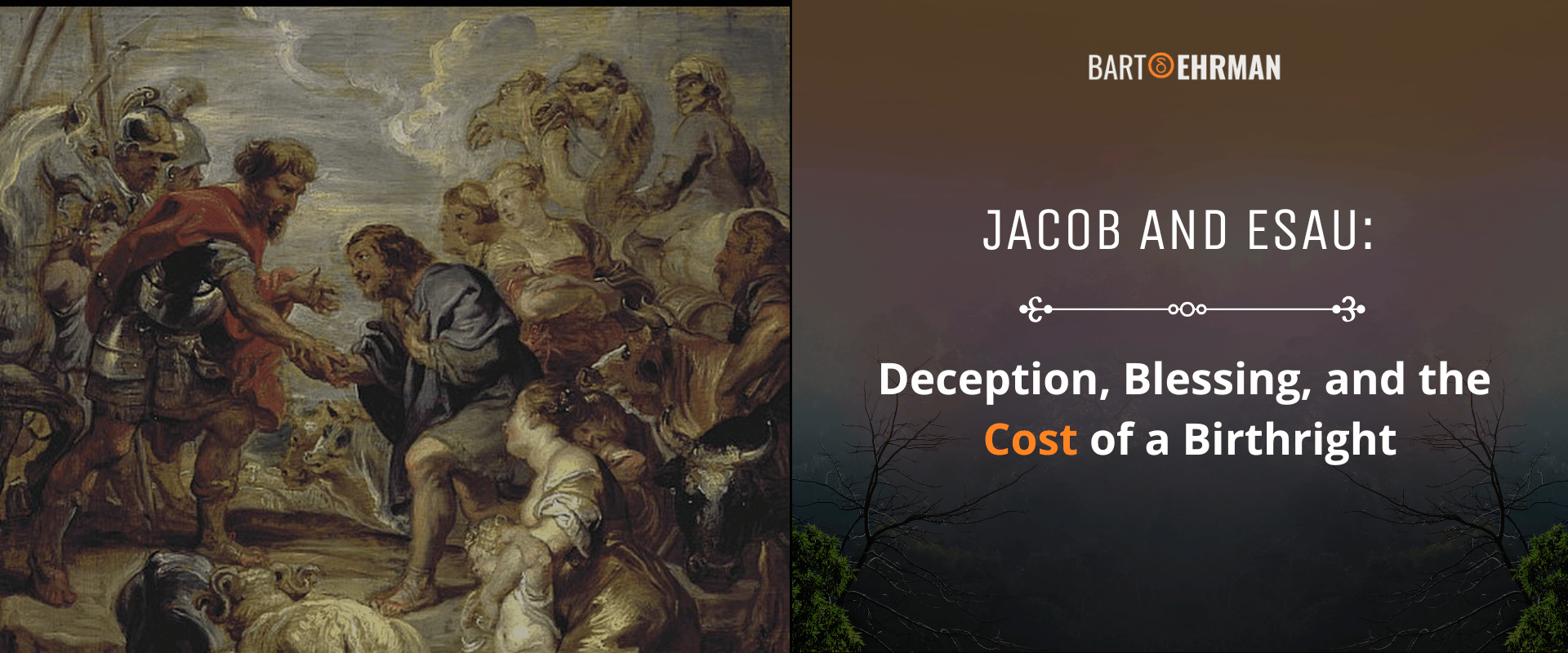
Jacob and Esau: Story Summary
For many centuries, Jewish and Christian tradition attributed the authorship of Genesis to Moses, viewing the book as the unified product of a single inspired figure.
Since the rise of critical scholarship in the Enlightenment, however, this view has been largely abandoned. Linguistic, stylistic, and thematic analysis has shown that Genesis is best understood as a composite work, drawing on multiple sources and traditions that were edited and brought together over time.
The story of Jacob and Esau belongs to what critical scholars commonly refer to as the “Jacob cycle,” a sequence of narratives found primarily in Genesis 25-35 that focuses on Jacob’s origins, conflicts, migrations, and eventual establishment as the ancestor of Israel.
Albert de Pury explains the crucial features of the Jacob cycle by noting the following:
(Affiliate Disclaimer: We may earn commissions on products you purchase through this page at no additional cost to you. Thank you for supporting our site!)
“The Jacob cycle appears, in its essence, to constitute an autonomous legend of the origins of Israel, and perhaps one of the oldest. From an archaeological and historical perspective, the emergence during Iron Age I (eleventh-tenth centuries B.C.E.) of what would become the future tribes of Israel can be observed in the hill country of central Palestine and the Transjordanian plateau. Early ‘Israel’ was a tribal society. In such societies, genealogy — particularly segmented genealogy — provides the explanatory framework the society requires. As anthropologists and ethnologists have shown, genealogy in tribal societies (for example, among Arab Bedouin even in the early twentieth century) is transmitted orally and periodically adapted to new power relations that may arise between different groups. The story of Jacob as we find it in Genesis 25-35 is an excellent example of a genealogical legend. Most episodes and anecdotes in this narrative cycle have a genealogical function or implication, and the entire cycle reaches its climax when Jacob — initially excluded from his territory because of his offense and later received as a destitute refugee by another group — manages, through talent, perseverance, and above all cunning, not only to marry the daughters of the other group’s chieftain and acquire significant wealth, but also to impose separation and secure recognition of his clan as an autonomous tribal group.” (my translation)


Within this broader cycle, the episodes involving Jacob and his twin brother Esau are concentrated in Genesis 25 and 27.
The narrative begins with the unusual circumstances of the twins’ birth, already marked by struggle, and quickly moves to the episode in which Esau sells his birthright to Jacob in exchange for food.
The story then turns to Isaac, the aging father of Jacob and Esau, whose failing eyesight becomes a crucial narrative detail. Since he is blind, Isaac is forced to rely on his other senses (e.g., sound, touch, smell, and taste) to identify his son.
As it turns out, that was a vulnerability Rebekah (Isaac’s wife and the twins’ mother) deliberately exploited.
She devised a plan to ensure that Jacob, rather than Esau, receives the paternal blessing, a formal and consequential act that would shape the future status and inheritance of the son who received it.
Her strategy was explicit: Jacob is to disguise himself as his brother, complete with borrowed clothing and animal skins, to deceive his blind father. The plan succeeds, and Jacob secures the blessing that Isaac had intended to bestow upon his firstborn.
When Esau discovered what had happened, he reacted with grief and anger, prompting Jacob to flee to avoid his brother’s vengeance.
The narrative presents these events in a spare but emotionally charged manner, emphasizing action rather than explanation. Motives are rarely spelled out, and moral judgments are largely absent from the storytelling itself.
Instead, the focus remains on the irreversible consequences of words spoken, blessings bestowed, and relationships fractured. By the end of the episode, the family is divided, and Jacob’s departure marks the beginning of a longer journey that will define the remainder of the Jacob cycle.
Before moving into a scholarly analysis and exegesis of the Jacob and Esau story, it’s worth pausing to consider how this narrative relates to another famous and often-invoked episode from Genesis. Taking a brief step back to compare it with the binding of Isaac allows us to sharpen our understanding of what is distinctive about this account and prepares the ground for closer interpretation in what follows.
Jacob and Esau in Relation to the Binding of Isaac
Here, a brief reminder is in order. The binding of Isaac, narrated in Genesis 22, tells of God commanding Abraham to offer his long-awaited son as a sacrifice, only for the act to be halted at the last moment.
The story is tightly focused on obedience, divine testing, and the reaffirmation of God’s promise to Abraham through Isaac.
It belongs squarely within the broader Abraham cycle (the cluster of narratives in Genesis that focus on Abraham’s call, travels, testing, and covenant, and that precede and frame the later Jacob cycle) and functions as a climactic episode that underscores Abraham’s role as the founding patriarch whose faith secures the future of his lineage.
At a broad level, some thematic resonances with the story of Jacob and Esau are easy to detect.
Both narratives revolve around questions of inheritance, divine promise, and the transmission of blessing from one generation to the next, and both portray moments of intense familial tension at critical junctures in Israel’s ancestral history.
Yet the similarities shouldn’t be pressed too far. The Binding of Isaac is fundamentally a story about Abraham and his relationship to God, whereas the Jacob-Esau episodes belong to a different narrative world, one concerned with rivalry between brothers and the internal dynamics of a family already marked by conflict.
Most importantly, the binding of Isaac remains firmly embedded in the Abraham cycle, while the story of Jacob and Esau forms part of the Jacob cycle, with its own distinctive aims, themes, and narrative logic.
Any comparison, therefore, can only be heuristic, not interpretive, serving to clarify differences rather than to merge the two stories into a single theological or literary framework.
Jacob and Esau: Scholarly Exegesis
The Jacob-Esau narratives in Genesis hinge on a distinction that modern readers sometimes blur: “birthright” and “blessing” overlap in subject matter (status, inheritance, future), but they aren’t identical institutions.
Genesis 25 portrays a transaction involving the firstborn’s right (presented as transferable and made binding by oath), while Genesis 27 narrates a paternal blessing that functions less like casual well-wishing and more like a performative, end-of-life disposition.
That distinction matters for reading the story with historical sensitivity because the plot turns on the irreversibility of words and agreements once formally enacted, not on an abstract moral lesson about who “deserves” what.
It’s also important to notice how the narrative carefully prepares the reader for conflict long before the deception scene.
The account of the twins’ birth already sets rivalry into motion, describing conflict even before they are born, and this tension is reinforced by a divine oracle (a short prophetic pronouncement delivered to Rebekah) that predicts the younger son will ultimately outrank the elder.
As a result, the later reversal of expectations is presented as part of the story’s internal logic rather than as a sudden or arbitrary twist.
At the same time, Genesis characterizes the brothers through stark contrasts (Esau as a hunter who spends his life in the open fields, and Jacob as a more settled figure associated with life among the tents) and then immediately complicates family dynamics by introducing parental favoritism.
As Bill T. Arnold explains in his Commentary on Genesis, these early scenes establish the thematic cluster that drives the larger Jacob narrative (birth, blessing, and land) while also showing how favoritism and the “curse” of nonblessing can produce a cascade of family dysfunction that the story neither hides nor resolves neatly.
Furthermore, the famous “sale of the birthright” scene (25:29-34) is best read as a tightly constructed narrative designed to make a point through rhetoric as much as through plot.
The language compresses character into action: Esau returns famished, fixes on immediate need, and the narrator’s staccato close (“he ate… drank… rose… went”) underscores his shortsightedness.
Yet a form-critical caution is also in order!
Claus Westermann argues that this short episode likely had a life of its own as an independent tale before being integrated into the Jacob-Esau complex. He writes:
Gen. 25:29-34 is a short, simple, and self-contained narrative inserted here in connection with the genealogical information about the occupations of Esau and Jacob in v. 27; previously it was an independent narrative about the shepherd and the hunter. The same motif runs through it as through vv. 22-23, namely, the younger gains the upper hand over the elder, in vv. 22-23 in the political field, in vv. 29-34 in the economic. It is originally a "civilization myth" about the shepherd who gained supremacy over the hunter, and could well have had its origin in the Transjordan where the conditions existed for such a transition.
He also notes that caricatured portrayal of Esau shouldn’t be taken as a comprehensive psychological portrait of “Esau the person,” still less as a stable depiction across the entire cycle.
Read in that light, the episode’s function is to extend the brothers’ rivalry into the sphere of status and precedence, dramatizing how privilege can be surrendered (and later lamented!) without the text pausing to offer commentary beyond its closing evaluation.
Did You Know?
A Brotherly Puzzle from the New Testament.
One of the most famous “brother stories” in the Bible isn’t in Genesis at all, but in the Gospels. The New Testament refers several times to the “brothers” of Jesus (names such as James, Joses, Simon, and Judas even make the list).
From a strictly linguistic point of view, the Greek term ἀδελφοί normally means biological brothers, and nothing in the Gospel narratives goes out of its way to clarify otherwise. For historians and philologists, that has long made these passages a small but persistent puzzle.
The puzzle, however, generated a very influential answer within later Christian tradition. Under the growing impact of ascetic ideals and a heightened theology of purity, the belief emerged that Mary remained a perpetual virgin, which required explaining these “brothers” as cousins or close relatives.
Even though I was raised Catholic and grew up with that interpretation, I have to admit that, from a strictly historical and philological perspective, the simplest reading is also the most straightforward: the texts really do sound as if they are talking about Jesus’ actual brothers. I hope my Catholic friends won’t mind me saying that, or at least won’t disown me over coffee.
Genesis 27 then intensifies the conflict by shifting from a negotiated transaction to an irreversible spoken act.
The scene’s drama depends on Isaac’s sensory uncertainty and the repeated testing that makes the deception feel both precarious and deliberate: unable to see, Isaac listens to the voice with suspicion, but is reassured by touch and smell before finally pronouncing the blessing.
What is crucial is that once the blessing is spoken, the narrative treats it as binding even after Isaac recognizes what has happened. To put it more bluntly, the words have affected a reality that cannot simply be taken back.
E. A. Speiser underscores this dimension by drawing attention to ancient Near Eastern analogies that illuminate the legal-social “weight” of a final paternal disposition: the story presupposes a world in which an end-of-life declaration could carry formal force, and where the problem isn’t merely interpersonal dishonesty but the catastrophic finality of misdirected blessing.
This helps explain why the episode is narrated with such pathos, especially in the aftermath, when Isaac and Esau confront the consequences of a spoken act that cannot be undone.
At the same time, the narrative is strikingly restrained in overt moral interpretation, and that restraint is itself meaningful. In other words, the deception is clearly portrayed as such: the plot requires calculated misrepresentation, and the text doesn’t pretend otherwise.
Yet the story also embeds the act within a larger web of motivations and pressures (e.g., Rebekah’s determination, Isaac’s favoritism, Esau’s earlier bargain, and the oracle’s prior framing) so that responsibility is distributed across a family system already tilted toward conflict.
Rather than offering a simple ethical resolution, Genesis depicts how blessing, status, and family loyalty can collide, with each character acting in ways that are intelligible within the narrative world even when troubling to later readers.
In this sense, the story of Jacob and Esau should be read as a carefully crafted exploration of how contested legitimacy is produced and preserved inside foundational traditions.
Finally, it’s worth observing what the narrative makes impossible: a clean restoration of the pre-conflict family.
In later biblical tradition, Jacob would come to symbolize not only struggle and fracture but also future hope — a development famously captured in the enigmatic image of the “star of Jacob” (Numbers 24:17), which shows how this deeply conflicted figure was eventually woven into broader expectations about Israel’s destiny.
Yet within the narrative world of Genesis itself, no such resolution is offered. The blessing episode doesn’t end with reconciliation but with rupture and flight.
The text implies that Jacob’s gain is inseparable from costs which include alienation from home, fear of retaliation, and the long detour that will define the rest of the so-called Jacob cycle.
As a result, the story holds together two realities without harmonizing them: on the one hand, the chosen line advances through Jacob; on the other, the means by which it advances fractures a household and leaves lasting wounds.
That unresolved tension is precisely what has kept Jacob and Esau at the center of scholarly discussions!
In other words, it forces interpreters to reckon with the narrative logic of Genesis (genealogy, promise, and blessing) while acknowledging that the text preserves, rather than erases, the troubling human realities through which those themes are narrated.
NOW AVAILABLE!
Finding Moses: What Scholars Know About The Exodus & The Jewish Law
Riveting and controversial, the "FINDING MOSES" lecture series takes you on a deep dive into the stories of Moses, the exodus, and a whole lot more...
Appendix: Why Might God Be Portrayed as Approving Jacob’s Deception?
Coming from a Catholic background, there are certain elements of my own belief that have long required careful negotiation with the critical-historical method! These include, most notable, doctrines such as Mary’s perpetual virginity, which rest on later theological development and ecclesial tradition.
Wrestling with difficult passages, tensions between text and tradition, and interpretive trajectories that unfold over time is therefore not new to me.
After all, Catholic engagement with Scripture has always involved holding together historical inquiry, literary sensitivity, and theological reflection, even when these do not align neatly or without friction.
That broader experience provides a helpful framework for approaching the troubling question raised by the story of Jacob and Esau: how can the narrative depict Jacob as the bearer of blessing when his success is secured through deception?
One possible Catholic way of framing the issue (drawing on insights found in the Come and See Catholic commentary on Genesis) is to distinguish carefully between what Scripture records and what it endorses.
The patriarchal narratives do not present their central figures as moral ideals, nor do they suggest that human wrongdoing is somehow rendered virtuous because it occurs within a salvific story. Instead, these texts consistently portray God as faithful to the covenant promise despite, not because of, deeply flawed human actions.
In this light, Jacob’s reception of the blessing need not be read as divine approval of deceit, but as an affirmation that God’s purposes aren’t ultimately thwarted by human failure.
This approach also allows room for moral consequence and narrative tension to remain intact. The story itself doesn’t resolve the ethical problem it poses: Jacob’s gain is accompanied by exile, fear, and prolonged estrangement, and the blessing he receives comes at a significant personal cost.
From a Catholic perspective, then, the value of the narrative may lie precisely in its refusal to simplify the relationship between divine fidelity and human behavior.
Finally, rather than offering a final answer, this reading invites humility. It acknowledges that Scripture can witness God's enduring commitment while still preserving the ambiguity, discomfort, and moral complexity of the human stories through which that commitment is narrated.
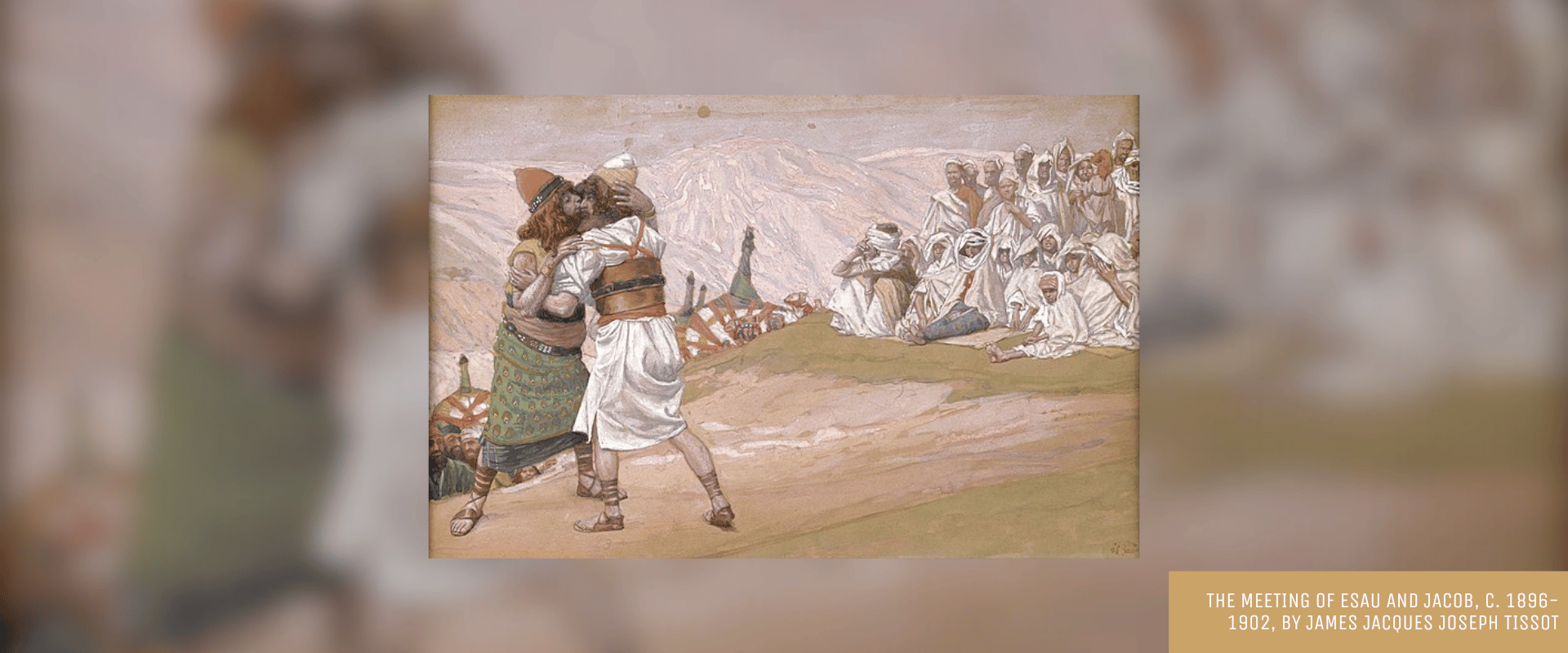
Conclusion
As we come to conclusion, we should remind ourselves that the story of Jacob and Esau endures precisely because it resists tidy conclusions. It confronts readers with a narrative in which blessing is real, consequences are lasting, and moral clarity is deliberately elusive.
Genesis neither excuses deception nor resolves the tensions it creates. Instead, it preserves a story in which divine promise moves forward through deeply human conflict, leaving scars rather than closure in its wake.
That refusal to smooth over difficulty may be one of the text’s most enduring strengths. If anything, Jacob and Esau reminds us that the Bible isn’t a collection of inspirational anecdotes designed to make us feel morally comfortable, but a body of literature that expects its readers to think, wrestle, and occasionally squirm.
And perhaps that, too, is part of its blessing, even if it’s not the kind one would ever want to receive under false pretenses!
NOW AVAILABLE!
Finding Moses: What Scholars Know About The Exodus & The Jewish Law
Riveting and controversial, the "FINDING MOSES" lecture series takes you on a deep dive into the stories of Moses, the exodus, and a whole lot more...