
Do Catholics and Protestants Have Different 10 Commandments?

Written by Marko Marina, Ph.D.
Author | Historian
Author | Historian | BE Contributor
Verified! See our guidelines
Verified! See our editorial guidelines
Date written: March 27th, 2026
Disclaimer: The views and opinions expressed in this article belong to the author and do not necessarily match my own. - Dr. Bart D. Ehrman
Do Catholics and Protestants have different 10 Commandments? At first glance, the question may sound strange.
Growing up in Croatia, I encountered a mix of religious cultures, including the influence of Protestant traditions (especially in the northern parts of the country) within what is otherwise a predominantly Catholic environment.
During my student years, I was even involved in a small ecumenical student organization that brought together people from different Christian denominations. As you might imagine, conversations in that setting ranged widely, but certain topics came up again and again. Among them were the relevance, meaning, and purpose of the famous Ten Commandments.
Most people assume that the Ten Commandments are fixed and universal across Christianity. After all, they are among the most recognizable ethical teachings in the Bible and have shaped Jewish and Christian moral thinking for centuries.
But as someone who studies the history of Christianity professionally, I can tell you that few things in religious history are as fixed and universal as they may initially appear. The Ten Commandments (believe it or not) are a good example.
While the biblical passages themselves are shared across Christian traditions, the way those Commandments are divided, numbered, and taught has not always been identical.
So do Catholics and Protestants actually have different 10 Commandments? The answer is both simpler and more interesting than many people expect.
To understand what is going on, we need to step back and look first at the biblical origins of the Commandments themselves and then at how different Christian traditions came to interpret and organize them.
As we’ll see, the differences that exist today aren’t rooted in different scriptures (even though there are differences there as well), but in the long history of interpretation that followed.
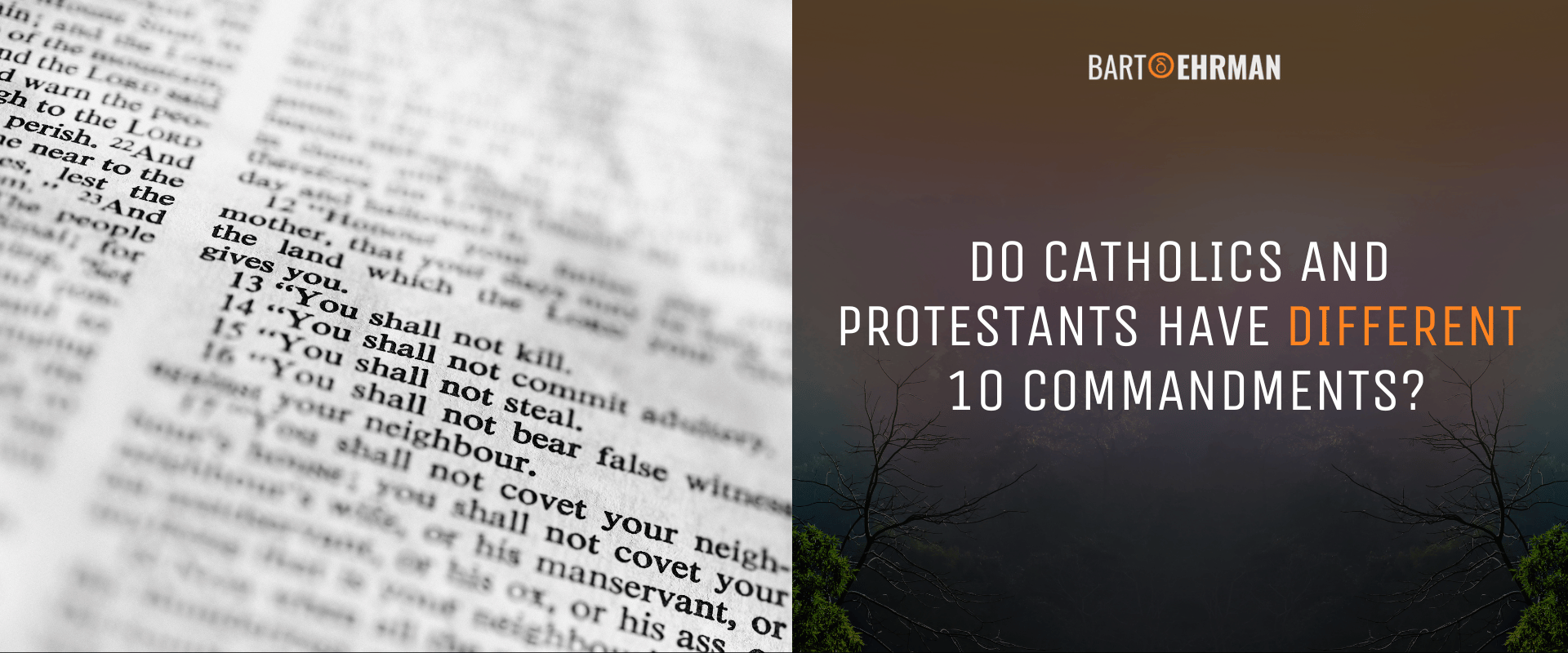
The Old Testament Origins of the 10 Commandments
To answer the question of whether Catholics and Protestants have different Ten Commandments, we first need to go back to the origins.
Each Christian tradition, in one way or another, grows out of the earlier Jewish tradition. After all, Jesus himself was a Jew who lived and taught within the religious world of 1st-century Judaism.
It therefore comes as no surprise that the famous 10 Commandments, also known as The Decalogue, first appear in the Hebrew Bible, or what Christians call the Old Testament. But where exactly do we find them, and how should we understand these Commandments within their original historical and social setting?
The Commandments appear in two major passages of the Hebrew Bible: once in the Book of Exodus (Exodus 20:1–17) and again in the Book of Deuteronomy (Deuteronomy 5:6–21).
In the biblical narrative, both versions are connected to the covenant between God and the people of Israel at Mount Sinai.
According to the story, these divine instructions were revealed shortly after the Israelites’ escape from Egypt and served as a foundational statement of the obligations that defined the covenant community.
Importantly, however, the two passages aren’t identical. Although they contain essentially the same set of principles, they differ in wording and emphasis. The Commandment about the Sabbath, for example, is grounded in God’s creation of the world in Exodus, but in Deuteronomy, it’s tied to Israel’s experience of slavery in Egypt and liberation from it.
Scholars have long noted that these texts are best understood as part of a broader ancient Near Eastern context. The Decalogue is distinctive in form: unlike many other ancient law collections, it consists largely of brief and categorical prohibitions rather than detailed case laws.
Carol Meyers, in her Commentary on Exodus, emphasizes that the biblical text itself actually speaks of “words” spoken by God rather than “laws,” which is why the traditional term Decalogue (from Greek meaning “ten words”) is often more precise.
(Affiliate Disclaimer: We may earn commissions on products you purchase through this page at no additional cost to you. Thank you for supporting our site!)
Moshe Weinfeld similarly stresses that the Decalogue shouldn’t be read simply as a legal code but as a foundational declaration of Israel’s covenant obligations.
In his analysis of Deuteronomy, the Commandments function almost like a concise charter for the Israelite community. In other words, as broad principles that express loyalty to God and proper relations within society.
As he explains:
At the dawn of Israelite history, the Decalogue was promulgated in its original short form as the foundation scroll of the Israelite community, written on two stone tablets, which were later called ‘the tablets of the covenant’ or ‘tablets of the testimony.’ The tablets, to be sure, functioned as a testimony to Israel’s commitment to observe the commandments inscribed upon them. We know today from Hittite documents, contemporary with Moses’ time, that nations used to place the covenant documents at their gods’ feet.


One more feature of these texts turns out to be especially important for our question. Although the tradition speaks of “ten” Commandments, the biblical passages themselves do not clearly mark where one ends and another begins.
As Weinfeld notes, ancient Jewish interpreters themselves didn’t always agree on how to divide the text into ten separate statements. Later Christian traditions inherited this interpretive flexibility.
That is why Catholics and Protestants today can draw from the same biblical passages while nevertheless numbering the Commandments somewhat differently.
Understanding this background helps explain why the issue is not as straightforward as it might initially appear. The biblical sources provide the same foundational material for all Christian traditions, but the way those texts are organized and taught has developed over centuries of interpretation.
To see how those later traditions emerged, we now need to look more closely at how the Commandments came to be understood within two specific branches of Christianity, beginning with the Catholic tradition.
Catholic 10 Commandments
The Catechism of the Catholic Church explicitly explains the numbering and division of the Ten Commandments:
“The present catechism follows the division of the Commandments established by St. Augustine, which has become traditional in the Catholic Church. It is also that of the Lutheran confessions. The Greek Fathers worked out a slightly different division, which is found in the Orthodox Churches and Reformed communities.” (2066)
This statement is important because it immediately clarifies a key point: the Catholic tradition doesn’t claim that its numbering is the only possible one. Rather, it follows a specific interpretive tradition that developed within the history of the church.
That tradition is usually traced back to Augustine of Hippo in the late 4th and early 5th centuries. Augustine proposed a particular way of dividing the Commandments in which the prohibition of worshiping other gods and the prohibition of making graven images are understood as part of a single Commandment about proper worship of God.
At the same time, the final Commandment concerning coveting is divided into two separate commands: one directed against coveting a neighbor’s spouse and another against coveting a neighbor’s possessions. Over time, this Augustinian arrangement became standard in the Western church.
By the medieval period, this system of numbering had become deeply embedded in Catholic teaching and catechesis. It was reinforced in the theological and educational traditions of the Latin church and eventually reaffirmed in the doctrinal formulations that emerged during the era of the Council of Trent in the 16th century.
From that point onward, the Augustinian division remained the standard way the Commandments were taught in Catholic contexts, and it continues to be so.
Within Catholic theology, however, the Commandments are much more than the set of isolated rules. They are interpreted as forming a coherent moral framework that expresses the fundamental structure of human obligations.
Did You Know?
What Happens When “No Idols” Is Taken Very Seriously?
One modern Christian movement that takes the commandment against idols extremely seriously is the Jehovah's Witnesses. While most Christian churches allow religious art, statues, or icons, Jehovah’s Witnesses interpret the biblical prohibition of images very strictly. For that reason, their places of worship typically contain no crosses, statues, icons, or religious artwork.
The goal is to avoid anything that might resemble the kind of image-veneration condemned in passages such as Exodus 20. Their interpretation extends beyond religious images as well. Jehovah’s Witnesses generally do not salute national flags or participate in patriotic ceremonies, because they believe such acts can resemble forms of idolatry by giving symbolic devotion to something other than God.
These practices make Jehovah’s Witnesses one of the clearest modern examples of a Christian group that interprets parts of the Ten Commandments in a noticeably stricter way than most other churches.
Peter Kreeft, in his book Catholic Christianity, explains that the Commandments have traditionally been seen as divided into two related groups.
The first set concerns humanity’s duties toward God, while the second concerns duties toward other human beings. This interpretive structure reflects a broader biblical theme that links love of God with love of neighbor.
Kreeft notes that in the traditional Catholic arrangement, the first three Commandments deal with worship, reverence for God’s name, and the observance of the Sabbath. In other words, these are the matters that define the proper relationship between believers and God.
The remaining Commandments address human relationships: honoring parents, respecting life, preserving fidelity in marriage, protecting property, speaking truthfully, and avoiding covetous desire.
In this framework, the Decalogue functions as a summary of moral life that integrates religious devotion with social responsibility.
In his article, John H. Stapleton, summarizes the significance of Decalogue for Catholics in the following way:
These Divine mandates are regarded as binding on every human creature, and their violation, with sufficient reflection and consent of the will, if the matter be grave, is considered a grievous or mortal offense against God. They have always been esteemed as the most precious rules of life and are the basis of all Christian legislation.
Seen in this way, the Catholic tradition emphasizes both the unity and the comprehensiveness of the Commandments. They express what Catholics understand as the basic moral order governing both religious and social life.
Yet, as the catechism itself acknowledges, this way of organizing the Commandments isn’t the only one that developed within Christianity.
Other Christian traditions adopted different methods of dividing the same biblical text. To see how that happened (thus answering our burning question: Do Catholics and Protestants have different 10 Commandments?), we now turn to the way the these commandments came to be numbered and interpreted in the mainstream Protestant traditions.
NOW AVAILABLE!
Finding Moses: What Scholars Know About The Exodus & The Jewish Law
Riveting and controversial, the "FINDING MOSES" lecture series takes you on a deep dive into the stories of Moses, the exodus, and a whole lot more...
Protestant 10 Commandments
It’s impossible to speak of Protestantism as a single movement or a single religious community. As Mark A. Noll notes in his book Protestantism: A Very Short Introduction:
Contemporary Protestant diversity is much more than just geographical. Church traditions that trace their origins to the earliest days of the European Reformation – including Lutherans, Presbyterians, Anglicans, Mennonites, and several Reformed denominations – or that arose in Europe and America during the 17th and 18th centuries (Congregationalists as well as many varieties of Methodists and Baptists) are now found throughout the world. But for Protestantism outside of Europe and North America, Pentecostal and local independent churches, which are a product of only the last century, have come to play a much larger role. Even in Europe, while the traditional churches retain considerable influence, the most active congregations are often Pentecostal, sometimes filled with newcomers from Africa or the Caribbean. Amazingly, one of Europe’s largest churches today is the Embassy of the Blessed Kingdom of God for All Nations in Kiev, which was founded only in 1994 by Sunday Adelaja, a Nigerian Pentecostal who had come to study in the Soviet Union before the collapse of communism.
Because Protestantism is so diverse, it makes little sense to search for a single Protestant answer to most theological questions.
Instead, historians usually begin with the leading figures of the Reformation itself. When it comes to explaining the reasons why Catholics and Protestants have different 10 Commandments, two names stand out: Martin Luther and John Calvin.
Luther, the German reformer whose teachings ignited the Protestant Reformation in the early 16th century, retained the traditional division of the Commandments associated with Augustine.
In this scheme, the prohibition against worshiping other gods and the prohibition against making graven images belong to a single Commandment about proper worship of God.
The final Commandment about coveting is then divided into two: one addressing the desire for a neighbor’s spouse and another addressing the desire for a neighbor’s property. In other words, Luther’s numbering of the Commandments ended up being essentially the same as the one used in the Catholic tradition.
A different approach emerged in the Reformed tradition associated with Calvin. As the historian Susan E. Schreiner explains in her essay on Calvin’s interpretation of the Decalogue, Calvin believed the Commandments formed a carefully ordered structure reflecting the relationship between God and humanity.
In his view, the prohibition of idols should be treated as a distinct Commandment rather than folded into the command against worshiping other gods.
This seemingly small interpretive decision produced a different numbering system. By separating the prohibition of images into its own Commandment, Calvin created a structure of four Commandments concerning duties toward God and six concerning duties toward other people.
As Schreiner notes, Calvin regarded the Decalogue as expressing the universal moral law that God had inscribed on human conscience, now presented in written form in Scripture.
Calvin also emphasized the ongoing role of the law in the life of believers. While he agreed with Luther that the Commandments reveal human sinfulness, he placed particular stress on what later theologians would call the “third use of the law”: the Commandments as a guide for Christian moral life.
In Calvin’s view, the Decalogue instructs believers in the pursuit of holiness and shapes the moral life of Christian communities.
By the time Protestant traditions spread across Europe and eventually around the world, both of these approaches were influential.
Some Protestant churches retained the numbering inherited from Luther and Augustine, while others adopted the arrangement associated with Calvin and the Reformed tradition. The result is that Christians who read the same biblical passages sometimes divide the Commandments differently.
All of this may sound a bit abstract, so the easiest way to see the difference is with a quick comparison table of how Catholics and Protestants number the Commandments.

Do Catholics and Protestants Have Different 10 Commandments? An Illustrative Table
# | Catholic & Lutheran Traditions | Reformed/Many Protestant Traditions |
|---|---|---|
1 | No other gods | No other gods |
2 | Included in the first Commandment | No idols/graven images |
3 | Do not take God’s name in vain | Do not take God’s name in vain |
4 | Keep the Sabbath | Keep the Sabbath |
5 | Honor father and mother | Honor father and mother |
6 | Do not kill | Do not kill |
7 | Do not commit adultery | Do not commit adultery |
8 | Do not steal | Do not steal |
9 | Do not bear false witness | Do not bear false witness |
10 | Do not covet your neighbor’s spouse | Do not covet |
11 * | Do not covet your neighbor’s goods | - |
* In the Catholic and Lutheran traditions, the Commandment about coveting is divided into two separate Commandments, while in the Reformed tradition, it remains one Commandment.
Conclusion
So, do Catholics and Protestants have different 10 Commandments?
Looking back on my student days in Croatia, when conversations about theology and church traditions often came up among friends from different Christian backgrounds, I remember how questions like this could spark surprisingly lively discussions.
As we have seen, the answer is both yes and no. The biblical text itself is the same for all Christians, but different historical traditions (especially those shaped by Augustine, Martin Luther, and John Calvin) developed different ways of dividing and numbering the Commandments.
These differences are, of course, less about changing Scripture and more about how Christian communities have interpreted and organized the same ancient text. In the end, what remains striking is that, across these traditions, the Ten Commandments have continued to serve as a shared moral foundation for Jewish and Christian thought for more than two millennia.
NOW AVAILABLE!
Finding Moses: What Scholars Know About The Exodus & The Jewish Law
Riveting and controversial, the "FINDING MOSES" lecture series takes you on a deep dive into the stories of Moses, the exodus, and a whole lot more...