
Cherubim Angel: What are the Cherubim in the Bible? (Verses)

Written by Joshua Schachterle, Ph.D
Author | Professor | Scholar
Author | Professor | BE Contributor
Verified! See our editorial guidelines
Verified! See our guidelines
Date written: August 26th, 2025
Disclaimer: The views and opinions expressed in this article belong to the author and do not necessarily match my own. - Dr. Bart D. Ehrman
Cherubim angel discussions through the ages have made these beings among the most fascinating creatures portrayed in the Bible. These supernatural beings are intimately connected with God in the Hebrew Bible, although their descriptions make them so otherworldly that it can be difficult for modern people to even conceive of them. So what are the cherubim?
In this article, I’ll explore multiple facets of the cherubim, from the etymology of their name to their divine functions and how they differ from other supernatural beings in the Bible. By comprehending the cherubim, we will be able to grasp how ancient Jews and Christians believed that God interacted with the world and humanity.
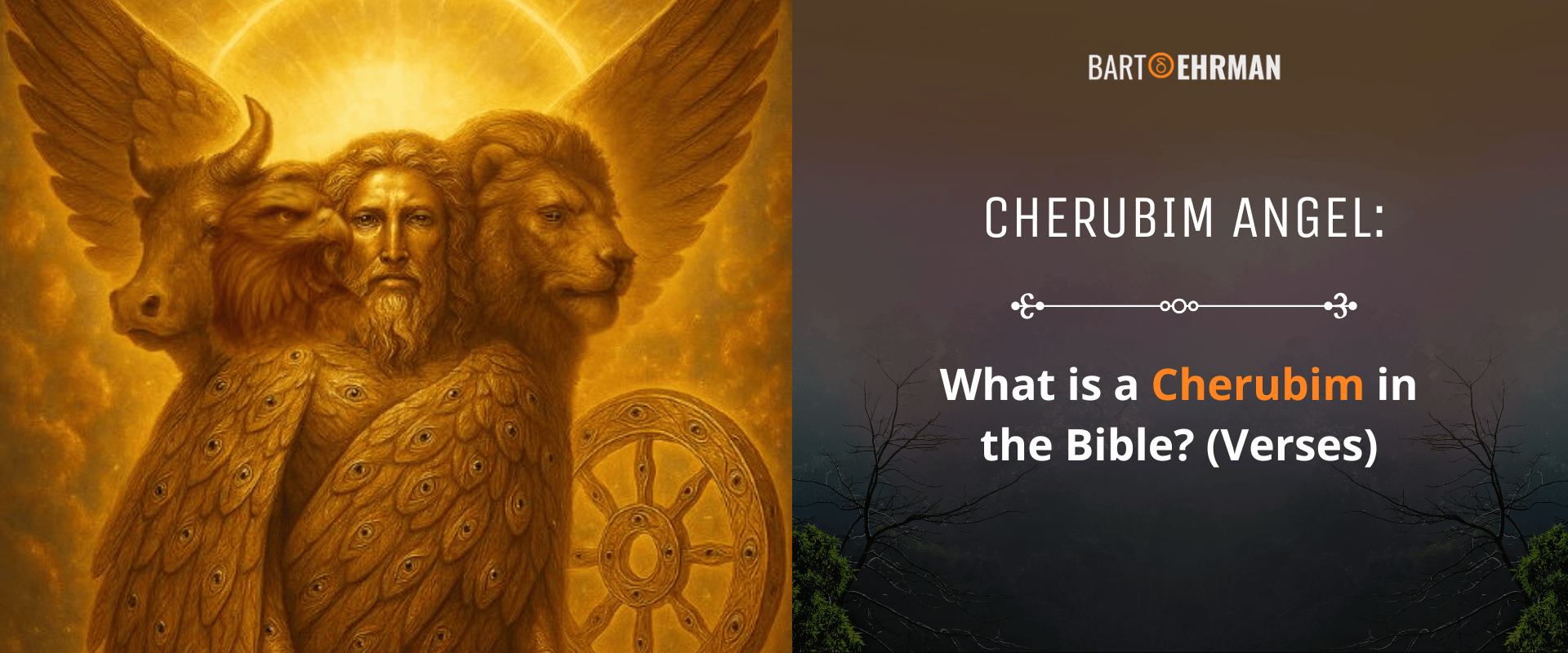
What Are the Cherubim in the Bible?
Our English word cherubim (pronounced CHAIR-oo-beem) is the plural of the word cherub (an “-im” ending on a Hebrew noun makes it plural). It is derived from the Hebrew word kerubh, which was transliterated into kheroub in Greek and, finally, cherub in Latin.
The word’s original etymology is uncertain to this day. In his book Ancient Israel: Its Life and Institutions, Roland De Vaux argued that it came from the Babylonian word karâbu meaning “auspicious”. In her book Of Wing and Wheels: A Synthetic Study of the Biblical Cherubim, Alice Wood notes that French scholar Édouard Paul Dhorme believed the term was derived from the Assyrian word kāribu, which referred to a class of celestial beings who mediated between the gods and human beings.
(Affiliate Disclaimer: We may earn commissions on products you purchase through this page at no additional cost to you. Thank you for supporting our site!)
This may be the true origin of the word cherub since the cherubim are a class of angels, appearing both in Judaism and Christianity. There are, in fact, nine ranks of angels according to early Christian sources. Although they are not all listed in one place in the Bible, early Jewish and Christian interpreters gathered together the names of these ranks of angels from various biblical references. The earliest list of all nine types of angels as a hierarchy comes from a 5th-century Christian author known as Pseudo-Dionysius the Aeropagite, in his book about angelology titled On the Celestial Hierarchy:
Highest Rank:
- Seraphim
- Cherubim
- Thrones
Middle Rank:
- Powers
- Dominions
- Authorities
Lowest Rank:
- Principalities
- Archangels
- Angels
As you can see, this Cherubim angel positioning makes these beings one of the highest in the hierarchy, second only to the seraphim in Christian angelology. Conversely, though, highly-influential Jewish author Maimonides in his Mishneh Torah reversed this order, placing the cherubim as the second-lowest class of angels in his list.
As an aside, our ideas of what cherubs look like are usually based on Renaissance paintings of chubby, infants with wings. The origin of this image is the Renaissance revival of ancient Greek art and culture. Among other figures, Renaissance artists thus painted divine beings known as the putti, beings painted or sculpted as naked male children with wings in ancient art. These somehow became identified during this era with the cherubim. As we’ll see, though, this is not how cherubim are depicted in the Bible.
So, now that we’ve established that the cherubim are types of angels, let’s look into what the Bible says about their functions and physical characteristics.
What Roles Did Cherubim Fill?
The first biblical reference to the cherubim comes in the book of Genesis. After Adam and Eve sin, God
drove out the humans, and at the east of the garden of Eden he placed the cherubim and a sword flaming and turning to guard the way to the tree of life (Genesis 3:24).


Because the verse says “cherubim” and not “cherub,” it’s clear that God posted at least two of them to guard the tree of life. It would seem, then, that the cherubim were believed to be angelic guards or soldiers.
Later in Exodus, when God is telling the Israelites how to construct their mobile temple known as the Tabernacle, he tells them to hang a curtain inside to separate the room where the ark of the covenant is kept.
You shall make a curtain of blue, purple, and crimson yarns and of fine twisted linen; it shall be made with cherubim skillfully worked into it” (Exodus 26:31).
There is still no description of the appearance of the cherubim here, but the fact that God wants them depicted on the entrance to such a holy part of the Tabernacle indicates their importance as guardian figures. In Exodus 25, by the way, God had ordered that the ark of the covenant be decorated with two cherubim made of gold on either side of its lid.
These cherubim on the ark are referred to in 1 Kings 8:6-7, when King Solomon has the ark, which was normally kept in a special secluded room, brought into an assembly on a festival day.
Then the priests brought the ark of the covenant of the Lord to its place, in the inner sanctuary of the house, the most holy place, underneath the wings of the cherubim. For the cherubim spread out their wings over the place of the ark, so that the cherubim made a covering above the ark and its poles.
That text indicates Cherubim were still considered, even as mere statues, to serve a protective or guardian function, in this case guarding the ark of the covenant.
In Psalms 18:9-10, however, the cherubim are seen to perform a different duty. In this Psalm the author, traditionally believed to be King David, relates how he called upon God to rescue him and God came:
He bowed the heavens and came down;
thick darkness was under his feet.
He rode on a cherub and flew;
Descending to the earth, God somehow rides on a cherub as if it is a beast of burden or a type of vehicle. This is the first time the Bible mentions this function but not the last.
In the strange, celestial visions of the prophet Ezekiel, we again see the cherubim serving as God’s vehicle, this time bearing his wheeled throne:
Now when the cherubim moved, the wheels would move beside them; also when the cherubim lifted up their wings to rise from the ground, the wheels themselves would not turn away from beside them. When the cherubim stood still, the wheels would stand still; and when they rose up, the wheels would rise with them, because the spirit of the living beings was in them (Ezekiel 10:16-17).
By the way, cherubim angels, as weird as they appear and as fiercely as they guard the tree of life, are considered unremittingly good in the Bible, since they function entirely as servants of God.
What Did Cherubim Look Like?
Based on the passage from 1 Kings 8:6-7, it seems clear that the cherubim were depicted with wings.
Then, in 10:20-22, we see our first detailed description of the appearance of the cherubim:
These are the living beings that I saw beneath the God of Israel by the river Chebar; so I knew that they were cherubim. Each one had four faces and each one four wings, and beneath their wings was the form of human hands. As for the likeness of their faces, they were the same faces whose appearance I had seen by the river Chebar. Each one went straight ahead.
Although the description is fairly clear, it’s still somewhat hard to imagine these strange beings since we have no point of reference to such creatures in our world. However, this will prove to be the clearest depiction of the cherubim in the Hebrew Bible. Any New Testament descriptions of them (i.e., Rev. 4:6-8, Heb. 9:5) are entirely dependent on those images from the Hebrew Bible.
How Are the Cherubim Different From the Seraphim?
Because they are both part of the highest rank of angels (in Christianity, anyway), it can be difficult to distinguish between the cherubim and the seraphim. However, the book attributed to the prophet Isaiah provides a description of the seraphim, which gives us some points of comparison. In this passage, Isaiah, like Ezekiel, is experiencing a vision:
In the year that King Uzziah died, I saw the Lord sitting on a throne, high and lofty, and the hem of his robe filled the temple. Seraphs were in attendance above him; each had six wings: with two they covered their faces, and with two they covered their feet, and with two they flew. And one called to another and said,
“Holy, holy, holy is the Lord of hosts;
the whole earth is full of his glory” (Isaiah 6:1-3)
The seraphim here differ from the cherubim in two ways. First, they each have six wings instead of the cherubims’ four. Next, they seem to have a function of holy praise here not described in depictions of the cherubim. But they perform a further function as well. When Isaiah wails that as a sinful man, it is dangerous for him to see God,
Then one of the seraphs flew to me, holding a live coal that had been taken from the altar with a pair of tongs. The seraph touched my mouth with it and said, “Now that this has touched your lips, your guilt has departed and your sin is blotted out.”
While the cherubim guard places for the Lord and carry him about, the seraphim praise God and even serve as go-betweens between God and human beings. The power to forgive Isaiah’s sins is clearly not granted by the seraph, but rather by God with the seraph as his mediator.
This may be why Pseudo-Dionysus and others saw the seraphim as higher in the hierarchy of angels than the cherubim: they connect God’s power to humanity. Additionally, he said that each rank of angels performed different functions. While the highest rank, including the cherubim, were closest to God and his power and wisdom, the second rank — powers, dominions, and authorities — are leaders and warriors. The lowest rank, however, generally serve as divine messengers to and guardians of humanity.
Conclusion
When the Hebrew Bible’s authors wrote the cherubim angel verses, they conceived these beings as filling important roles and detailed them early in the biblical canon. When God expels Adam and Eve from the Garden of Eden for their sin, he assigns cherubim to guard the path to the tree of life. This indicates that one of their functions was to protect holy things. That role is equally apparent in the way that the ark of the covenant contains statues of cherubim on its lid, and the curtain separating the holiest part of the Tabernacle from the rest is painted with cherubim as well.
A further function appears especially clearly in the book of Ezekiel, where the cherubim are seen flying God’s throne around, much in the way that a beast of burden would pull someone in a cart. Moreover, Ezekiel depicts the cherubim as each having four faces and four wings, with human-like hands beneath each of the wings.
While the seraphim are shown praising God and performing a mediative function between God’s might and humanity, it seems that the cherubim function as guards and vehicles, not specifically interacting with human beings at all in the Bible.
join bart ehrman's new conference!
New Insights into the Hebrew Bible
March 20-22 | 13 Bible Scholars | Early-Bird Pricing
Inaugural conference will focus on the book of Genesis