
Adam and Eve’s Story: History, Legend, or Myth?

Written by Marko Marina, Ph.D.
Author | Historian
Author | Historian | BE Contributor
Verified! See our guidelines
Verified! See our editorial guidelines
Date written: August 26th, 2025
Disclaimer: The views and opinions expressed in this article belong to the author and do not necessarily match my own. - Dr. Bart D. Ehrman
If Adam and Eve stood trial in a modern history department, what evidence would we bring to the stand, and what verdict would we render? Of the many stories in the Bible, only a handful have become so iconic that they’ve shaped not just theology but also art, literature, and the broader imagination of Western civilization.
The tale of a garden, a tree, a serpent, and a fateful bite is certainly one of them. Everyone “knows” the story of Adam and Eve, even those who have never opened a Bible. The story of Adam and Eve children hear about in Sunday school may shape their later beliefs. But what do we actually find when we turn to the ancient text itself?
Before we get ahead of ourselves, it’s worth remembering that stories this famous often come preloaded with assumptions: the fruit was an apple, the serpent was Satan, the sin was sex. Yet, when we take a fresh look at Genesis 2-3, much of what we “know” isn’t there.
The biblical account is shorter, stranger, and far more theologically charged than popular retellings suggest. And, as historians, our task is not to defend cherished images but to ask: what kind of story is this, and what was it trying to communicate in its own ancient context?
In what follows, we’ll first situate Adam and Eve where they actually appear in the Bible and briefly summarize their story. Then we’ll ask the historian’s inevitable question: is this a record of real events, or is it something else entirely?
From there we’ll move into some of the big scholarly conclusions about the meaning of Genesis 2-3, and along the way we’ll tackle a set of frequently asked questions, from the language Adam and Eve supposedly spoke to how long they lived.
The goal isn’t to debunk or defend but to understand, critically and historically, one of the most influential stories ever told.
If you’d like to dive even deeper into Genesis, check out Dr. Bart D. Ehrman’s six-lecture course, In the Beginning: History, Legend, or Myth in Genesis? In it, he explores the creation of the world and other foundational stories, tracing where history ends and myth begins in this most influential of biblical books.
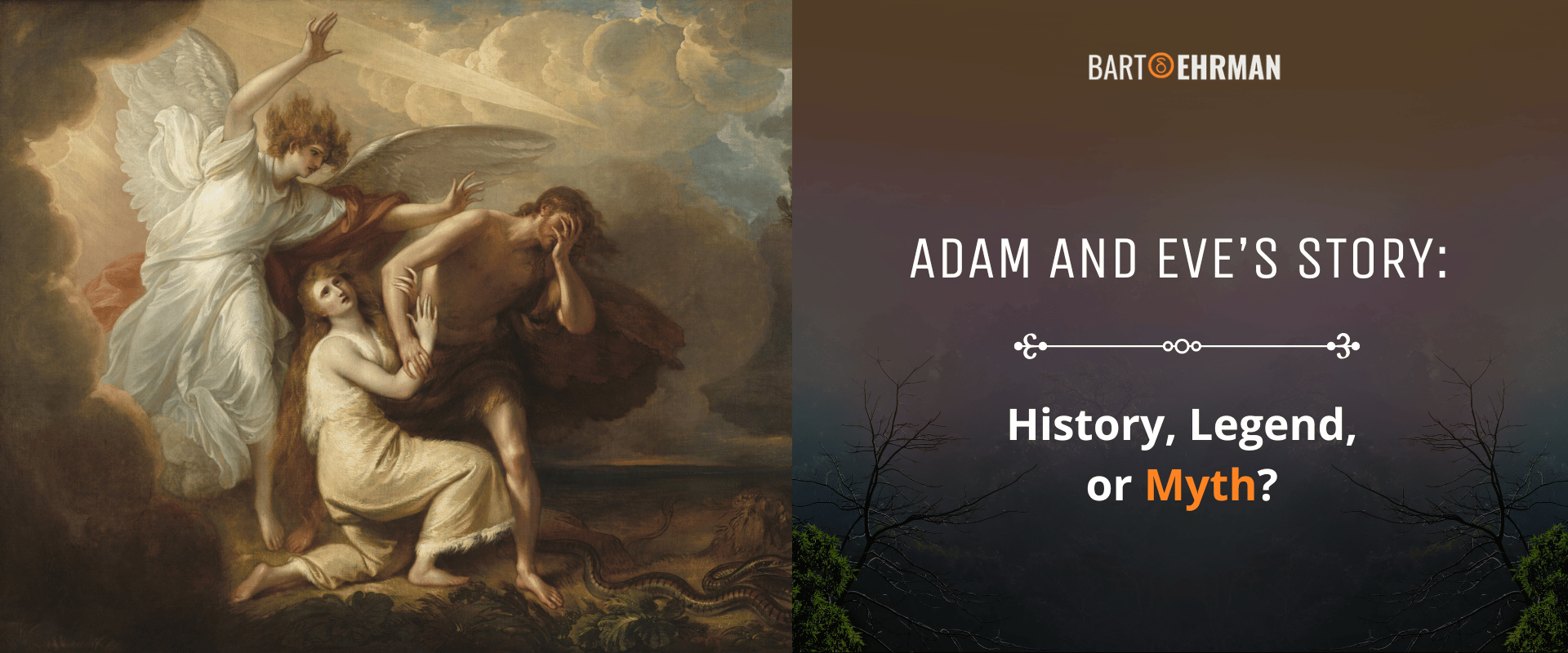
The Adam and Eve Story: What the Bible Actually Says
The story of Adam and Eve appears in the first book of the Bible, Genesis. The narrative appears in chapters 2 and 3, immediately after the majestic account of creation in Genesis 1. These opening chapters of Scripture are among the most familiar and influential in all of Western tradition, shaping not only theology but also art, literature, and cultural imagination.
For many centuries, Jewish and Christian readers assumed that Moses wrote Genesis, along with the other four books of the Pentateuch. Modern scholarship, however, paints a far more complex picture.
Over the past two centuries, critical study of the Pentateuch has given rise to what is known as the Documentary Hypothesis. This theory suggests that the five books of Moses aren’t the work of a single author, but rather a compilation of different sources woven together by later editors.
The idea is that Israel’s earliest traditions were preserved in multiple, sometimes overlapping accounts, each reflecting different theological emphases and historical contexts. By the time Genesis reached its final form, these strands had been combined into a seamless (though not always consistent!) narrative.
As Joseph Blenkinsopp explains in his book Creation, Un-Creation, Re-Creation: A Discursive Commentary on Genesis 1-11:
(Affiliate Disclaimer: We may earn commissions on products you purchase through this page at no additional cost to you. Thank you for supporting our site!)
The identification of sources has always been a matter of great concern in critical scholarship on the Bible in the modern period. To state the situation briefly, there is broad agreement that Genesis 1-11 results from the combination of two principal sources. What has come to be known as the Priestly source (siglum P) carries the main narrative line, provides a degree of continuity, uses distinctive and often formulaic language, and is concerned primarily with worship, the religious calendar, Sabbath (which even God observes, Gen. 2:2) and purity rules. This source refers to the deity as ‘Elohim’… The source with which P has been combined, usually designated Yahwistic on account of the name Yahweh which it uses (siglum J), is more focused on the human predicament and more characteristically lay than priestly and clerical in orientation. That Genesis 1-11 results from the combination of these two sources is still the ruling assumption in academic commentary, but like all such assumptions it leaves space for a hermeneutic of suspicion.


This insight is important, because the story of Adam and Eve belongs not to the Priestly account of Genesis 1 but to the Yahwistic narrative of Genesis 2-3. The tone is different, the focus more earthy and human-centered, with God walking in the garden, forming man from dust, and fashioning woman from his side.
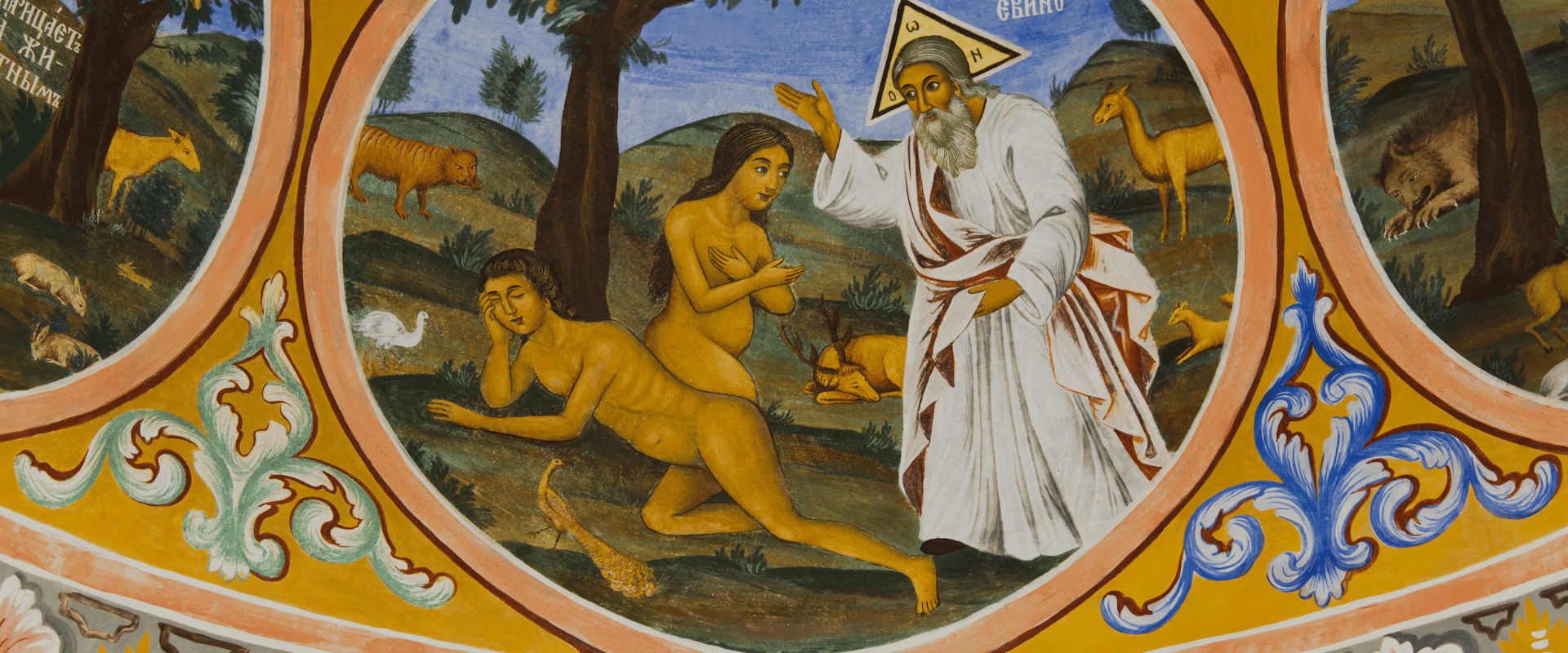
The story itself unfolds in a few vivid strokes. God forms the first human, Adam, from the ground and breathes life into him. A garden called Eden is planted, filled with trees both pleasing and fruitful, including the tree of life and the tree of the knowledge of good and evil.
Adam is placed there to till and keep it, but he is forbidden to eat from the latter tree. Seeing that it is not good for the man to be alone, God fashions a woman, Eve, as his companion.
A serpent then approaches Eve, persuading her to eat from the forbidden tree, and she in turn gives the fruit to Adam. Their eyes are opened; they recognize their nakedness; shame and fear enter the world.
When confronted, Adam blames Eve, Eve blames the serpent, and God pronounces consequences: pain in childbirth, toil in labor, conflict, and eventual death. The couple is expelled from Eden, and cherubim are stationed at the gate to guard the way to the tree of life.
This, in brief, is the biblical story of Adam and Eve. But is it a historically reliable account of human origins? Or is it, rather, a symbolic narrative that conveys deeper truths about the human condition? To answer that, we now turn from simply summarizing the story to asking hard historical questions that may take us out of the garden and into the realm of critical scholarship.
Are Adam and Eve Historical? What Critical Scholarship Says
The Israelites didn’t write scientific treatises about the nature of the universe and of humanity. Instead, they created myths that served as a way of articulating the meaning of life at the time they were composed. Genesis 2 and 3 do that with a story!
Rather than abstract speculation, the account of Adam and Eve narrates, in symbolic form, how human beings came to be the way they are: mortal, laboring, desirous, and estranged from the divine. To approach the story historically isn’t to ask whether it happened but to ask what kind of story it is and why it was told.
For most critical scholars, the conclusion is clear: Adam and Eve weren’t historical figures. Several lines of evidence lead to this consensus. First, the creation accounts in Genesis 1 and Genesis 2 appear to be different and, at points, contradictory.
In Genesis 1, humanity (male and female) is created last, after animals; in Genesis 2, the human is created first, then animals, then woman. These aren’t two consecutive descriptions of the same event but two distinct traditions, stitched together in the final form of Genesis.
Second, the stories contain elements that defy scientific explanation. Genesis 1 describes light existing before the creation of the sun, moon, and stars, something cosmology doesn’t support. Genesis 2 depicts plants existing before there is sunlight to sustain them. The narratives, therefore, work as theology and myth, not as proto-scientific explanations of the universe.
Third, the very names and terms in the story indicate symbolic rather than biographical meaning. Ronald Hendel, in his Commentary on Genesis, points out that the Hebrew word for the first human is hāʾādām—literally “the human.”
He explains:
The first human is hāʾādām (‘the human, man’). As in 1:26–27, this word can mean humankind in general or a particular human, marked as male. It is a singular noun, which can be used as a collective plural. The relevant sense—singular or plural, gender-neutral or gender-specific—is determined by context. The semantic multivalence of hāʾādām is exploited in this story. On one level, hāʾādām represents humans in general, since this person is ‘the human,’ with the definite article implying that ‘the human’ is a kind of prototype. Like the first human, all humans are made of earthy stuff, are enlivened by breathing, and return to the soil at death. On this level hāʾādām is the ancestor and symbol of all humans.
In addition, scholars often point out that the narrative itself bears all the hallmarks of myth rather than biography. The talking serpent, the trees whose fruits confer either eternal life or divine wisdom, and the presence of cherubim with a flaming sword at the garden’s gate all place the story firmly in the realm of symbolic storytelling.
Such motifs are common in the mythological literature of the ancient Near East. Even a woman's creation from a man's “side” or “rib” invites cross-cultural and anthropological comparison. Some scholars suggest that Genesis may reflect, or perhaps respond to, the Sumerian Dilmun paradise myth.
In that story, the god Enki eats forbidden plants and is cursed by the goddess Ninhursag, who then creates the goddess Nin-Ti (whose name can mean both “lady of the rib” and “lady who gives life”) to heal him. In a similar vein, Adam’s “giving birth” to Eve from his own body echoes other mythological motifs, such as Dionysius emerging from Zeus’ thigh or Athena springing forth from his head.
Did You Know?
The Creation Story That Silenced Half the Church
A couple of years ago, I read an interesting book by Glen Scrivener in which he argued that Christianity gave birth to (or at least seriously advanced) some of the most important cultural values of our society, including compassion, freedom, and equality.
It was the last of these that made me pause, because Scrivener seems to have overlooked a rather uncomfortable detail: for much of Christian history, the story of Adam and Eve was used to justify the exact opposite: inequality between men and women.
Take the creation story itself. Eve is created as Adam’s “helper,” not the other way around. That might sound benign today, but in antiquity it became a theological foundation for female subordination. And the theme runs deep across Scripture.
One of the starkest examples comes in 1 Timothy: “A woman should learn in quietness and full submission [ὑποταγῇ—literally, obedience or subjection]. I do not permit a woman to teach or to assume authority over a man; she must be quiet.” The reasoning? The author points directly back to Genesis: “For Adam was formed first, then Eve. And Adam was not the one deceived; it was the woman who was deceived and became a sinner.”
In other words, Eve’s secondary creation and her role in being deceived by the serpent were seen as proof that women are more easily misled, more vulnerable, and thus should remain silent and subordinate. Early Christian communities often leaned heavily on this interpretation, and its echoes reverberated for centuries in Christian theology and practice.
So, these aren’t the features of a historical memoir but of a myth crafted to convey meaning through imaginative narrative. What, then, does the story mean?
The majority view among critical scholars is that Genesis 2-3 is a myth that seeks to explain the origin of sin, suffering, and death. It is a story about disobedience to divine command, the allure of wisdom, and the consequence of transgression.
By framing this in the narrative of the first humans, the text addresses the universal condition of all humanity. We all experience shame, toil, mortality, and alienation; the story provides a mythic etiology for why.
Other scholars, however, have offered alternative readings. James Barr, in his book The Garden of Eden and the Hope of Immortality, argues that the story is not primarily about sin at all but about immortality. He writes:
It is a story of how human immortality was almost gained, but in fact was lost. This was, I need hardly remind you, the reason, and the only reason, why Adam and Eve were expelled from the Garden of Eden: not because they were unworthy to stay there, or because they were hopelessly alienated from God, but because, if they stayed there, they would soon gain access to the tree of life, and eat of its fruit, and gain immortality: they would ‘live for ever.’ Immortality was what they had practically achieved.
Despite differences of emphasis, scholars agree on one key point: the story of Adam and Eve isn’t a historical record of real individuals. It’s a myth, shaped by the cultural and theological world of ancient Israel, designed to explain something fundamental about human existence.
NOW AVAILABLE!
Finding Moses: What Scholars Know About The Exodus & The Jewish Law
Riveting and controversial, the "FINDING MOSES" lecture series takes you on a deep dive into the stories of Moses, the exodus, and a whole lot more...
FAQ: Seven Quick Scholarly Answers
Before we wrap things up, let’s turn to some of the most frequently asked questions about Adam and Eve. We won’t dive into detailed analysis here, but even brief answers can shed light on these pivotal “figures” who have had an enormous influence on the development of both Judaism and Christianity.
How long ago were Adam and Eve created according to Christian tradition?
Traditional chronologies, such as that of Archbishop James Ussher in the 17th century, dated the creation of Adam and Eve to 4004 B.C.E. by adding up biblical genealogies.
Other Jewish and Christian thinkers produced slightly different calculations, but all treated Genesis as a literal timeline. Critical scholarship, however, views these figures as theological constructs, not historical dates.
What language did they speak?
The Bible doesn’t specify any language for Adam and Eve. Later writers speculated that they spoke the primordial tongue known to scholars as the “Adamic language.” It was, in some cases, identified with Hebrew, an idea found, for instance, in the Jewish historian Josephus (Antiquities 1.1.4.). Christian authors such as Augustine repeated it.
What was the forbidden fruit that Adam and Eve supposedly ate?
Genesis never names the fruit of the tree of the knowledge of good and evil. The popular identification with an apple arose in Latin Christianity because the Latin word malum means both “evil” and “apple.” Jewish traditions suggested other candidates, such as the fig (linked to the fig leaves in Gen 3:7), the grape, or wheat, but all these are symbolic interpretations, not historical identifications.
How many children did Adam and Eve have?
Genesis mentions three sons by name (Cain, Abel, and Seth) and notes that Adam “had other sons and daughters” (Gen 5:4). Later traditions expanded on this: the book of Jubilees, for example, lists nine additional children, though these accounts reflect later imaginative elaboration rather than the biblical text itself.
How long did Adam and Eve live?
Genesis 5:5 records that Adam lived 930 years. The Bible never states Eve’s age, and later traditions vary; the extreme lifespans in Genesis are generally understood by scholars as symbolic rather than historical.
How did Adam and Eve die?
The Bible reports Adam’s death in Genesis 5:5, noting that it occurred at 930 years old. However, there is no account of the manner of his death. Eve’s death isn’t narrated at all! It should be noted that the later writings like the Life of Adam and Eve supply legendary details, but these aren’t part of the biblical tradition.
Do you have to believe in Adam and Eve to be a Christian?
It depends! Christian creeds don’t necessarily require belief in Adam and Eve as literal historical individuals. Some Christian denominations accept evolutionary science and read the Genesis story symbolically.
Other denominations still insist on their historicity, often in connection with doctrines of original sin. Within Roman Catholicism, there is a strong stream of thought asserting the belief that, at least, the creation of humans started with two individuals, contrary to some scientific models that argue in favor of the position called polygenism.
Pope Pius XII, in his encyclical Humani Generis published in 1950, asserted:
It is in no way apparent how such an opinion [polygenism] can be reconciled with that which the sources of revealed truth and the documents of the teaching authority of the Church propose with regard to original sin, which proceeds from a sin actually committed by an individual Adam and which, through generation, is passed on to all and is in everyone as his own.
From a historical perspective, the diversity of views shows that Christianity has never been dependent on one single interpretation of Adam and Eve.
Conclusion
In the end, I don’t think that the story of Adam and Eve is a historical record of the world’s first couple but a myth that ancient Israel used to grapple with profound questions of life, mortality, and humanity’s relationship to God.
Whether understood as an etiology of sin, a reflection on lost immortality, or a meditation on human limits and aspirations, the narrative belongs to the symbolic world of myth and theology rather than to the realm of biography and science.
And yet, its influence has been extraordinary. From Paul’s letters to Augustine’s theology, from medieval art to modern debates over science and faith, Adam and Eve have continued to shape how Jews and Christians understand what it means to be human.
NOW AVAILABLE!
Finding Moses: What Scholars Know About The Exodus & The Jewish Law
Riveting and controversial, the "FINDING MOSES" lecture series takes you on a deep dive into the stories of Moses, the exodus, and a whole lot more...