

How Old Was Methuselah? And Did People Really Live That Long?

Written by Marko Marina, Ph.D.
Author | Historian
Author | Historian | BE Contributor
Verified! See our guidelines
Verified! See our editorial guidelines
Date written: November 18th, 2026
Disclaimer: The views and opinions expressed in this article belong to the author and do not necessarily match my own. - Dr. Bart D. Ehrman
I think that even people who have never opened a Bible in their lives have heard of Methuselah. I have a friend who has absolutely no interest in Judaism, Christianity, or religion in general.
Yet I remember him once asking me about Methuselah, fascinated and even a little amused by the idea that someone could have lived for such an extraordinarily long time. I tried to explain how biblical scholars approach such accounts and why they might have made sense to the people who first wrote and read them.
This information gave context to the “How old was Methuselah?” question. But, as it turned out, my friend was far more interested in the remarkable claim itself than in any scholarly explanation I had to offer!
As the individual who is the oldest person in the Bible, Methuselah reminds us that the collection of ancient writings we now call the Bible contains many stories that can seem rather strange, puzzling, or even amusing to modern readers.
After all, these texts emerged in societies whose ways of understanding the world were often quite different from our own.
And while it may be tempting to dismiss such accounts as little more than ancient fantasies, doing so risks overlooking some fascinating questions about the people who produced them and the ideas they sought to communicate.
So, who exactly was Methuselah, and what does the Bible actually say about him? Was he the only biblical figure credited with such an extraordinary lifespan? And, perhaps most intriguingly, how do modern historians and biblical scholars make sense of these remarkable claims about human longevity?
But before we go into the fascinating story of Methuselah, have you ever wondered who actually wrote the first five books of the Bible?
Traditionally attributed to Moses, these ancient texts contain striking repetitions, differences, and sometimes even contradictions that have puzzled readers for centuries.
In his fascinating 10-lecture course, The Bible by Committee: How the Pentateuch Was Really Written, Yale scholar Joel Baden takes you behind the scenes of biblical composition, showing how scholars uncover the different sources and traditions woven into these books. Join him to explore the evidence for yourself and discover why the Bible may never look quite the same again!
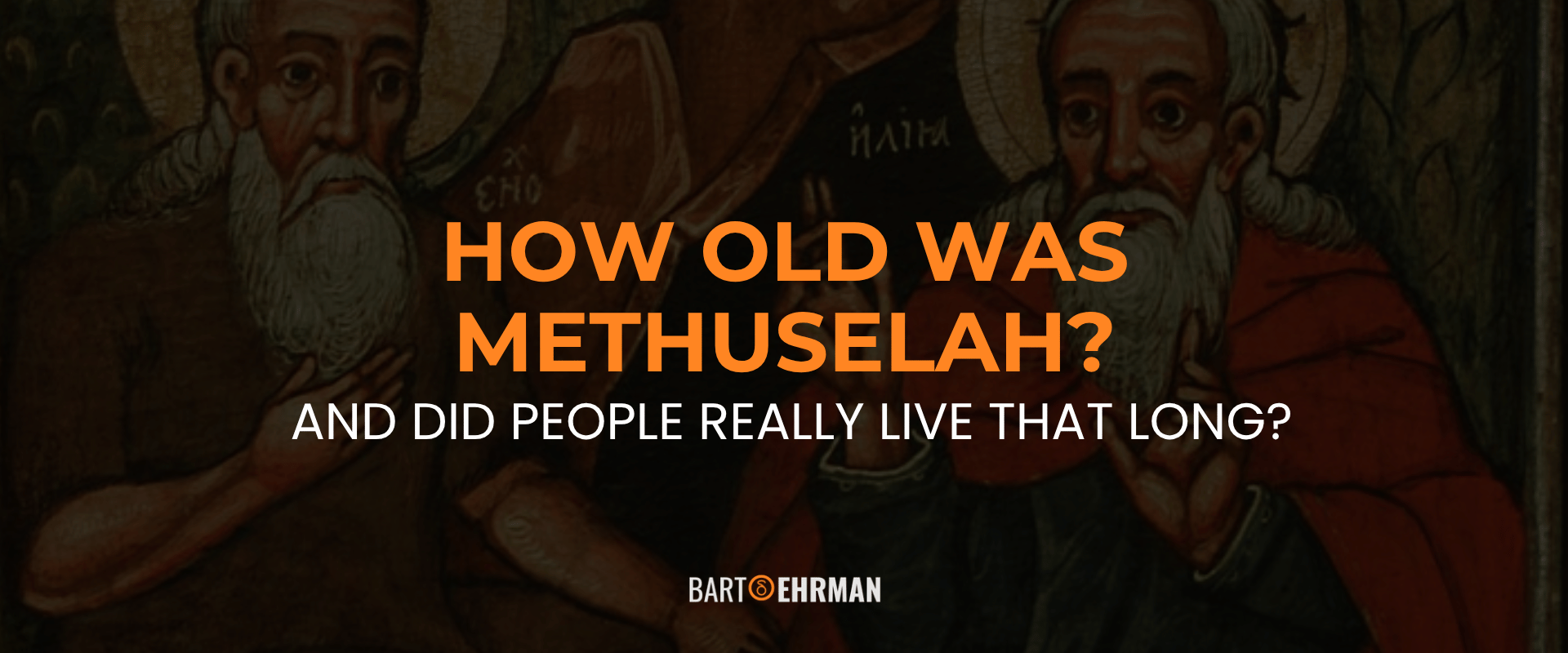
How Old Was Methuselah, and Who Was He?
In his book Forever Young: A Cultural History of Longevity, Lucian Boia offers an interesting observation about humanity's enduring struggle with mortality:
(Affiliate Disclaimer: We may earn commissions on products you purchase through this page at no additional cost to you. Thank you for supporting our site!)
Human beings are far from happy with their lot. Moreover we are alone – on this Earth at least – in asking existential questions. Intelligent enough to ask them we may be, but almost certainly not enough to find the answers. How can we come to terms with our brief lives, whose joys are too often mitigated by sorrow and which end, to all intents and purposes, in obliteration? Faced with this most unsatisfactory reality, three strategies are open to us. First is the message of the traditional religions: nothing ends with death. One way or another life goes on, but in a different dimension. The ‘double’ of our material body - regarded as immortal — passes into the Hereafter or, possibly (according to the theory of metempsychosis), is reincarnated in a series of many different forms. Perhaps it is only ‘afterwards’ that true life begins.


Humanity's fascination with longevity, and the possibility of overcoming the limitations of ordinary human existence, finds one of its most remarkable expressions in the biblical account of Methuselah.
But before we consider what his extraordinary lifespan might mean, we need to establish what the Bible actually tells us about him.
Methuselah appears in the Book of Genesis, the first book of the Hebrew Bible (or Old Testament), in a genealogical account tracing the generations from Adam to Noah.
More specifically, Genesis 5 identifies him as the son of Enoch, a figure who is himself distinguished by the unusual statement that he "walked with God" before God took him (Genesis 5:24). Methuselah, in turn, became the father of Lamech and the grandfather of Noah, whose story occupies a prominent place in the subsequent chapters of Genesis.
But what makes Methuselah particularly famous is neither his ancestry nor his descendants. Instead, it’s the extraordinary number of years the Bible attributes to him. More specifically, he was the oldest man in the Bible, at least regarding those whose ages are explicitly recorded there.
How old was the oldest person in the Bible? According to Genesis 5:25–27, Methuselah was 187 years old when he fathered Lamech. He then lived another 782 years, during which he had other sons and daughters, before dying at the astonishing age of 969.
Curiously, however, Genesis tells us almost nothing more about the oldest person in the Bible. We learn nothing about his personality, accomplishments, or experiences during those many centuries.
His name also appears in genealogical lists in 1 Chronicles 1:3 and Luke 3:37, but these passages provide no additional biographical information.
And yet, remarkable as Methuselah's lifespan may seem, he was hardly the only biblical figure said to have lived for centuries. In fact, Genesis contains several other examples of extraordinarily long lives, some of which come surprisingly close to his own.
The Ten Oldest People in the Bible
In his book An Introduction to the Bible, John W. Rogerson explains:
Writing in the ancient world was an activity mainly confined to a professional class located in two powerful institutions, the Temple and the royal court. The traditions out of which the Old Testament grew were most likely written by scribes trained in either or both of these institutions, as located in the northern kingdom, Israel, and the southern kingdom, Judah... The Old Testament begins with what scholars call a Primeval History, a series of narratives set in a 'beginning time' different from, yet continuous with, that of the writers/readers and hearers of the narratives. The purpose of the Primeval History is to explain the origin of the world and its fundamental features from the point of view of the distinctive religious beliefs of the writers/editors.
Rogerson's observation helps us appreciate an important point: the opening chapters of Genesis weren’t written as modern historical accounts, but they emerged from ancient traditions concerned with explaining the origins of the world and humanity.
It’s hardly surprising, then, that these narratives contain elements that may strike modern readers as rather strange.
Among the most remarkable are the extraordinarily long lifespans attributed to figures who supposedly lived in humanity's distant past.
Who was the oldest person in the Bible? Methuselah has that distinction, but he was far from alone in this respect!
To put his remarkable age into perspective, the following table presents the ten longest-lived individuals mentioned in the Bible, along with their reported lifespans and the passages in which they appear.
Rank | Biblical Figure | Lifespan | Biblical reference |
|---|---|---|---|
1. | Methusalah | 969 | Genesis 5:27 |
2. | Jared | 962 | Genesis 5:20 |
3. | Noah | 950 | Genesis 9:29 |
4. | Adam | 930 | Genesis 5:5 |
5. | Seth | 912 | Genesis 5:8 |
6. | Kenan | 910 | Genesis 5:14 |
7. | Enosh | 905 | Genesis 5:11 |
8. | Mahalalel | 895 | Genesis 5:17 |
9. | Lamech | 777 | Genesis 5:31 |
10. | Shem | 600 | Genesis: 11:10–11 |
Keep in mind that the lifespans listed in this table are based on the Masoretic (Hebrew) textual tradition of Genesis. Other ancient textual traditions preserve somewhat different figures, a fascinating issue we explore in greater detail in our "Scholarly Insights" box below.
NOW AVAILABLE!
Finding Moses: What Scholars Know About The Exodus & The Jewish Law
Riveting and controversial, the "FINDING MOSES" lecture series takes you on a deep dive into the stories of Moses, the exodus, and a whole lot more...
Did People Really Live That Long? What Scholars Say About Methuselah's Age
Outside of the common Methuselah age question, we should broaden our question. How long did people live in the Bible, or within broader society? In his book Old Age in the Roman World: A Cultural and Social History, Tim G. Parkin notes:
Most ancient testimony that has been used to elucidate the demographic structure of the ancient world - tombstone, inscriptions, mummy labels, tax receipts, legal texts, and skeletal material - is, unfortunately, all but useless. At the very best such testimony may often be said to support the notion that average life expectancy at birth in the ancient world was of the range of twenty or thirty years. This is what we would expect anyway. The Roman Egyptian census material, sparse as it is, is the best primary information that we have, and it too supports this notion.
Of course, such estimates do not mean that most ancient people died in their 20s or 30s. High infant and childhood mortality substantially lowered average life expectancy, while those who survived childhood could sometimes live into their sixties, seventies, or beyond.
Nevertheless, there is no credible historical or biological evidence that human beings ever lived for several centuries.
So, how should we understand Methuselah's extraordinary lifespan? As the oldest person to ever live in the Bible, was he simply an exceptional individual, or does the Book of Genesis require us to approach the question from an entirely different perspective?
To answer that question, we must first recognize that Genesis 5 isn’t a modern demographic record but part of what biblical scholars call the Primeval History, a collection of narratives and genealogies concerned with humanity's earliest beginnings.
Scholarly Insights
969 Years and Counting? The Mystery of Methuselah's Age.
Did you know that ancient versions of the Bible don't always agree on how long the earliest humans lived? The story of Methuselah offers a particularly fascinating example! According to the Masoretic Text, the Hebrew textual tradition underlying most modern Bible translations, Methuselah lived for 969 years and died in the very year of Noah's Flood.
The ancient Greek translation known as the Septuagint, however, preserves a different chronology in which Methuselah apparently survived the Flood by another fourteen years! This creates a rather puzzling problem: if the Bible tells us that only Noah, his family, and the creatures aboard the ark survived, how could Methuselah still have been alive?
Meanwhile, the Samaritan Pentateuch offers yet another chronological arrangement, placing the deaths of Methuselah and two other ancestors in the year of the Flood. Such differences have led scholars to investigate whether ancient scribes deliberately adjusted the genealogical numbers to resolve chronological inconsistencies.
Could the familiar biblical ages, then, reflect not just ancient traditions about the distant past but also centuries of textual transmission and revision? The evidence offers a fascinating glimpse into how the biblical text developed, and it is well worth exploring these different versions to see how their numbers compare!
Ronald Hendel, in his Commentary on Genesis, explains that the genealogy in this chapter serves an important literary purpose: it connects the creation of humanity with the generation of Noah and the biblical Flood.
The text follows a remarkably consistent pattern, telling us how old each ancestor was when he fathered his successor, how many additional years he lived, and, finally, how old he was when he died.
Through this repeated formula, the genealogy organizes the passage of time across ten generations, creating a sense of continuity between the world's creation and the catastrophe of the Flood.
Methuselah's 969 years must therefore be understood within this broader literary framework rather than treated as an isolated historical claim.
Interestingly, Hendel also cautions against assuming that every extraordinary lifespan conceals a specific numerical code. Although Enoch's 365 years may have astronomical significance, scholars haven’t identified any convincing numerical system that explains all the ages recorded in Genesis 5.
But the literary structure of Genesis is only part of the explanation.
To understand why its authors might have imagined their earliest ancestors living for so many centuries, we must also consider the wider cultural world in which these traditions developed.
E. A. Speiser, in his Commentary on Genesis, draws attention to ancient Mesopotamian traditions concerning rulers who supposedly lived before a great Flood.
The famous Sumerian King List, for example, attributes reigns lasting tens of thousands of years to kings of the distant past!
Methuselah is the figure who was the oldest living person in the Bible, but compared with such astonishing figures found elsewhere, even his 969 years appear remarkably modest. Yet Speiser also emphasizes an important distinction: the Mesopotamian texts describe kings, whereas Genesis presents a genealogy of humanity's earliest ancestors.
Furthermore, the names of the biblical patriarchs cannot be directly identified with those appearing in the Mesopotamian lists.
These similarities, therefore, do not establish that the biblical authors simply copied an existing Mesopotamian account. They do, however, demonstrate that extraordinarily long lifespans belonged to a broader ancient Near Eastern way of imagining the remote past.
This brings us back to a question that modern readers frequently ask: Why did people live so long in the Bible?
From a historical-critical perspective, the most productive answer isn’t that ancient humans possessed extraordinary biological abilities that have somehow disappeared.
Rather, the remarkable ages in Genesis belong to ancient traditions in which the earliest generations of humanity were imagined as inhabiting a world profoundly different from the one experienced by later readers.
Within the broader narrative of Genesis, human lifespans gradually diminish as the story moves away from the primordial past toward the generations of Abraham and his descendants. This literary progression helps distinguish the extraordinary world of humanity's beginnings from the more familiar conditions of subsequent human existence.
Yet precisely what each number originally signified remains uncertain. Both Hendel and Speiser acknowledge the limits of our ability to reconstruct the principles behind these figures. Ultimately, Methuselah's age tells us considerably more about how ancient biblical authors represented humanity's distant past than it does about how long people actually lived.
Conclusion
I'm quite sure that my friend mentioned in the introduction to this article would still find Methuselah's extraordinary lifespan more amusing than the scholarly explanations we have explored. And perhaps that is understandable!
How old was Methuselah? As we’ve covered above, he lived to be 969. The idea of someone living for nearly a thousand years is bound to capture our imagination.
Indeed, Methuselah is the figure who’s the oldest person in the Bible. Yet, as we have seen, the real historical significance of Methuselah's story lies not in the possibility that people once lived for centuries, but in what these remarkable ages reveal about the ancient world in which the biblical traditions developed.
The authors and transmitters of Genesis inherited ways of imagining humanity's distant past that differed considerably from our own, and they incorporated these traditions into a broader narrative connecting creation, successive generations, and the Flood.
Although we cannot explain with certainty why Methuselah was assigned precisely 969 years, examining his story within its literary and cultural context allows us to appreciate something far more interesting than an extraordinary claim about human longevity: the different ways ancient societies understood their origins, organized their past, and reflected on the human condition.
NOW AVAILABLE!
Finding Moses: What Scholars Know About The Exodus & The Jewish Law
Riveting and controversial, the "FINDING MOSES" lecture series takes you on a deep dive into the stories of Moses, the exodus, and a whole lot more...