
What Is Original Sin? Meaning, Bible Verses, and Where the Doctrine Came From

Written by Marko Marina, Ph.D.
Author | Historian
Author | Historian | BE Contributor
Verified! See our guidelines
Verified! See our editorial guidelines
Date written: October 26th, 2026
Disclaimer: The views and opinions expressed in this article belong to the author and do not necessarily match my own. - Dr. Bart D. Ehrman
What is original sin? Recently, one of my former students asked me which Christian doctrine I consider the most important. It’s, of course, not an easy question to answer.
Christian denominations were developed around a cluster of beliefs that became foundational to their theology, worship, and understanding of the human condition, and isolating any one of them as the most important is bound to be somewhat arbitrary.
Still, if I had to draw up a short list, the doctrine of original sin would certainly be near the top. Few Christian teachings have exercised such a profound influence on how generations of believers have understood human nature, moral failure, suffering, and the need for salvation.
At the same time, original sin is one of those doctrines that can seem deceptively straightforward until we begin asking what Christians have actually meant by it.
Is it simply another name for the story of Adam and Eve? Does the Bible explicitly teach that all human beings inherit the consequences of the first human sin? And did the earliest Christians understand those consequences in the same way that later theologians did?
Questions such as these take us well beyond the familiar image of the forbidden fruit in the Garden of Eden.
What is the original sin, and what does it mean? To answer those things, we need to look not only at the biblical passages that have traditionally been associated with it, but also at the long history of interpretation that transformed those passages into one of the most influential doctrines in Christian history.
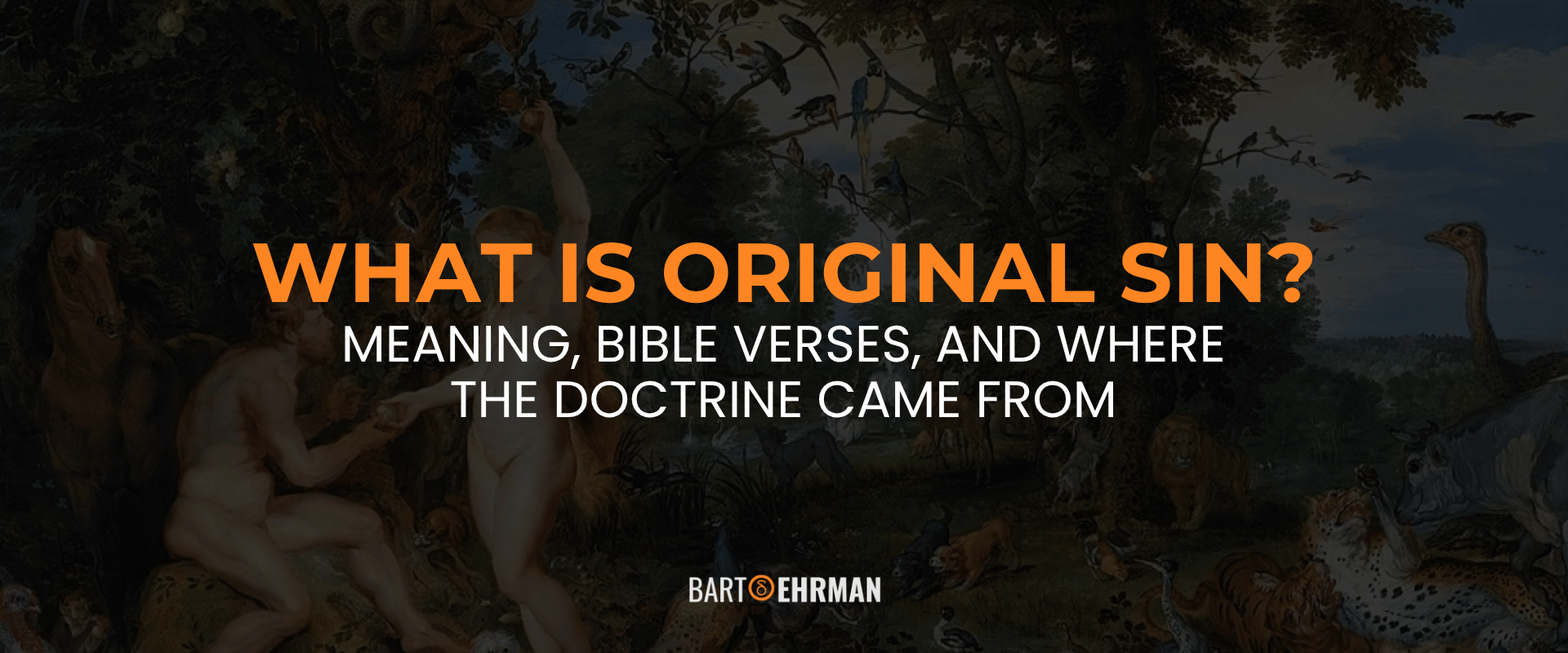
What Is Original Sin? Definition
Before we can look closely at the potential biblical foundations of this doctrine and its historical development, we should answer a more basic question: What exactly is the original sin meaning and its related doctrine?
Since Christianity today encompasses numerous traditions with sometimes significantly different theological formulations, the question can be made more precise: What is original sin in the Catholic tradition?
When discussing the basics of original sin, Catholic theology understands it as the condition into which humanity fell as a consequence of the first human transgression.
It’s not simply another term for an individual sinful act. Rather, it describes a condition shared by humanity in which the original relationship between human beings and God has been damaged, leaving human nature deprived of its original holiness and subject to suffering, death, and an inclination toward sin.
The Catholic theologian Karl Adam offered a particularly vivid explanation of this idea in his classic work The Spirit of Catholicism:
(Affiliate Disclaimer: We may earn commissions on products you purchase through this page at no additional cost to you. Thank you for supporting our site!)
The wretchedness of fallen humanity, the essence of the original sin, consisted in this, that the supernatural union with God, in which man was originally created, and through which alone he could attain his perfection, his wholeness, his completion, was by Adam’s fall broken and dissolved. When Adam fell away from God, all humanity in him and through him fell away likewise. That is a basic conviction of Christianity, which was adumbrated in certain post-canonical Jewish writings, and received formulation as a Christian doctrine especially at the hands of St. Paul. At the basis of this Christian dogma of an original and inherited sin, and of our redemption through the new man Christ, lies the great and striking thought that mankind must not be regarded as a mass of homogeneous beings successively emerging and passing away, nor merely as a sum of men bound together by unity of generation, as being descendants of one original parent, but as one single man.


Adam’s formulation emphasizes the solidarity of humanity. Namely, Adam’s fall is understood as an event with consequences for humanity considered as a whole.
The same connection between humanity’s fallen condition and the need for salvation appears in a more compressed form in the Catechism of the Catholic Church.
It declares the following:
The doctrine of original sin is, so to speak, the ‘reverse side’ of the Good News that Jesus is the Saviour of all men, that all need salvation and that salvation is offered to all through Christ. [T]he Church, which has the mind of Christ, knows very well that we cannot tamper with the revelation of original sin without undermining the mystery of Christ.
In other words, within Catholic theology the doctrine is inseparable from a larger account of salvation: understanding what has gone wrong with humanity provides the theological background for understanding why humanity requires redemption through Christ.
Protestant theologians have also developed influential accounts of original sin, though they have not always defined the doctrine in precisely the same terms.
One especially significant example is the Swiss Reformed theologian Karl Barth.
Barth’s approach is distinctive because he insists that sin cannot be understood properly in isolation from Christ. For him, Christian knowledge of human fallenness begins not with an abstract theory of human nature but with God’s revelation in Jesus Christ.
As he puts it in Church Dogmatics:
We maintain the simple thesis that only when we know Jesus Christ do we really know that man is the man of sin, and what sin is, and what it means for man . . . It is a matter of the knowledge of the one God who in His Word became flesh for us, and therefore of the knowledge of His truth in this one revelation, and therefore of the one indivisible knowledge of the Christian faith, the basis and subject of which is God in His atoning work and therefore God in Jesus Christ. The knowledge of human sin is enclosed in this knowledge. The knowledge of human sin is acquired in and with the acquiring of this knowledge: not anywhere else, not as separated from it in any respect or to any degree, but strictly and accurately and fully in it . . . knowledge of real sin takes place in the knowledge of Jesus Christ.
Barth’s point is that the reality and seriousness of human sin become fully intelligible only in light of Christ and God’s act of reconciliation.
He therefore places less emphasis on describing original sin as a quasi-biological substance or defect transmitted mechanically from Adam and more emphasis on humanity’s universal and concrete participation in a history of sin disclosed for what it truly is through Christ.
Catholic and Protestant theologians can therefore speak about original sin while emphasizing somewhat different aspects of the doctrine: the inherited condition of humanity, the consequences of Adam’s fall, the relationship between universal sinfulness and individual responsibility, and the connection between sin and salvation in Christ.
Establishing what Christians mean when they use the term today is therefore a necessary first step.
The next question is more historical and exegetical: does the Bible itself clearly teach the doctrine in these later forms, or did those formulations emerge through subsequent interpretation of biblical texts?
To answer that, we need to turn first to Genesis and then, more importantly, to Paul’s discussion of Adam, sin, and death in Romans 5.
Is Original Sin in the Bible? From Genesis to Paul
Since at the heart of the doctrine of original sin stands a particular story about Adam and Eve’s transgression, the best place to begin is with that account in the first book of the Pentateuch: the Book of Genesis.
Yet this immediately raises an important methodological question. Do Jews believe in original sin, and how might their early interpretations differ from current ones? When modern Christians read Genesis 2–3, they often approach the story through centuries of later theological interpretation and therefore assume that the text itself is describing what subsequently came to be called “the Fall.”
Bill T. Arnold cautions against precisely this assumption in his Commentary on Genesis:
Although philosophical and theological treatments routinely refer to this passage as ‘the fall’ of humankind, the Hebrew word for ‘fall’ (npl) is not used here. Nor is this concept used anywhere in Israel's Scriptures to relate this passage to humanity's fall from a state of grace infecting all subsequent humans. It was only in the traditions of later Judaism that the concept was first expressed, which was subsequently developed by the Apostle Paul, and especially by St. Augustine... We may think of Gen 3 simply as ‘the transgression,’ while acknowledging that most of our faith traditions embrace this text as the cornerstone for further theological reflection on the human condition.
If that is the case, how should we read Genesis 2 and 3 while respecting the historical and literary context of the stories found there?
The narrative certainly describes a dramatic transformation.
The humans disobey the divine prohibition concerning the Tree of the Knowledge of Good and Evil; their eyes are opened; they become conscious of their nakedness; God pronounces judgments involving pain, labor, and a changed relationship between humanity and the soil; and, finally, they are expelled from Eden so that they cannot eat from the Tree of Life and “live forever.”
But none of this amounts, in the text itself, to an explicit claim that Adam’s personal guilt was inherited by every subsequent human being. Nor does Genesis formulate a mechanism by which sin is transmitted from one generation to another.
Those are later theological questions asked of the story rather than propositions directly articulated by its narrator.
Ronald Hendel, in his Commentary, explains that the anthropology of Genesis 2–3 is considerably more complex than a simple movement from perfection to total corruption.
Humans are portrayed from the beginning as earthly creatures made from dust and therefore implicitly mortal, while their transgression produces both loss and gain: they are expelled from paradise into a world of labor, suffering, sexuality, shame, and mortality, yet they also acquire knowledge that makes them “like gods.”
The story thus functions as an account of the paradoxical human condition, suspended between animal mortality and godlike knowledge, and as a transition from innocence to self-conscious maturity rather than as an explicit doctrine of inherited guilt.
Significantly, Hendel also emphasizes that Genesis presents humans as mortal creatures from the outset and that exclusion from the Tree of Life prevents them from attaining immortality, rather than depicting death itself as a wholly new biological condition introduced only after the transgression.
The distinction becomes even clearer when we consider how the Eden story was interpreted after Genesis.
Later Jewish writings increasingly connected Adam’s transgression with the wider human condition. Hendel points, for example, to the Wisdom of Solomon, which connects the entrance of death into the world with “the envy of the devil,” and to 4 Ezra, where Adam is explicitly blamed for a misfortune that affected his descendants.
These texts show that interpretations linking Adam’s act to the fate of later humanity developed gradually within Jewish reflection rather than appearing in Genesis itself.
In conclusion, Hendel's words are worth citing fully:
Paul linked the idea of Adam’s sin with the redemption of sin through Jesus’s crucifixion and resurrection. In Paul’s theology, Christ atoned for ‘the transgression of Adam, who is a type of the one who was to come’ (Rom 5:14). He explains, ‘just as one man’s trespass led to condemnation for all, so one man’s act of righteousness leads to justification and life for all’ (Rom 5:18). The path from Adam to Christ leads from sin and death to their solution, salvation and eternal life. In these ways we can see how the Eden story became embroidered into Christian theology. The church father Augustine later elaborated Paul’s doctrine of original sin, introducing the idea that it is transmitted by sexual intercourse (specifically semen) and that the emotive power of sexuality is the consequence and bodily expression of sin. This melancholy interpretation of the Eden story is motivated by attitudes toward sexuality that are foreign to the anthropology of Genesis.
This brings us right to the doorstep of our next section: Paul’s influence and importance within the broader theological trajectory that only centuries later resulted in the emergence of the doctrine of original sin.

What is Original Sin in the Bible? Paul and Romans
The decisive New Testament passage for the later doctrine of original sin is Romans 5:12–21. Here, Paul writes that sin entered the world “through one man,” Adam, and that death entered through sin; he then contrasts Adam’s trespass and disobedience with Christ’s obedience and saving act.
By the end of the passage, the parallel has become explicit: through the trespass of one came condemnation, while through the righteous act of another came justification and life; through one man’s disobedience “many were made sinners,” while through the obedience of Christ “many will be made righteous.”
Yet the larger purpose of the passage shouldn’t be overlooked.
As Robert Jewett explains in his Commentary on Romans, Paul’s primary goal in Romans 5:12–21 isn’t to formulate a doctrine of Adam’s sin but to demonstrate the vastly greater power of divine grace.
The passage is organized around two contrasting realms: Adam stands at the head of a humanity dominated by sin, death, and condemnation, whereas Christ inaugurates a new realm characterized by grace, righteousness, and life.
The point of Paul’s comparison is ultimately Christological and soteriological: however destructive Adam’s transgression may have been, what God has accomplished through Christ is greater still.
To understand that argument properly, however, we should resist reducing Paul’s language about “sin” to a collection of individual immoral actions.
In Sin: The Early History of an Idea, Paula Fredriksen emphasizes the almost cosmic dimensions of Paul’s thinking.
Sin, death, and related forces can function as powers exercising dominion over human beings and even over creation itself.
Paul can therefore speak of Jews and Gentiles alike as being “under sin” and elsewhere describe creation itself as subjected to futility and decay.
Within this apocalyptic framework, Adam serves as what Fredriksen calls sin’s “passageway”: through his trespass sin and death enter the human world, whereas Christ becomes Adam’s counterpart, the figure through whom their dominion is finally overcome.
This is also why expressions sometimes loosely summarized as being “born in sin” need to be handled carefully.
Paul himself doesn’t use that phrase in Romans 5, nor does he offer a theory of newborn infants inheriting Adam’s personal guilt. His concern is broader: humanity exists within a world already ruled by Sin and Death, and every person also participates in that condition through actual sin.
Did You Know?
Original Sin Meets Modern Science
Did you know that original sin still sits at the center of some very modern debates about science and human origins? Traditional formulations often assumed that all humanity descended from a single first couple whose transgression changed the condition of the human race.
Evolutionary biology, however, describes human origins in terms of populations developing over long periods of time, which raises obvious questions: Was Adam a historical individual, a symbolic figure, or something in between? And if humans were never descended from only one original pair in the straightforward traditional sense, how should inherited sin be understood?
That is why original sin continues to shape conversations about evolution, human nature, free will, death, and what it means to be human.
Similarly, Joseph Fitzmyer, in his Commentary on Romans, warns against turning Paul’s words too quickly into the fully developed doctrine of original sin that emerged in later Western Christianity.
Paul certainly assigns Adam genuine causal significance. Fitzmyer stresses that it would distort Romans 5 to explain humanity’s condition solely by reference to individual acts of wrongdoing.
After all, throughout verses 15–19, Adam’s single transgression repeatedly has consequences for the “many,” culminating in the statement that through one man’s disobedience they “were made sinners.”
At the same time, Paul never explains how Adam’s action produces that condition, and he says nothing about hereditary transmission in the later Augustinian sense.
Particularly important is the notoriously difficult clause in Romans 5:12, eph’ hō pantes hēmarton. The traditional Latin rendering, in quo omnes peccaverunt, encouraged the interpretation “in whom all sinned,” that is, that humanity somehow sinned in Adam.
However, Fitzmyer argues that this shouldn’t simply be read back into Paul’s Greek. Indeed, he explicitly rejects expanding hēmarton into “all sinned in Adam.” For him, the verb refers to the actual sins of individual human beings.
Instead, Fitzmyer prefers to understand eph’ hō consecutively, approximately “with the result that all have sinned,” so that Adam’s transgression has primary causal significance while humanity’s own sins constitute a secondary, genuinely personal causality.
Romans 5 therefore takes us considerably further toward original-sin theology than Genesis does, but it still doesn’t give us the complete later doctrine.
Paul portrays Adam as the head of the old humanity, connects his transgression causally with the universal reign of sin and death, and places Christ at the head of a new humanity in which those powers are defeated.
But he doesn’t speak of an inherited sinful substance, explain a biological mechanism of transmission, or explicitly claim that every human being personally sinned inside Adam.
As Fitzmyer aptly cautions, Paul’s teaching may be regarded as “seminal” for later doctrinal development, but it doesn’t yet contain all the precision of subsequent Christian dogma.
If the fully developed doctrine is therefore found neither in Genesis itself nor completely within Paul’s own worldview, where and when did original sin as Christians later came to know actually emerge?
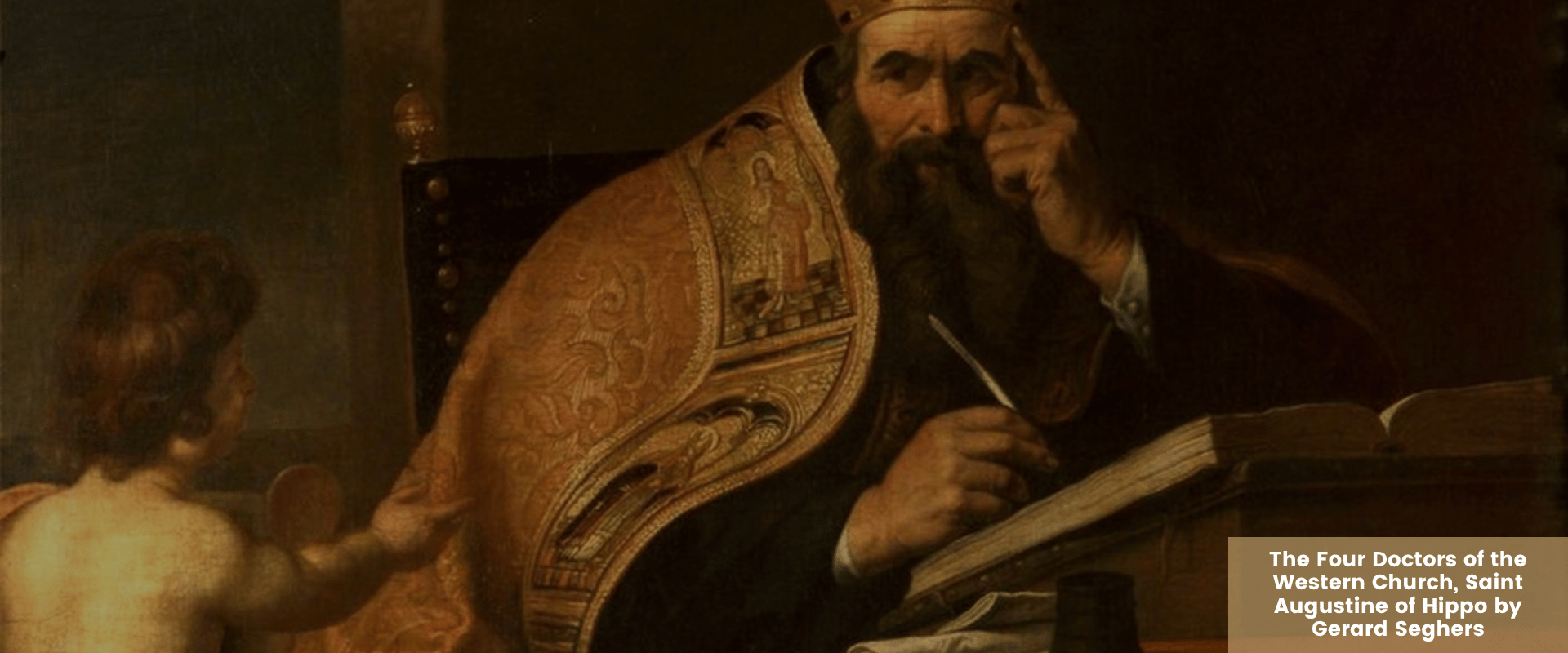
Who Created the Doctrine of Original Sin?
In his book Original Sin: A Cultural History, Alan Jacobs writes:
It is easy to imagine Augustine, still a relatively young man, sitting hour after hour in his episcopal study and poring over the letters of Paul. It is not likely that he ever relinquished the copy of the letter to the Romans that ushered him into the church; it is easy at least to imagine him clutching it as, in the last days of his life, the Vandals besieged Hippo. He assiduously studied the whole Bible, of course, and most of his recorded sermons were on the Gospels and Psalms, but one gets the sense that – having been brought into the faith by Paul’s incisive interpretation of his divided self – he forever after understood the whole of Christianity in a distinctively Pauline way.
Augustine’s Christianity was certainly deeply shaped by Paul, but the bishop of Hippo was far more than an interpreter of the apostle.
He became one of the most influential theologians in the history of Western Christianity. His sermons reveal an exceptionally gifted preacher, while his Confessions represented something strikingly innovative in ancient Christian literature.
How, then, should we understand his particular role in the development of the doctrine of original sin?
The first point to emphasize is that Augustine didn’t create the doctrine out of nothing. Christian thinkers before him already associated Adam’s transgression with humanity’s mortality and weakened condition, and ideas that would later become components of original-sin theology were especially well established in the Latin West.
Augustine also inherited an ecclesiastical practice that proved particularly important for his thinking: infant baptism. If infants had committed no personal sins (and Augustine explicitly acknowledged that they had not), why were they baptized for the forgiveness of sins?
His answer was that they must possess a sin that precedes any conscious choice. Indeed, he reasoned that if an infant could receive righteousness through Christ without personally choosing it, the infant could likewise become implicated in sin through Adam without having personally chosen that condition.
Augustine consequently developed a much stronger account of humanity’s relationship to Adam than merely saying that Adam set a bad example or introduced death into the world.
As Jesse Couenhoven explains in his article ”St. Augustine’s Doctrine of Original Sin”, the conceptual center of Augustine’s position is inherited sin.
Human beings descended from Adam are, in this view, born already implicated in the primal transgression and already possessing a damaged condition characterized by guilt, ignorance, and disordered desire.
Augustine understood this through a notion of human solidarity with Adam: humanity was somehow present in its progenitor, so that Adam’s act affected not merely himself but the human nature transmitted to his descendants.
This was more than a later legal theory in which Adam simply represented humanity before God. Namely, Augustine envisioned a deeper, even ontological, solidarity between Adam and the human race.
Needless to say, Paul’s letters were crucial to this development, particularly Romans 5. Augustine read Romans 5:12 through the Latin text available to him as saying that death spread to all people “in whom all have sinned,” and he understood the “whom” to refer to Adam: all humanity had therefore sinned in Adam.
As seen, contemporary scholars generally understand the underlying Greek differently, commonly translating the phrase along the lines of “because all sinned.”
Yet Augustine’s doctrine cannot simply be reduced to one disputed translation. He also appealed to 1 Corinthians 15:22 (“as in Adam all die”) and, more broadly, to Paul’s entire Adam vs. Christ contrast: just as humanity receives righteousness and life through Christ, Augustine reasoned, humanity’s sinful condition derives from Adam.
What Augustine added to earlier Christian reflections was therefore a particularly forceful synthesis: Adam’s transgression didn’t merely leave later humanity mortal or morally vulnerable; humans were born already sharing an inherited sinful condition and thus dependent upon divine grace even before committing any personal sins.
At the same time, Augustine’s theory was neither entirely unprecedented nor perfectly systematic.
Earlier Western Christians had already developed important elements of the doctrine, while Augustine himself never fully resolved how inherited sin was transmitted from Adam through successive generations.
Couenhoven therefore cautions against portraying him simply as the doctrine’s inventor. Instead, he concludes:
I am led to conclude, then, that while Augustine was the great systematizer, developer, and defender of the doctrine, he was not its inventor. He certainly pursued the doctrine more than any before him, and few since, and he pressed it into a form peculiar, in many ways, to himself – especially by his clear emphasis on inherited sin – but it did not originate with him.
Conclusion
What is original sin? While it is indeed probably one of the most important doctrines in the Christian tradition, it’s even more important to understand how that doctrine actually came into being.
Genesis 2–3 provides the foundational story of human transgression, but it does not yet articulate a theory of inherited guilt or explain how Adam’s sin might be transmitted to later generations.
Paul, especially in Romans 5, moves the discussion much further by placing Adam and Christ at the heads of two contrasting realms, connecting Adam with the reign of sin and death and Christ with grace, righteousness, and life.
Yet even Paul doesn’t offer the fully developed doctrine that later became so influential in Western Christianity.
That development took place gradually, through centuries of interpretation, and reached a particularly powerful synthesis in Augustine, who drew together Pauline theology, earlier Christian reflection, and the practice of infant baptism into a doctrine centered on humanity’s inherited sinful condition and its universal need for divine grace.
Augustine, therefore, wasn’t simply the “inventor” of original sin, but its most consequential early systematizer and defender.
Tracing this development reminds us that major Christian doctrines are often not born fully formed in a single biblical verse. Instead, they emerge through long and complex conversations between Scripture, interpretation, theological controversy, and changing understandings of what it means to be human.