
Did Thomas Go to India?

Written by Marko Marina, Ph.D.
Author | Historian
Author | Historian | BE Contributor
Verified! See our guidelines
Verified! See our editorial guidelines
Date written: June 27th, 2026
Disclaimer: The views and opinions expressed in this article belong to the author and do not necessarily match my own. - Dr. Bart D. Ehrman
Did Thomas go to India? Whenever this question comes up in my classroom, everyone seems to know immediately which Thomas we are talking about.
The New Testament and early Christian history contain many fascinating stories, but one of the most memorable is surely the tradition that St. Thomas, one among the 12 apostles of Jesus, who traveled far beyond the familiar world of the Gospels and proliferated the Christian message of Jesus in India.
It’s a powerful image: an apostle who first appears in the New Testament as hesitant, questioning, and uncertain becomes, in later Christian memory, a fearless missionary crossing cultural and geographical boundaries.
The figure remembered popularly as “Thomas the doubter” is transformed into Thomas the traveler, preacher, miracle-worker, and martyr.
But that transformation raises an important historical question. How much of this story can we actually know? The tradition of Thomas in India has played a major role in Christian imagination, especially among Christian denominations that trace their origins to his apostolic mission.
Yet historians have to distinguish between memory, legend, theology, and recoverable history. The question isn’t whether the story mattered (it certainly did, and still does) but whether the evidence allows us to say that Thomas himself really made such a journey.
To answer that, we need to begin with the much more modest portrait of Thomas found in the New Testament before turning to the text that did more than any other to send him, in Christian imagination, all the way to India.
But before we move into the New Testament portrayals of Thomas, let me briefly recommend Bart D. Ehrman’s eight-lecture course “Paul and Jesus: The Great Divide.”
In this course, Dr. Ehrman explores two of the most important figures in Christian history from a historical and scholarly perspective: Jesus of Nazareth and the apostle Paul. What did they have in common? Where did their messages overlap?
And where did Paul’s understanding of Christ, salvation, and the Law move in directions that Jesus himself may not have anticipated? For anyone interested in how historians study the origins of Christianity, this course is a fascinating guide to both continuity and difference at the very heart of the Christian tradition.
St. Thomas the Apostle: New Testament Evidence
The New Testament Gospels, contrary to a widespread impression, do not go into much detail about most of the disciples of Jesus. After all, they aren’t the focus of the story: Jesus’ life, death, and resurrection are.
The same applies in the case of St. Thomas. If we begin with the Synoptic Gospels, Thomas is hardly a developed character at all.
In the Bible, he appears in the lists of the Twelve, but he doesn’t speak, act, preach, travel, or receive individual narrative attention.
In Mark 3:18, Matthew 10:3, and Luke 6:15, he is simply one name among others. The same is true in Acts 1:13, where Thomas is again listed among the apostles after Jesus’ resurrection. He is not mentioned during the Sermon on the Mount or any other significant New Testament stories. From these sources alone, we would know almost nothing about him beyond that early Christians remembered him as one of the Twelve.
It’s only in the Gospel of John that Thomas emerges from this anonymity. John explicitly identifies him as “Thomas, called the Twin” (John 11:16; 20:24; 21:2), using the Greek equivalent Didymus.
Even here, however, Thomas isn’t presented as a missionary to India, a church founder, or a martyr. He appears instead as a literary and theological figure within John’s larger story about Jesus.
His first significant appearance comes in John 11, when Jesus decides to return to Judea after the death of Lazarus.
The disciples know that this journey may be dangerous, and Thomas says, “Let us also go, that we may die with him.”
The statement is striking. It shows loyalty, perhaps even courage, but also a certain misunderstanding. As Glenn Most observed in his book Doubting Thomas, Thomas’ willingness to die with Jesus appears precisely in a story about Jesus going not to die, but to raise the dead.
In John’s narrative, Thomas already stands close to Jesus, but he doesn’t yet grasp the meaning of Jesus’ power over death.
Thomas appears again in John 14, during Jesus’ farewell discourse. Jesus tells the disciples that he is going to prepare a place for them and that they know the way to his destination.
Thomas responds, “Lord, we do not know where you are going. How can we know the way?” This question gives Jesus the occasion for one of the Gospel’s most famous declarations: “I am the way, and the truth, and the life.”
Once again, Thomas’ role is not incidental. His inability to understand allows Jesus to clarify something central for John’s readers. Thomas asks the question that opens the way for revelation. He isn’t merely stubborn or skeptical.
Instead, he functions as the disciple whose incomprehension helps the Gospel articulate its theological message.
(Affiliate Disclaimer: We may earn commissions on products you purchase through this page at no additional cost to you. Thank you for supporting our site!)
Scholarly Insights
How Early Is the Acts of Thomas?
The Acts of Thomas is most often dated to the first half of the 3rd century, but the debate is more complicated than that formula suggests. Susan E. Myers has argued that the usual evidence for this dating is not conclusive: Origen may have known only an earlier Thomas tradition rather than the completed text; Roman names and terms do not securely date the work; and the relationship between the Acts of Thomas, Bardaisan, and Manichaeism (Bardaisan was an influential Syriac Christian thinker from Edessa, while Manichaeism was a later dualistic religious movement founded by Mani in the 3rd century) is difficult to establish with precision.
Myers therefore proposes that while some earlier stories may be older, the completed work probably belongs to the middle or second half of the 3rd century and may even have been shaped in part as a Christian response to Mani and Manichaean claims.
But the matter doesn’t end there. Lautaro Roig Lanzillotta agrees with Myers that the standard arguments for a first-half-of-the-3rd-century date aren’t decisive, but he reaches the opposite conclusion.
In his view, if those arguments fail, there is no compelling reason to separate the Acts of Thomas from the other major Apocryphal Acts of the Apostles, which are commonly placed in the second half of the 2nd century. The result is a striking scholarly disagreement: some place the work, or at least its final form, in the later 3rd century, while others now argue for a much earlier composition in the second half of the 2nd century.
So, in the end, I recommend going back to each theory and deciding for yourself. It’s always fun to weigh the evidence and arguments, especially when the evidence points in different directions and serious scholars draw sharply different conclusions from it.
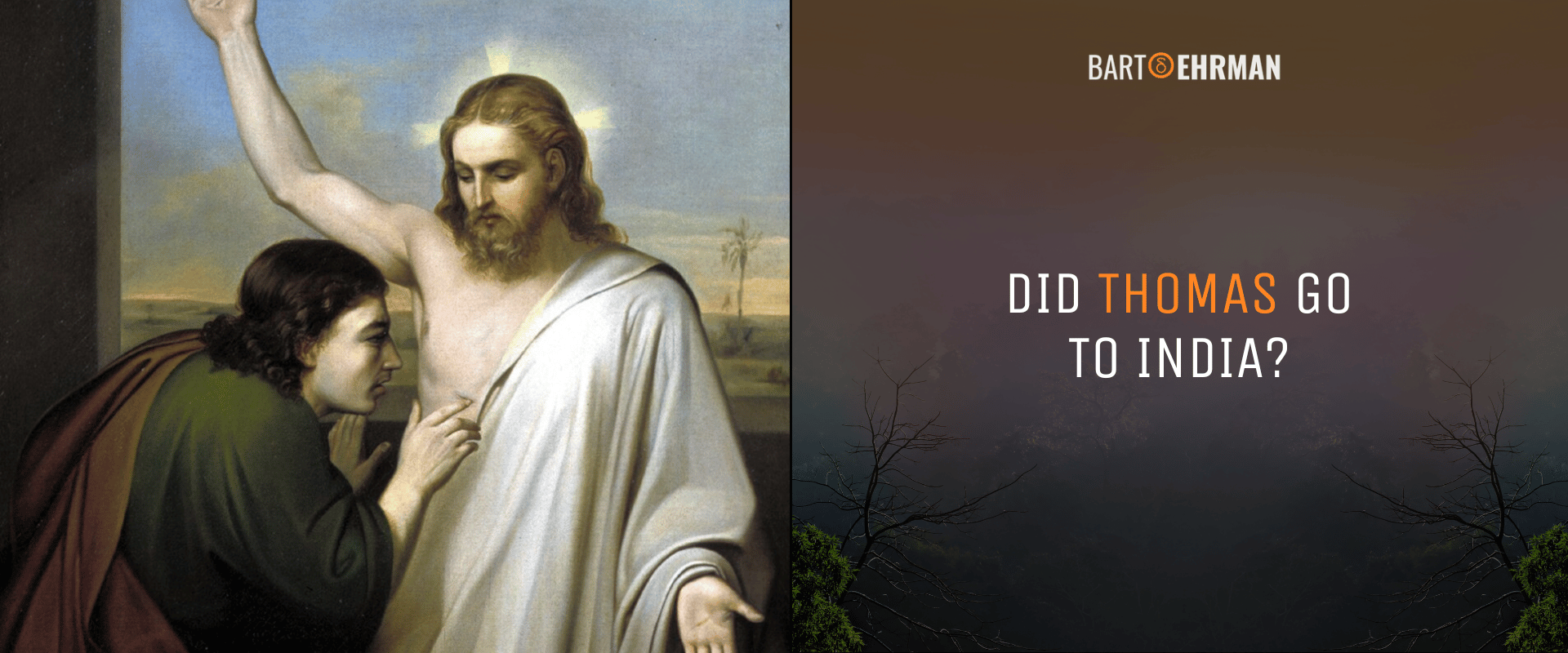
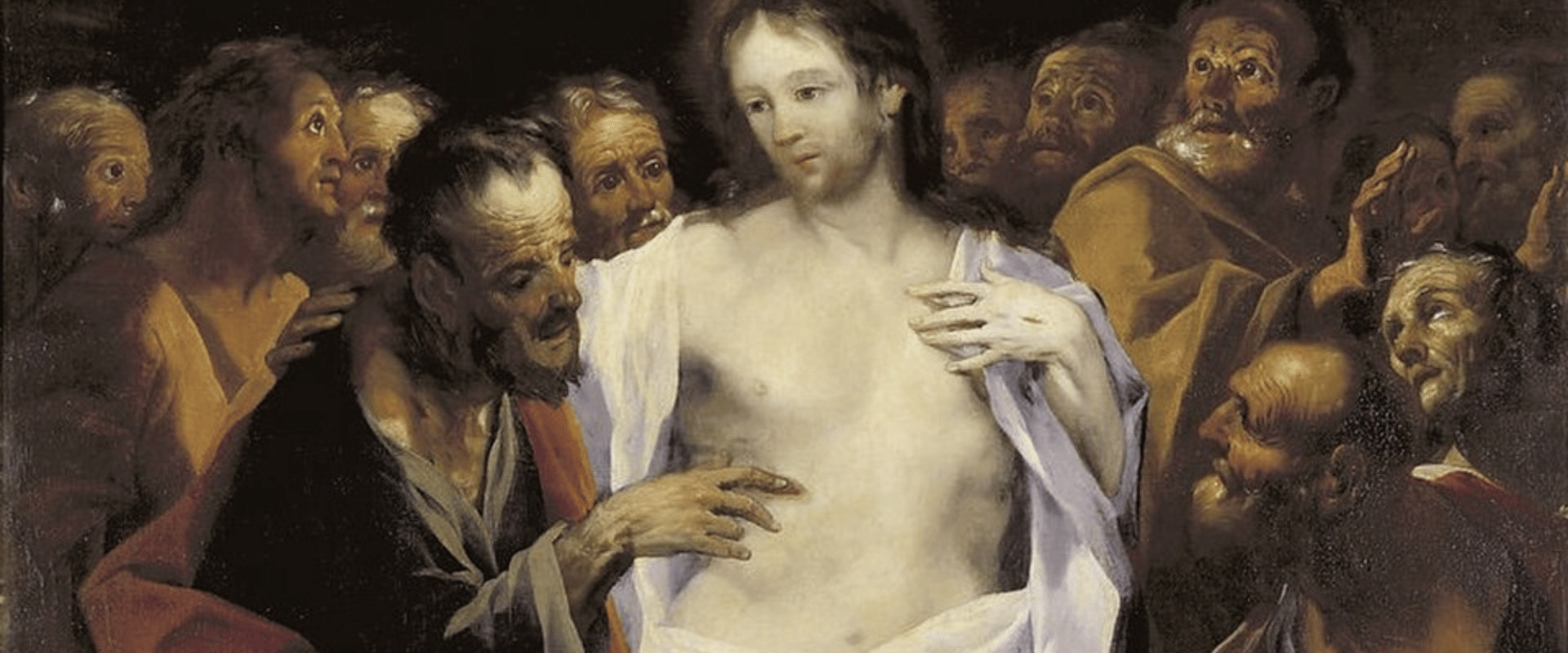
The best-known scene, of course, comes in John 20. Thomas is absent when the risen Jesus first appears to the disciples.
When they tell him, “We have seen the Lord,” Thomas refuses to accept their testimony unless he sees the marks of the nails and places his hand in Jesus’ side. This is the origin of the familiar phrase “Thomas the doubter,” though the label can be misleading.
In John’s Gospel, Thomas becomes the character through whom the Gospel dramatizes the relation between seeing, touching, hearing, and believing. When Jesus appears again and addresses Thomas directly, Thomas responds with the climactic confession, “My Lord and my God!”
Ironically, the disciple remembered for doubt utters one of the highest christological confessions in the entire New Testament.
Most also notes an important detail often missed by readers: John doesn’t actually say that Thomas touched Jesus’ wounds. The text says that Jesus invited him to do so, and that Thomas answered with his confession.
His belief comes from the encounter itself, especially Jesus’ words and presence, not necessarily from satisfying his earlier demand for physical proof.
This matters for our question, “Did Thomas go to India?”, because the Thomas of the New Testament isn’t yet the Thomas of later missionary legend.
In the Gospels, especially in John, he is a figure used to explore faith, doubt, resurrection, and recognition. Glenn Most rightly concludes:
John had assigned Thomas the function of closing off his text and guaranteeing, once and for all, our belief in a story whose credibility causes various kinds of difficulties for the synoptic Evangelists. John uses Thomas, who creates doubt, only so that this doubt may be given a name and finally abolished: once Thomas has been convinced, the text has completed its mission and should now be capable of being brought to a definitive, absolute close.


That is the Thomas we meet in the New Testament: not an apostle of India, but a carefully crafted witness to the resurrection.
To find Thomas who travels east, preaches in India, converts kings, performs miracles, and dies as a martyr, we have to leave the New Testament behind and enter the imaginative world of later apocryphal Christian literature.
Did Thomas Go to India: The Emergence of the Legend
The idea that Thomas went to India comes straight from a later story found in what scholars call the Acts of Thomas.
Rather than being a New Testament text, it’s one of the apocryphal apostolic acts: writings that expanded the careers of Jesus’ apostles beyond what the canonical books tell us. We'll begin with a short summary of the story and then focus on the crucial historical-critical questions.
Acts of Thomas: Summary
The story begins in Jerusalem, where the apostles divide the world by lot for their missionary work. India falls to Judas Thomas, also called Didymus.
Thomas, however, doesn’t want to go. He protests that he is physically weak and asks how he, “being a Hebrew,” can go among the Indians to proclaim the truth.
Jesus appears to him and tells him to go, but Thomas still resists. So Jesus takes a more dramatic approach: he appears to an Indian merchant named Abban who has come on behalf of King Gundaphorus to buy a skilled carpenter, and sells Thomas to him as a slave.
The bill of sale identifies Jesus as “son of the carpenter Joseph” and Thomas as his slave. In this strange and striking way, Thomas begins his journey to India.
Once Thomas arrives in the East, the story quickly reveals what kind of Christianity this text wants him to represent.
His first major episode takes place at a royal wedding in Andrapolis. Rather than blessing married life in any ordinary sense, Thomas becomes associated with sexual renunciation.
Jesus himself appears to the bride and groom in the form of Thomas and persuades them to refrain from intercourse, presenting ordinary marriage and procreation as spiritually dangerous and inferior to a heavenly marriage.
The king, understandably horrified by the disruption of his daughter’s wedding, searches for Thomas, but the apostle has already departed.
From there Thomas proceeds to the cities of India and comes before King Gundaphorus, who commissions him to build a royal palace.
Thomas receives the king’s money, but instead of constructing a visible palace, he distributes the funds to the poor. When the king later demands to see the building, Thomas explains that the palace has indeed been built, but in heaven, where the king will see it after death.
The rest of the Acts of Thomas continues in the same dramatic style. Thomas heals, exorcizes demons, raises the dead, preaches, baptizes converts, and repeatedly provokes the anger of powerful men, especially when elite women respond to his message of renunciation.
The text includes a series of episodes involving serpents, speaking animals, demonic possession, visions of hell, imprisonment, hymns, baptisms, and conversions. It also includes the famous Hymn of the Pearl, sung while Thomas is in prison.
Did Thomas have a wife in the Bible? The idea probably comes mainly from The Chosen, where Thomas has a romantic relationship with Ramah, who is presented as his partner or wife-to-be. That is a dramatic invention of the show, not something stated in the New Testament. To put it bluntly, there is absolutely no mention of Thomas' wife anywhere in the Bible.
Finally, Thomas gets put to death by execution under King Misdaeus or Mazdai, and the story ends by presenting him as a martyr in India.
In other words, the Acts of Thomas gives us the full legendary arc that the New Testament never provides: Thomas the reluctant apostle becomes Thomas the missionary to India, miracle-worker, ascetic teacher, founder of communities, and martyr.
So, do we believe that Thomas really went to India? How do historians approach this document and the narrative it contains?

Did Thomas Go to India? A Scholarly Look at the Evidence
The first thing to note is that the Acts of Thomas isn’t a 1st-century source. As Johnson Thomaskutty, in his book Saint Thomas the Apostle: New Testament, Apocrypha, and Historical Traditions, notes, the work is usually (See: Scholarly Insights Box!) regarded as an early 3rd-century composition, often dated around 200–250 C.E.
It was known by the 4th century, since Epiphanius of Salamis refers to it, and it survives especially in Syriac and Greek forms, along with later versions in other languages.
Thomaskutty also emphasizes that the text belongs to the wider world of apocryphal apostolic acts. Like the Acts of Peter, Acts of Paul, Acts of Andrew, and Acts of John, it combines missionary adventure, theological instruction, miracle stories, prayers, hymns, speeches, and martyrdom narrative.
It’s therefore not best approached as a neutral biography, much less as a travel diary written by someone who accompanied Thomas. It’s a theological and literary narrative produced generations after the apostle would have lived.
That, of course, doesn’t mean the text is historically worthless. Thomaskutty is right to point out that the Acts of Thomas contains side details that have invited historical discussion, especially the figure of King Gundaphorus or Gondophares.
The existence of an Indo-Parthian ruler by that name is supported by coins and inscriptions, and that fact has often been used by defenders of the tradition to argue that the story may preserve some historical memory.
The text also repeatedly places Thomas in “India,” and later Syriac and ecclesiastical traditions connect Thomas’ mission and martyrdom with India and Edessa.
Thomaskutty’s own approach is relatively open to the possibility that historical kernels are embedded in the narrative. He acknowledges legendary and fictional elements, but resists treating the whole work as pure invention.
This is an important nuance: the question “Did Thomas go to India?” cannot be answered simply by saying that the Acts of Thomas is late and legendary, as if that automatically proves that every element in the narrative itself is false or made up.
Still, from a critical-historical perspective, there are serious reasons for caution. The work is too late to function as direct evidence for Thomas’ actual movements after Jesus’ death.
Its genre isn’t objective, historical reporting we can treat as proof, but apocryphal apostolic romance, filled with stylized episodes, symbolic geography, miraculous interventions, and theological agendas.
Moreover, its asceticism is especially important. The Thomas of this text isn’t merely a missionary; he is a radical ascetic who discourages sexual relations even within marriage, promotes purity and renunciation, and repeatedly destabilizes households by persuading women and couples to abandon ordinary marital expectations.
Some ancient Christian writers already viewed the text suspiciously because of its Encratite or Manichaean associations.
That mattered because both Encratite and Manichaean forms of Christianity were associated, in different ways, with a much more radical rejection of marriage, sexual intercourse, and ordinary embodied life than most emerging “orthodox” Christian authorities were willing to accept. Namely, Encratites promoted strict sexual renunciation, while Manichaeans developed a wider dualistic worldview in which the material body and procreation were often viewed negatively.
For later church authorities, therefore, the Acts of Thomas could appear as a text that promoted suspect forms of asceticism and theology. Later versions were accordingly altered or ‘catholicized’ to make them more acceptable.
But that tells us something crucial: the Acts of Thomas reflects the religious debates, ascetic ideals, and literary imagination of the post-apostolic Syriac Christianity more than the socio-cultural world of the time when St. Thomas lived.
This is why J. K. Elliott’s judgment is especially useful. He writes:
The consensus of modern scholarly opinion is sceptical about the historicity of the Thomas story, and in any case the local references are perfunctory. As is usual in this type of literature the eponymous hero and the milieu of the separate episodes are colourless and stylized. It is not impossible that at the time of the original composition of the Acts, Christianity had been established in India. The convention that apostolic activity was behind the establishment of a new Christian community encouraged the church in Edessa to magnify its own involvement in such a development by giving prominence to the pioneering work of Thomas.
That is probably the safest historical conclusion. The Acts of Thomas may preserve echoes of real eastern Christian expansion, trade connections, Indo-Parthian geography, and the later importance of Thomas traditions in Edessa and India.
But it doesn’t allow us to say that Thomas himself actually traveled to India, preached there, and died there exactly as the story describes.
So, did Thomas go to India? Historically speaking, the answer has to remain extremely cautious. The tradition is ancient, meaningful, and deeply important, especially for communities that came to identify themselves with Thomas’ apostolic mission.
But the earliest detailed story of that mission comes from a 3rd-century apocryphal text whose narrative is deeply shaped by legend, ascetic theology, missionary romance, and community memory.
The historian’s task is therefore not to mock the tradition, but to classify the evidence properly. The Acts of Thomas is invaluable for understanding how some early Christians imagined Thomas, India, mission, sanctity, and apostolic authority.
It can’t be used as a serious source for reconstructing what the apostle Thomas himself actually did after the death of Jesus.
Conclusion
So, the next time a student asks me, “Did Thomas go to India?”, I will probably answer: “In theory, anything is possible, but we don’t have any serious evidence for that claim.”
The New Testament gives us a Thomas who asks questions, struggles to understand, and finally confesses the risen Jesus as “My Lord and my God.” It doesn’t give us Thomas the missionary to India.
That figure emerges most fully in the Acts of Thomas, a fascinating apocryphal text that may preserve echoes of real eastern Christian expansion, but whose narrative is shaped by legend, theology, ascetic ideals, and community memory.
Thomas’ journey to India cannot be established as a secure historical fact, but neither should the tradition be dismissed as meaningless. It became a powerful story through which later Christians, especially in India and the Syriac-speaking East, imagined their place in the apostolic past.
The Thomas who went to India may remain elusive as a figure of history, but he became extraordinarily real as a figure of Christian collective memory.