
Why Was Enoch Removed from the Bible?

Written by Joshua Schachterle, Ph.D
Author | Professor | Scholar
Author | Professor | BE Contributor
Verified! See our editorial guidelines
Verified! See our guidelines
Date written: June 11th, 2026
Disclaimer: The views and opinions expressed in this article belong to the author and do not necessarily match my own. - Dr. Bart D. Ehrman
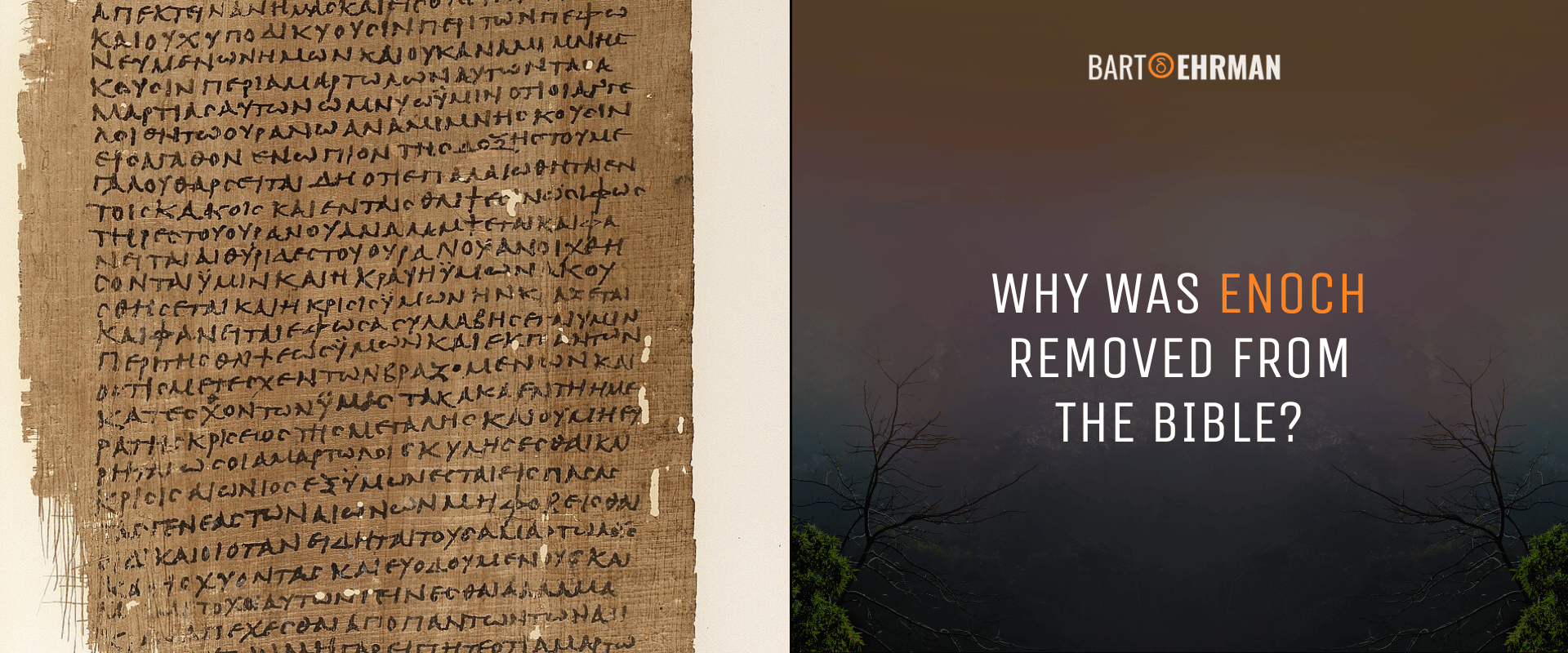
The Book of Enoch has attracted scholarly and popular attention for many years. It presents itself as the revelations of an enigmatic Old Testament patriarch about which very little is known. Is it in the Bible? Despite its influence on Jewish thought and its preservation among ancient Jewish and Christian communities, the Book of Enoch is conspicuously absent from almost all biblical canons. Why was Enoch removed from the Bible? Why stay away from this book? It was a book many early Christians read so why not in the Bible?
In this article, I’ll look into the historical development of the Book of Enoch, its reception within ancient Judaism and Christianity, and the reasons why it was ultimately excluded from most biblical canons.
Who Was Enoch in the Bible?
We initially encounter Enoch very briefly in Genesis 5. Although he is mentioned in a few other books (1 Chron 1:3, Luke 3:37, Heb 11:5–6, Jude 1:14–15), all of them merely refer to the sparse information about him in a Genesis 5 genealogy, where, beginning with Adam and ending with Noah and his sons, Enoch is listed as the seventh generation in Adam’s line and the son of a man named Jared. It says that he had a son named Methuselah and lived a total of 365 years. Beyond that information, we read this:
Enoch walked with God; then he was no more, because God took him (Gen 5:24).


This rather vague description of what happened to Enoch would spawn centuries of speculative writing about him. Why? As we’ll see, the brevity of the reference to Enoch in Genesis only added to its mystery and allure for future generations of Jewish authors.
What Is the Book of Enoch?
The Book of Enoch—also known as 1 Enoch since there are two others—is an apocalyptic Jewish text in which Enoch narrates his travels and divine revelations (the word “apocalypse” comes from the Greek meaning “revelation” or “disclosure”). Who wrote the book of Enoch and when was it written before the Bible? According to George W. E. Nickelsburg, the book was written in sections between the 3rd and 1st centuries BCE by multiple anonymous authors. This places its authorship in the intertestamental period, between the writings of the Hebrew Bible and the New Testament. Is it mentioned in the Bible? We'll explore that soon.
(Affiliate Disclaimer: We may earn commissions on products you purchase through this page at no additional cost to you. Thank you for supporting our site!)
The book is divided into five separate sections: “The Book of Watchers, ” “Parables of Enoch, “Astronomical Book,” “Dream Visions,” and “Epistle of Enoch.” Each section seems to have a different author. I’ll briefly summarize each section below and give you some facts about them.
“The Book of Watchers” tells of 200 angels, the Watchers, who descended to Earth at Mount Hermon, lusted after human women and sired children with them. These half-angel, half-human children are called the Nephilim and described as ferocious giants (see this reference in Genesis 6:1–4).
Meanwhile, the Watchers corrupt humans by teaching them illicit knowledge, including metallurgy for making lethal weapons, astrology, cosmetics, and magic. At the same time, their children, the Nephilim, turn violent and begin to attack humanity.
In response, God sends his archangels to stop the Watchers. The archangels capture the Watchers and imprison them under the earth. Meanwhile, the Nephilim destroy each other. Enoch, the ancestor of Noah, is then chosen to be an intercessor between the fallen angels and God, who later rejects the Watchers’ pleas for mercy. At the end of the book, Enoch is taken on several otherworldly voyages, visiting heaven and seing the resting places of both good and the evil souls.
“The Parables of Enoch” (also known as the “Similitudes”) is a series of three parables. Parable 1 shows the final judgment, in which upright people are rewarded, while mighty rulers are judged for persecuting the just. Parable 2 introduces the "Son of Man" who sits on a throne of glory to judge the Watchers, evil rulers, and other oppressors. Parable 3 shows how righteous people are rewarded, as well as the resurrection of the dead. It includes visions of heaven, and the final resting place of souls.
“The Astronomical Book” or “Book of the Heavenly Luminaries” reveals the arcane knowledge an angel named Uriel presents to Enoch about the physical workings of the universe. It explains the movements of the sun, moon, and stars as they rise and set through twelve celestial "doorways." It also explains variations in the duration of days and the four winds. Uriel stresses that the stars follow divine laws that, like God, never change.
“The Dream Visions” are two divine revelations given to Enoch about God’s judgment and history. The first vision shows what will happen when the world is destroyed: the sky falls, trees are uprooted, and mountains crash into each other. This is followed by a call for repentance, explained by Mahalalel, Enoch’s grandfather. The second vision, known as the “Animal Apocalypse,” tells the history of the world using a complicated allegory where different people groups are represented as animals. For instance, the early Patriarchs are bulls, the Israelites are sheep, and the Israelites’ enemies are savage beasts or birds of prey.
Finally, the “Epistle of Enoch”, which is not exactly a letter but merely a series of exhortations to future generations of those faithful to God, emphasizes living morally and remembering the prophetic insights of the previous four books. Enoch tells his descendants to live righteously and reject the wickedness which ushered in the fall of the unrighteous angels and the flood, hinting that a similarly dire consequence could result from future sinful behavior.
Why Was Enoch Removed from the Bible in Judaism?
Since the Book of Enoch was a book of Jewish apocalypticism written originally in Hebrew and Aramaic, let’s begin with some Jewish history. While the book was written over the course of several centuries, as I noted above, its composition can be broadly placed within the Second Temple Period of Judaism (516 BCE to 70 CE). In fact, fragments of the Book of Enoch were found among the Dead Sea Scrolls, showing that it was in use, and possibly even considered Scripture, by the Essenes, a Jewish separatist group who often castigated mainstream Jewish religion for its lack of rigor.
If this is true, then the Book of Enoch might even have helped shape Second Temple Judaism. In fact, in the Oxford Handbook of Biblical Studies, Philip Davies writes that some scholars have proposed that there was an “Enochic Judaism” in this period, in which we can see
a myth of fallen angels as the origin of evil, a ‘solar’ calendar of 364 days, not of twelve lunar months… a tradition of a final judgement of all creation, and an interest in the names, identity, and function of numerous heavenly beings. In particular, ‘Enochic Judaism’ espouses a pessimistic view of Israel’s history, one of almost continuous evil and rebellion, from which only the elect will be released at the end of time.
Keep in mind, though, that this form of Judaism, perhaps represented by the Qumran community, was vehemently opposed to the mainstream Jewish religious authorities, which it viewed as insufficiently scrupulous. This might explain why the Book of Enoch was never made an official part of the Hebrew Bible canon.
In her book Fallen Angels and the History of Judaism and Christianity, Annette Yoshiko Reed writes that early rabbis after the Second Temple Period generally did not accept the validity or authority of the Book of Enoch:
If there were, in fact, Rabbinic polemics against Enochic texts and traditions, they seem to have met with a surprising degree of success. It seems plausible, moreover, that such polemics might have led to the loss of these “outside books” to Rabbinic Judaism. And, however we explain the patterns in our evidence, it remains that the Enochic myth of angelic descent was divorced from the interpretation of Gen 6:1–4 in classical Rabbinic Judaism, just as the exegesis of Gen 5:21–24 that undergirds the authority of Enochic literature was invalidated.
For this reason, the Jewish biblical canon, which was probably finalized by the 2nd century CE at the latest, excluded the Book of Enoch. This would ultimately affect the Christian view of the book as well. Despite this eventual exclusion, Gershom Scholem wrote that the traditions represented in the Book of Enoch contributed greatly to the Jewish spiritual movement known as Merkabah mysticism in the 1st century CE.
So, why was Enoch removed from the Bible in Judaism? It wasn’t. Instead, although it was certainly read by many, it was never actually included in the canon in the first place.
DID PAUL AND JESUS HAVE THE SAME RELIGION?
Jesus taught a message of repentance to prepare for the Kingdom of God while Paul taught faith in Jesus. Did they agree? Should they be considered the “co-founders” of Christianity?
Why Was Enoch Removed from the Bible in Christianity?
In the New Testament, there is a direct quote from the Book of Watchers in Jude 1:14–15:
It was also about these that Enoch, in the seventh generation from Adam, prophesied, saying, “See, the Lord is coming with ten thousands of his holy ones, to execute judgment on all and to convict all the ungodly of all the deeds of ungodliness that they have committed in such an ungodly way and of all the harsh things that ungodly sinners have spoken against him.”
In The Old Testament Pseudepigrapha, translator Ephraim Isaac notes that 1 Enoch influenced “New Testament doctrines about the Messiah, the Son of Man, the messianic kingdom, demonology, the resurrection, and eschatology.” In addition, he writes that
1 Enoch played a significant role in the early Church; it was used by the authors of the Epistle of Barnabas, the Apocalypse of Peter, and a number of apologetic works. Many Church Fathers, including Justin Martyr, Irenaeus, Origen, and Clement of Alexandria, either knew 1 Enoch or were inspired by it. Among those who were familiar with 1 Enoch, Tertullian had an exceptionally high regard for it.
Given this star-studded cast of early Christian luminaries who found the book useful, why was it ultimately left out of the Christian biblical canon?
In the third century, Origen of Alexandria, as he’s quoting from the book of Enoch, adds the qualifier “if anyone cares to accept that book as sacred.” This probably demonstrates that the tide was already turning against 1 Enoch in Christian circles in his time. In the 4th century, when the canon was beginning to be finalized, no less an authority than Augustine of Hippo dismissed the book as an “apocryphal fable” in his massive book The City of God. He also wrote that the story of angels procreating with human beings could not be true and therefore reinterpreted the passage from Genesis 6 to avoid that interpretation.
While Augustine admitted that Jude had characterized Enoch as a prophet, he argued for the Book of Enoch’s exclusion from the Bible for two reasons. First, he found its authenticity doubtful, given how long ago Enoch must have lived; in other words, he didn’t believe it was actually written by Enoch. Second, he believed it contained “many false statements” that contradicted the Old Testament books already accepted as canonical by Christians.
In addition, since early Christian Old Testament canons were based almost entirely on the Hebrew Bible’s canon, the fact that the book was not found in any early Hebrew Bible collections argued against its inclusion in the Christian Bible.
So, why was Enoch removed from the Bible in Christianity? It wasn’t. Although it was certainly read by many early Christians, it was never actually included in the canon in the first place. This is true for the Catholic Bible and almost all others as well. Is it a sin to read the Book of Enoch? In most Christian traditions, it is not a sin, although they emphasize that it is not as reliable a source of wisdom as the canonical Scriptures.
Except, that is, in the Ethiopian Bible.
Was Enoch Removed from the Bible in Ethiopian Christianity?
The most complete manuscripts of the Book of Enoch are in Geʽez, a South Semitic language that originated in what is now Ethiopia and Eritrea. While Ge’ez is no longer the vernacular language of those countries, it remains the liturgical language of the Ethiopian Orthodox church. Additionally, while no other Christian church in the world ultimately accepted the Book of Enoch as canonical, the Ethiopian Orthodox Tewahedo Church and the Eritrean Orthodox Tewahedo Church include the book in their Bibles. Why? Well, there are a few different reasons.
First, Ethiopia adopted Christianity widely in the 4th century. At that time, books such as the Book of Enoch were still circulating in wider Christian circles. However, since it was far from major Christian centers such as Alexandria, Egypt, the Ethiopian church developed its canon in relative isolation, thus retaining many "apocryphal" or deuterocanonical works, which other churches would exclude. Besides the Book of Enoch, for instance, the Ethiopian canon includes the Book of Joshua, the son of Sirac, and The Book of Joseph, the son of Bengorion, two books not found in any other biblical canons.
Second, the Ethiopian and Eritrean churches feel the book’s inclusion is validated by Jude’s use of it. Since Jude, a canonical book, directly quotes 1 Enoch and even treats Enoch as a prophet, the book’s legitimacy was validated in the Ethiopian church tradition.
Finally, since the only complete version of 1 Enoch is preserved in Ge'ez, the Ethiopian and Eritrean church considers this the authentic, original language of the text (although scholars argue that it was written first in Hebrew and Aramaic, based on examples from the Dead Sea Scrolls). In other words, they believe the Book of Enoch was originally written in their language and is thus an integral part of their Christian identity.
So, was Enoch removed from the Bible in Ethiopian and Eritrean Christianity? No, because it has always been part of their biblical canon and remains so to this day.

Conclusion
The Book of Enoch was a Jewish apocalyptic text containing interpretations and elaborations of short passages from Genesis, as well as wild, cosmic visions of eternity. Written between the 3rd and 1st centuries BCE, the book was popular among some Jews during the Second Temple Period. However, its canonical status appears to have been a non-starter for most Jewish and Christian traditions. What is wrong with it in the eyes of those who opposed it?
While the Qumran community clearly revered at least some parts of the text, later, more mainstream rabbinic authorities would all but erase the book, never affirming its status among the Hebrew Scriptures.
Early Christians, on the other hand, seemed to revere the book, as evidenced by its citation in the canonical book of Jude and references to it by early Church fathers such as Tertullian and Justin Martyr. However, by the 4th century when the borders of the Christian canon began to harden, influential Christians, such as Augustine of Hippo, had rejected the book, deciding that it was likely not written by Enoch himself and finding too many instances in which it contradicted other Old Testament books.
The only exception to this is found in the Ethiopian church where the book remains a part of their biblical canon. Perhaps because it was preserved so completely in the ancient Ethiopian language or perhaps because Ethiopian Christianity was allowed to develop without the heavy hand of other Church authorities around the world, the Book of Enoch, along with other books that most Christian Bibles leave out, was included in their canon.
NOW AVAILABLE!
In The Beginning™ - History, Legend, & Myth in Genesis
In Part One of Bart's new "How Scholars Read the Bible" Series, dive into the stories of the first book of the Bible from a historical perspective.