
Book of Jubilees: Authorship, Dating, and Summary

Written by Joshua Schachterle, Ph.D
Author | Professor | Scholar
Author | Professor | BE Contributor
Verified! See our editorial guidelines
Verified! See our guidelines
Date written: March 15th, 2026
Disclaimer: The views and opinions expressed in this article belong to the author and do not necessarily match my own. - Dr. Bart D. Ehrman
What is the Book of Jubilees—and why did some ancient Jews treat it as sacred Scripture while most sects of Judaism eventually left it out of the Hebrew Bible? Modern readers often assume that the boundaries of the biblical canon were always fixed. But until the late 1st or early 2nd centuries CE, Jewish communities were still debating, expanding, and reinterpreting their sacred texts. It was in this dynamic world that the Book of Jubilees emerged.
In this article, I’ll examine the Book of Jubilees, stepping into the rich and contested world of Second Temple Judaism—a world in which Scripture was not only being preserved, but actively rewritten in the service of theology, identity, and communal boundaries.
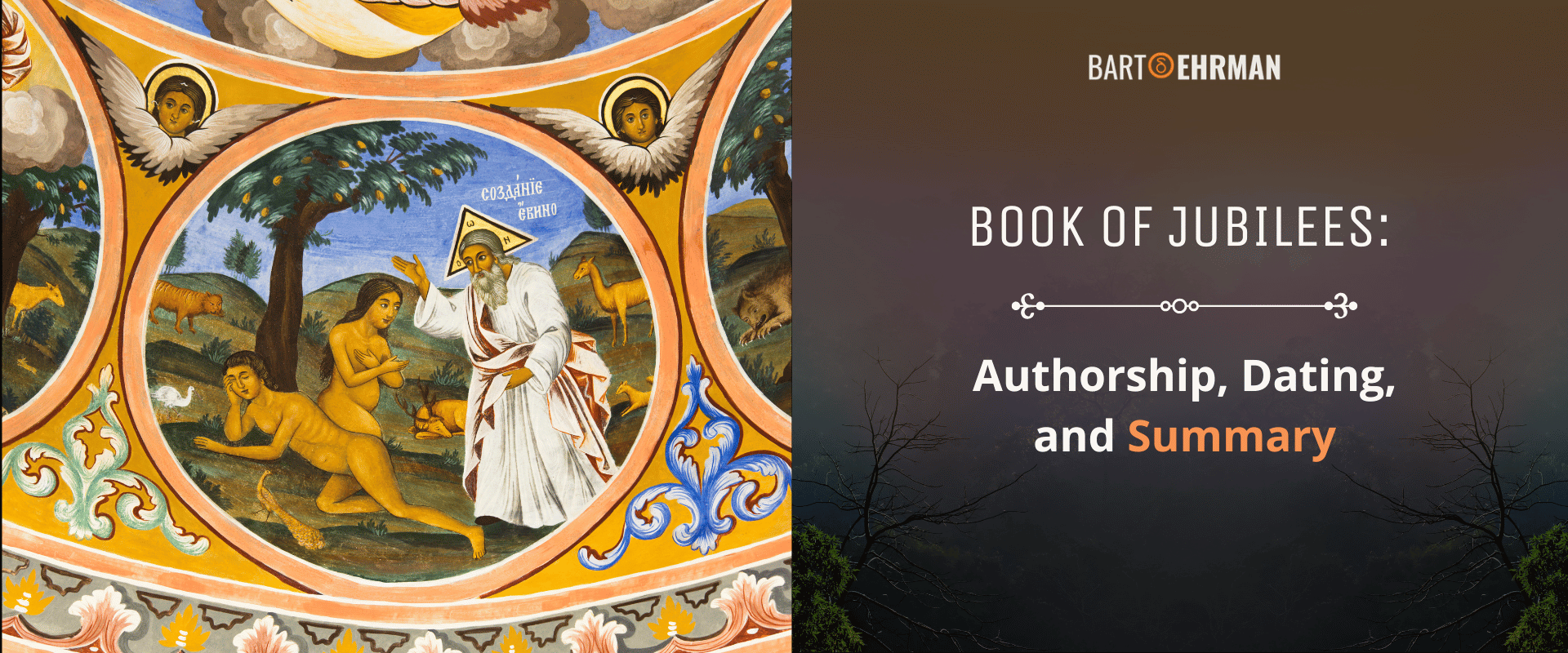
What Is the Book of Jubilees?
In his book Scripture and Tradition in Judaism, Geza Vermes noted that the Book of Jubilees belongs to a category he called “the Rewritten Bible.” This is a category of ancient Jewish texts that retell biblical stories—principally those from the Hebrew Bible—to add details and make them more relatable to readers of later generations. Other examples in this category include canonical books such as 1 and 2 Chronicles, which retell the stories from the books of Samuel and Kings, and the Genesis Apocryphon, which retells and expands on the stories of Abraham and Noah.
Beyond merely reaching out to different audiences, though, the whole point of this category of Jewish literature was to emphasize things not highlighted in the original books. The Book of Jubilees is a great example of this, as it expands upon the books of Genesis and Exodus.
Interestingly, it is not considered canonical by any form of mainstream Judaism and is only part of the biblical canon for the Ethiopian Orthodox Tewahedo Church, the Eritrean Orthodox Tewahedo Church, and Haymanot Judaism (Ethiopian Jews). I’ll explain the connection to Ethiopia and Eritrea as we get into the book’s history.
(Affiliate Disclaimer: We may earn commissions on products you purchase through this page at no additional cost to you. Thank you for supporting our site!)
History of the Jubilees Book
We know that early Christians were aware of Jubilees. Such renowned Christian authors as Justin Martyr, Origen of Alexandria, and Epiphanius of Salamis used quotations from the book in their own writings. Since these early Christians all wrote in Greek, it must be assumed that there was a Greek version of the text, although the original was presumed to have been written in Hebrew. For many years, however, the only manuscripts of Jubilees were written in the ancient Ethiopian language known as Ge’ez and came from the 15th and 16th centuries CE.
However, when the Dead Sea Scrolls were discovered in the mid 20th century, there were 15 fragmentary copies of the Book of Jubilees found among them. According to James C. VanderKam, the book seems to have been highly respected and significant for the Essenes, the group presumed to have lived in the Qumran community where the Dead Sea Scrolls were found. VanderKam writes that
For the Dead Sea Scroll sectarians, Jubilees was apparently canonical or biblical, although they would not have used those terms. These copies have shown, as was long thought, that the book was composed by a Jew in Hebrew, since that is the language of all the copies found in the Dead Sea Scroll caves.


When Was the Book of Jubilees Written?
In his analytical guide to the Book of Jubilees, James VanderKam writes that the earliest scholarly analyses speculated that it was an early Christian book written in the 1st-century CE.
Various arguments were marshaled to buttress the position, including the idea that the stringent legal teachings of Jubilees were directed against the Pauline doctrine of justification by faith. It did not take long, however, for scholars to realise that the book was pre-Christian in date and that its teachings could not be classified as reactions to New Testament positions. Now, with the advent of the Hebrew copies from Qumran, more secure evidence has demonstrated this point beyond reasonable doubt.
So if the Book of Jubilees was written before the advent of Christianity, when was it written? As always, with ancient literature, determining a precise date is all but impossible. However, the Hebrew copies found at Qumran have definitely helped. The oldest of them has been dated to 125–100 BCE, so the original book must have preceded that date.
VanderKam points out that in addition to this information, the other way to date an ancient text like Jubilees is to see when other ancient documents refer to it. In this case, a reference to Jubilees was made in the fragmentary Hebrew text known as the Damascus Document, which was dated around 100 BCE. Combining these two pieces of evidence, the book of Jubilees must have been written before 100 BCE.
How late could it have been written? There are several possible indicators of this, but VanderKam says that one piece of evidence carries more weight than the others:
In the paragraph about Enoch (4.16–25) he [the author] summarises or alludes to several compositions by Enoch. His words do seem to indicate in several places (e.g. 4.19) that he knows the Enochian “Book of Dreams’(1 En. 83–90)—an apocalyptic work written a short time after 164 BCE.
It is therefore safe to conclude that the Book of Jubilees was written between 164 BCE and 100 BCE.
NOW AVAILABLE!
Finding Moses: What Scholars Know About The Exodus & The Jewish Law
Riveting and controversial, the "FINDING MOSES" lecture series takes you on a deep dive into the stories of Moses, the exodus, and a whole lot more...
Who Wrote the Book of Jubilees?
Unfortunately, the author of the Book of Jubilees followed the well-trodden path of ancient anonymous authors writing on sacred topics. Nevertheless, we do know that the book was written by a Jewish author, since it was written in Hebrew.
The earliest scholarly theories said that the book was written by a Pharisee. This opinion was based on the content of the book, which focuses heavily on strict adherence to the Torah and keeping the sacred festivals (more on this later). However, since Hebrew copies were found at Qumran among the Dead Sea Scrolls, scholarly opinion now leans towards the conclusion that the author was a member of the Essenes.
In addition, VanderKam says that the author was also likely a priest, based on his focus on faithfulness to the Torah and on the biblical characters offering sacrifices like priests. A final piece of information about this mysterious author can be implied from the story. One character in the text, against whom the narrative seems to be arguing, says that things were better for the Jews when they were not separated from Gentiles and that they should form a new covenant with the Gentiles. However, as VanderKam notes,
Rather than a covenant with the gentiles, the author calls for renewed emphasis on the one ancient covenant which from earliest times separated Jew and non-Jew. The division between the two was rooted in creation when God chose a people who alone would celebrate sabbath with him and the angels; and all of this had been eternally recorded on the heavenly tablets.
This emphasis on maintaining separation between Jews and Gentiles is one of the main indications that the author was a member of the Essenes, whose very existence as a group was driven by the notion of separating not only from Gentiles but also from Jews they believed were not truly faithful to God.
Book of Jubilees Summary
As I noted before, Jubilees is a retelling and expansion of Jewish biblical history from the creation to Moses receiving the Torah on Mount Sinai. The first paragraph of the book, Jubilees 1:1, previews this content, as well as its focus on divisions of time:
This is the history of the division of the days of the law and of the testimony, of the events of the years, of their (year) weeks, of their jubilees throughout all the years of the world, as the Lord spoke to Moses on Mount Sinai when he went up to receive the tables of the law and of the commandment, according to the voice of God as He said unto him, "Go up to the top of the Mount."
The time element is extremely important in Jubilees. The author adds details to the stories of Genesis and Exodus, but also divides them into time frames called Jubilees, referred to in Leviticus 25:8–10:
You shall count off seven weeks of years, seven times seven years, so that the period of seven weeks of years gives forty-nine years. Then you shall have the trumpet sounded loud; on the tenth day of the seventh month—on the Day of Atonement—you shall have the trumpet sounded throughout all your land. And you shall hallow the fiftieth year, and you shall proclaim liberty throughout the land to all its inhabitants. It shall be a Jubilee for you:
The author claims that from the creation of the world up to Moses receiving the law spans 50 Jubilees. He then subtracts 40 of those years for the time the Israelites spent wandering in the wilderness. The total number of years the book recounts, then, comes to 2,410.
The opening chapter of Jubilees also says that while Moses was on Mount Sinai receiving the Torah, God also “taught him the earlier and the later history of the division of all the days of the law and of the testimony.” This is followed by God’s instruction to Moses about what to do with this information:
And He said: "Incline thine heart to every word which I shall speak to thee on this Mount, and write them in a book in order that their generations may see how I have not forsaken them for all the evil which they have wrought in transgressing the covenant which I establish between Me and thee for their generations this day on Mount Sinai (Jubilees 1:6–7).”
Like the Pentateuch, then, the Book of Jubilees was traditionally attributed to Moses.
In his book The Book of Jubilees: Rewritten Bible, Redaction, Ideology and Theology, Michael Segal summarizes the book’s content in this outline:
Section 1 – Chapter 1: Introduction, narrative framework
Section 2 – Chapters 2–10: Stories about Adam and Noah (Primeval history)
Section 3 – Chapters 11–23:8: Stories about Abraham
Section 4 – Chapters 23:9–32: Appendix following Abraham’s death
Section 5 – Chapters 24–45: Stories about Jacob and his sons
Section 6 – Chapters 46–49: Slavery in Egypt and the Exodus
Section 7 – Chapter 50: Conclusion
Segal goes on to note that although sections 2-3 and 5-6 are based on the stories already found in the Torah, each story has numerous additions, including lengthy blessings from parents to their children. VandenKam says that
The author often reproduces the scriptural text word for word, but he also transforms it at numerous points by means of omissions and especially additions, giving the reader what he takes to be the proper interpretation of Genesis-Exodus and applying their teachings to the issues of his own day.
But beyond adding to the stories, the author crucially organizes the narrative, as I said above, into periods called Jubilees, a fact which is just as important to the author as the content of the stories. VanderKam explains that
His choice of chronological categories is no accident. It proves to be theologically eloquent: In the 50th jubilee period of his chronology, the Israelites were released from Egyptian servitude and entered the land long ago promised to their ancestors. That is, as a nation they accomplished in the 50th jubilee what was done on an individual basis (release for a slave and return of land to its original owner) during the 50th or jubilee year in the Bible. No doubt the writer also appreciated the fact that his chronological system used a base of seven (a jubilee period was seven times seven years), just as many other facets of biblical life involved heptads (e.g., the seven days of creation, the sabbath as the seventh day, various sacrifices, etc.
A Jubilee year, as he notes, was every 50th year —that is, the year after 7 divisions of 7 years each—and in these years, according to the Torah, Israelites were supposed to free all slaves and return any land that had been taken to the original owner (although we never see the recommendation that they should return Canaan to the Canaanites).
Additionally, many ancient societies viewed numbers as indicators of sacred truths, as in the numerological system known as Gematria. The author of Jubilees does something similar with his division of time in the retelling of biblical stories. VanderKam notes that the Essenes, unlike mainstream Jews in the Second Temple period who used a lunar calendar, used a solar calendar (although one of 364 days rather than 365).
What was the significance of this calendar for the Essenes? VanderKam says
Every date occurred on the same day of the week each year because 364 is precisely divisible by seven. In the lunar calendar that became normative in Judaism, the holidays moved through the days of the week, sometimes occurring on the sabbath; in the Jubilees calendar they never migrate. Thus, there would never be a conflict regarding which laws took precedence—those of the sabbath or those of a festival that happened to fall on the sabbath in a particular year. This difference in calendar was probably one of the causes for the eventual separation of the Essenes from their fellow Jews in the mid-second century B.C.
Having a distinct calendar provided both social cohesion—everyone in their community used the same calendar—and a stability the lunar calendar did not provide, at least in terms of conflicts between special holy days and the Sabbath.
Conclusion
The Book of Jubilees presents itself as a work much more ancient than it is. However, it fits comfortably into the genre (defined by modern scholars) known as the Rewritten Bible, in which well-known material from the Hebrew Bible is added to and reinterpreted in light of a future generation of readers/listeners.
While Christians in the first few centuries after Jesus knew and referred to the book, it was only the Essenes, a strict Jewish separatist group living at Qumran near the Dead Sea, who considered the book canonical and authoritative. In fact, scholars believe that it was likely an early member of the Essenes who wrote the book, since its date of authorship seems to coincide with the group’s separation from mainstream Jewish life.
Jubilees is a rewriting of stories from the creation to when Moses receives the divine law on Mount Sinai. In fact, its opening chapters say that God dictated the book to Moses on Mount Sinai. The author often quotes biblical stories verbatim from the Hebrew Bible, but then adds extra details, including long blessings and other discourses.
In addition, by dividing up the time span of the book into 50 periods of time, known as Jubilees, it establishes the significance of its own solar calendar as opposed to the lunar calendar of the rest of the Jewish world at the time. This is only one way that the author of Jubilees emphasizes the separation between faithful Jews, such as the Essenes, and anyone else, Jew or Gentile, who does not make the same commitment to God’s law.
NOW AVAILABLE!
Finding Moses: What Scholars Know About The Exodus & The Jewish Law
Riveting and controversial, the "FINDING MOSES" lecture series takes you on a deep dive into the stories of Moses, the exodus, and a whole lot more...