
When Was the Second Temple Built?

Written by Marko Marina, Ph.D.
Author | Historian
Author | Historian | BE Contributor
Verified! See our guidelines
Verified! See our editorial guidelines
Date written: February 24th, 2026
Disclaimer: The views and opinions expressed in this article belong to the author and do not necessarily match my own. - Dr. Bart D. Ehrman
When was the Second Temple built? Each community today (whether defined by religion, ethnicity, or culture) anchors aspects of its identity in collective memories of formative events and significant dates.
These moments function as chronological touchstones, shaping narratives about origins, continuity, and belonging. The Jewish tradition is no exception.
Although Judaism in its modern form differs in many respects from its ancient antecedents, it continues to preserve and commemorate key episodes from antiquity that remain foundational to historical consciousness and religious imagination.
Among these, the construction of the Second Temple of Jerusalem occupies a particularly prominent place. Yet what seems at first glance to be a straightforward historical reference ("the building of the Second Temple”) quickly proves more complex upon closer inspection.
Which moment, exactly, does this phrase denote? The initial efforts to rebuild after the Babylonian exile? The point at which the sanctuary became fully operational? The monumental expansion associated with Herod the Great centuries later? Or some combination of these stages layered together in retrospect?
The answers depend on how one frames the question and on which sources and methods are brought to bear on the problem.
This article approaches the issue from a historical-critical perspective, examining the chronological and historical contours behind the idea of the Second Temple rather than assuming a single defining moment.
By tracing the major phases of its construction, transformation, and use, we can better understand how a physical structure became embedded within broader political, religious, and cultural developments of the ancient Mediterranean world.
The following discussion will therefore guide readers through the key stages in this story. We’ll begin with the rebuilding efforts in the Persian period, move through later architectural and political developments, and finally consider how the Temple appears in the sources connected to the life of Jesus.
Together, these perspectives reveal why the question of when the Second Temple was built remains both historically intriguing and historiographically instructive.
But before we set off on our journey through the Second Temple period, you might be interested in exploring an even earlier chapter of Israel’s history.
In his 8-lecture online course Finding Moses: What Scholars Know About The Exodus and The Jewish Law, Dr. Bart Ehrman examines what modern scholarship can (and cannot) say about Moses, the Exodus, and the formation of Jewish law. If you enjoy historically grounded discussions like this one, the course offers a deeper look at the ancient traditions that shaped the world in which the Temple would later stand.
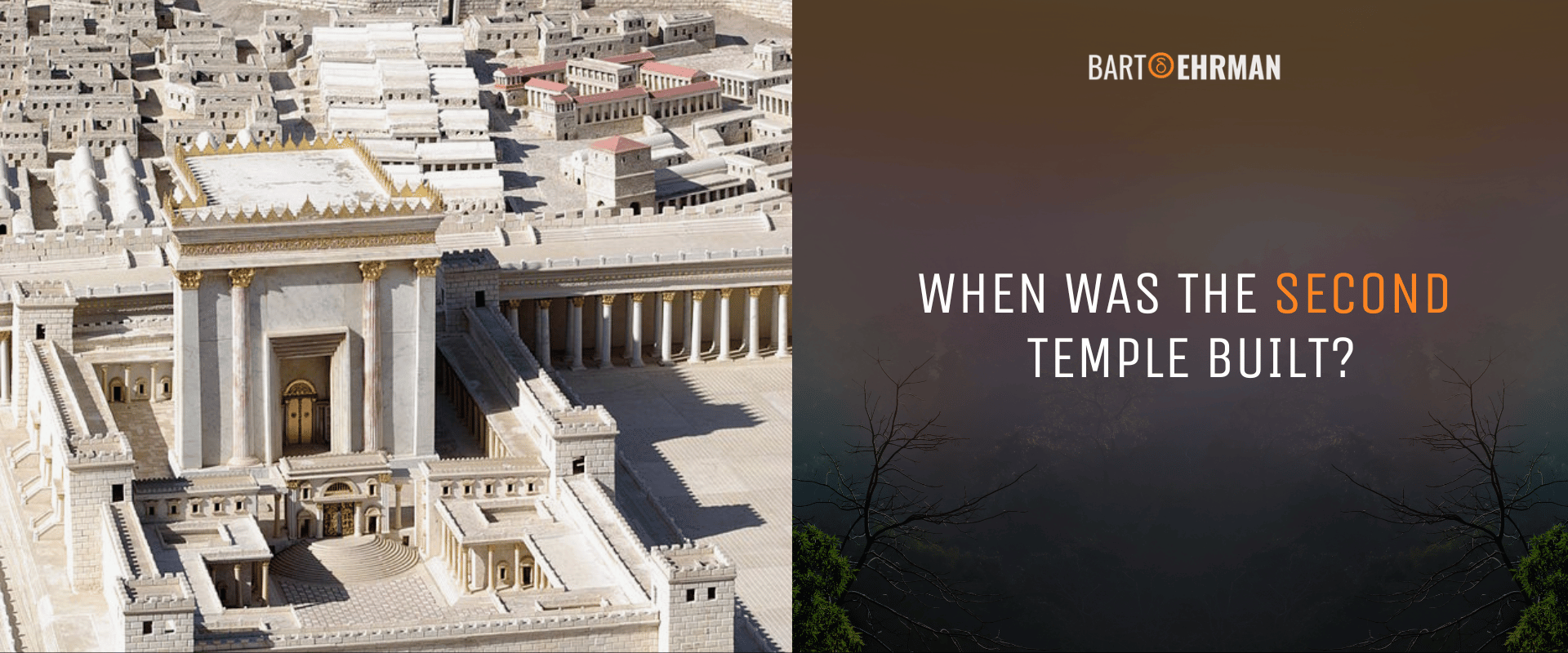
When Was the Second Temple Built? A Brief Look at the Historical Context
According to Jewish tradition as preserved in the Hebrew Bible, it was King Solomon who built the First Temple in Jerusalem, providing a permanent cultic center for the worship of Israel’s God.
This project emerged within the context of a consolidated monarchy, when the kingdoms of Israel and Judah were unified under royal administration and able to marshal the political and economic resources required for monumental construction.
The Temple served both as an architectural achievement and the institutional heart of sacrificial worship, royal ideology, and national identity. In other words, its presence reflected a period in which political sovereignty and religious centralization were closely intertwined.
The centuries following Solomon, however, were marked by fragmentation and instability. In his book The History of Ancient Israel, Michael Grant explains:
(Affiliate Disclaimer: We may earn commissions on products you purchase through this page at no additional cost to you. Thank you for supporting our site!)
The death of Solomon in c. 927 was followed by the Disruption – the division of the land into two kingdoms: Israel comprising the territories of the ten northernmost tribes, and Judah in the south consisting of the tribal area of that name and the small land of Benjamin. The disruption meant not only the abandonment of all imperial pretensions, but also the end of any real freedom of action for the two small states that had now come into being (the larger of them, Israel, only measured some sixty miles by forty). Although they managed to drag out their existence for some centuries, it was only for brief periods that they ceased to be at the mercy of more powerful neighbours.


Israel fell to the Assyrians in the 8th century B.C.E., and Judah endured cycles of political subordination and rebellion before ultimately confronting the expansion of Babylonian authority. These shifting geopolitical realities set the stage for one of the defining crises in ancient Judean history.
That crisis came at the beginning of the 6th century B.C.E., when the forces of the Neo-Babylonian Empire captured Jerusalem and destroyed the Temple, traditionally dated to 587/586 B.C.E.
The sanctuary that had embodied religious and political continuity was dismantled, and segments of the population were deported.
Roland de Vaux, in his classical study of the social and political history of the Ancient Israel, notes:
The destruction of the same Temple in 587 was an agonizing trial for Israel’s faith, but all was not lost, for the election would be renewed: after the return from the exile, Zacharias proclaimed that Yahweh would once more make Jerusalem his choice (Za 1: 17; 2: 16; 3: 2), and Nehemias, taking up the formula of Deuteronomy, reminded God that he had promised to reassemble the exiles in the place which he had chosen as the home for his Name (Ne 1: 9)... Jewish thought, especially in certain apocryphal works, and Hellenistic thought also, in Josephus and Philo, endeavoured to find in the Temple a cosmic symbolism; the Temple hill was for them the centre of the world. Similar speculations can be found in the Fathers of the Church and in medieval theologians, and some modern writers have tried to justify a symbolic interpretation by seeking analogies among the religious concepts of the Ancient East.
Being an absolute center of the Jewish religion in ancient times, it doesn’t come as a surprise that, as soon as the political opportunity presented itself, Judean communities would seek to rebuild what had been lost.
Such an opportunity emerged in 539 B.C.E., when a new imperial force entered the historical stage and swiftly brought the Babylonian Empire to an end.
The conquest by the Persians altered the political landscape of the Near East and opened possibilities that had previously seemed unattainable. In other words, a new political force brought developments that would soon reshape the religious life of Jerusalem and set the stage for the next chapter in the Temple’s history.
When Was the Second Temple Built? Zerubbabel and the Early Stages
Under the rule of Cyrus and his successors, imperial policy often favored the restoration of local cultic institutions, both as a gesture of legitimacy and as a means of stabilizing provincial administration.
Within this framework, traditions preserved in biblical literature describe authorization for the rebuilding of the Jerusalem sanctuary and the return of temple vessels removed by the Babylonians.
Whatever the precise administrative mechanisms involved, the change in imperial authority created conditions in which reconstruction of the Temple became conceivable once again.
Due to early initiatives associated with figures such as Sheshbazzar and Zerubbabel, temple rebuilding progress began. Zerubbabel and the high priest Jeshua featured prominently in the biblical narrative.
Their activities unfolded in a context shaped by imperial oversight and bureaucratic procedure. As H. G. M. Williamson notes, the traditions preserved in Ezra emphasize continuity with both the earlier temple and the Persian authorization to rebuild, presenting the enterprise as a legitimate restoration rather than a novel undertaking.
This rhetorical stress on continuity was strategically significant: when provincial officials inquired into the legality of the project, the Judean leadership appealed precisely to the antiquity of the sanctuary and to the decree attributed to Cyrus as grounds for their work.
The rebuilding process itself, however, was neither immediate nor uninterrupted. Archaeological and textual considerations suggest that activity stalled for years before gaining renewed momentum in the early reign of Darius I (522–486 B.C.E.)
Williamson rightly points out that claims of continuous construction reflect ideological positioning rather than literal chronology. In reality, substantial building appears to have resumed only later, encouraged by prophetic advocacy and confirmed by imperial approval.
The project thus emerged from an interplay of local religious motivation, prophetic encouragement, and administrative negotiation with Persian authorities rather than from a single decisive moment of reconstruction.
Ultimately, the sanctuary was completed toward the end of the 6th century B.C.E., conventionally dated to 515 B.C.E.
The completion of construction was followed by a formal dedication that signaled the transition from architectural project to functioning religious institution.
The account in Ezra describes communal celebration, sacrificial offerings, and the installation of priestly and Levitical divisions, indicating that cultic operations were fully reinstated.
As Williamson observes, the narrative moves seamlessly from the building’s completion to the resumption of regular worship, underscoring that the Temple’s significance lay not in its physical presence alone but in its role as the focal point of sacrificial practice and communal observance.
The subsequent celebration of Passover further marks the normalization of ritual life, presenting the restored sanctuary as reintegrated into the religious rhythms that defined Judean identity in the post-exilic period.
The building of the Second Temple was therefore as much a symbolic recovery of identity as it was an architectural accomplishment, representing the culmination of decades of political adjustment, theological reflection, and institutional reorganization in the aftermath of exile.
How Long Did the Second Temple Function?
It is impossible to know whether the Judeans at the beginning of the Second Temple period could imagine how long the restored sanctuary would stand. What began in the late 6th century B.C.E. under Persian imperial authorization would endure for nearly six centuries, surviving dramatic political transitions and cultural transformations.
The Temple functioned first within the administrative framework of the Achaemenid Empire, where Jerusalem remained a modest provincial center under Persian governance. Though politically subordinate, the sanctuary operated as the focal point of religious life, anchoring sacrificial worship, pilgrimage rhythms, and emerging textual traditions that would profoundly shape Jewish identity.
The conquests of Alexander the Great in the late 4th century B.C.E. brought the region into the orbit of Hellenistic rule, first under the Ptolemies and later the Seleucids.
This transition did not erase earlier influences but layered new cultural and political dynamics onto existing structures. Greek language and administrative systems became increasingly prominent, and Judea found itself entangled in broader struggles between competing Hellenistic powers
Periods of tension (most notably in the 2nd century B.C.E.) reshaped the Temple’s role in political resistance and religious reform, eventually giving rise to the Hasmonean dynasty. Under this Jewish dynasty, the Temple stood both as a religious center and as a symbol of restored autonomy.
Roman intervention in the 1st century B.C.E. marked yet another transformation. Beginning with Pompey’s involvement in Judean affairs and solidified under Herodian and later direct Roman administration, Jerusalem remained centered on its Temple, even as political authority shifted decisively toward imperial oversight.
Loren T. Stuckenbruck summarizes this long era in the following way:
In terms of cultural influences and sociopolitical conditions that shaped Jewish life and tradition, the Second Temple period was anything but homogenous. The segmenting chronological periodization that is often applied to the era – Persian, Hellenistic, Roman – should not be confused with cultural influences. For example, during the Persian period, not only Persian religion but also persistent Babylonian traditions and Egyptian influences can be discerned among the sources. Similarly, during the Hellenistic period, not only did the Greek language become an important carrier of culture and ideas, elements of the subcultures in Ptolemaic Egypt and Seleucia also made themselves felt and shaped not only Jewish communities in these regions but also those of Judea and Jerusalem as they came under their control. Likewise, as the Romans, under Pompey, began to weigh in directly on the power struggles in Judea, other people groups affected the balance of power, most notably Parthians, Idumeans, and Nabateans.
This long and complex history came to a violent end in the 1st century C.E. Namely, in 70 C.E., during the First Jewish Revolt, Roman forces under Titus destroyed Jerusalem and the Temple, bringing sacrificial worship to a halt.
Additionally, a second catastrophic uprising, the Bar Kokhba revolt of 132–135 C.E., further reshaped Jewish life under Roman rule and extinguished any realistic possibility of rebuilding the sanctuary.
NOW AVAILABLE!
Finding Moses: What Scholars Know About The Exodus & The Jewish Law
Riveting and controversial, the "FINDING MOSES" lecture series takes you on a deep dive into the stories of Moses, the exodus, and a whole lot more...
Herod’s Temple: A Huge Architectural Project
Within centuries of socio-political change during the Second Temple period, the center of Jerusalem’s piety remained, but it didn’t remain the same.
The sanctuary rebuilt under Persian rule continued to function through Hellenistic and early Roman administrations, yet its physical form and symbolic weight evolved alongside shifting political realities.
Discussions of who built the Second Temple often mention how the most dramatic transformation came under the reign of Herod the Great, who ruled Judea as a Roman client king from 37 to 4 B.C.E.
Installed with Roman backing yet governing a population deeply attached to its ancestral traditions, Herod faced a persistent challenge of legitimacy. It was within this context that he embarked on one of the most ambitious architectural undertakings of the ancient Mediterranean world: the reconstruction and monumental expansion of the Jerusalem Temple.
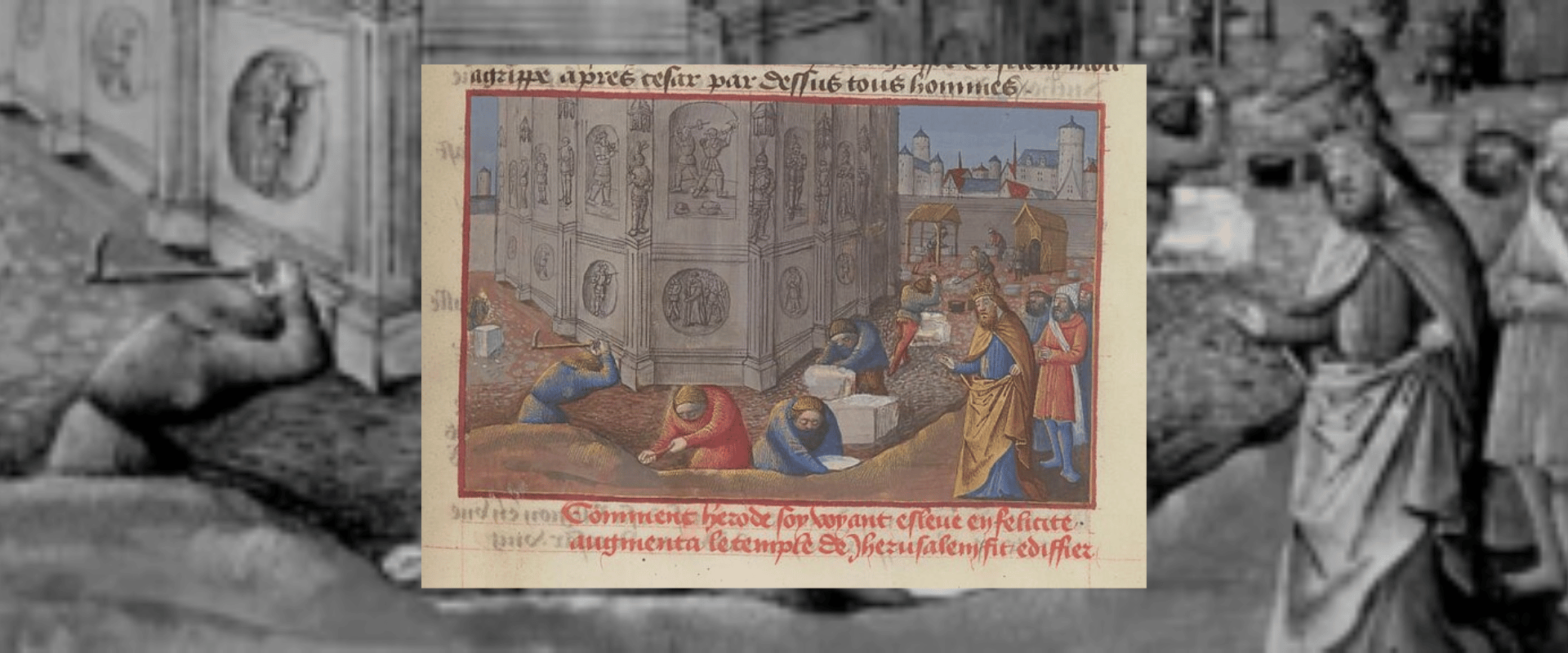
Herod’s temple didn’t emerge out of scratch. Rather, beginning around 20/19 B.C.E., the king initiated a massive renovation and enlargement of the existing Second Temple complex.
According to our principal literary source, Josephus, the sanctuary itself was rebuilt with remarkable speed so that sacrificial worship would not be interrupted, while the surrounding courts and structures continued to develop for decades.
The Temple Mount platform was dramatically expanded through enormous retaining walls, effectively doubling the size of the sacred precinct. The result was a vast, architecturally imposing complex that rivaled the grand sanctuaries of the Greco-Roman world.
While this enterprise can rightly be regarded as a major architectural accomplishment, it cannot be detached from what Germans would call Realpolitik: a policy grounded in practical calculation and power dynamics.
Christian-Georges Schwentzel, in his study Herode la Grand (“Herod the Great”), explains the ideological dimension of the undertaking in the following terms:
“The reconstruction of the Temple allowed Herod to display his piety, officially placing religion and the worship rendered to God above any political design. The works were carried out with extreme attention to the observance of all rules of purity. The king himself kept his distance from the works, which were entrusted to priests who had previously received training as masons or carpenters… The speech in which Herod announced his intention to rebuild the Temple allowed the king to launch into a comparison, not without ulterior motives, between Persian domination and the Roman Empire. If the second Temple was of modest dimensions, Herod claimed, it was because Kings Cyrus and Darius had not permitted the Jews to construct a larger building. Herod contrasted the subjection imposed on the Jews by the Persians with the friendship of the Romans; he compared Cyrus and Augustus, the latter granting the Jews full freedom to rebuild Solomon’s Temple. The Roman emperor was therefore even more beneficent toward the Jews than the founder of the Achaemenid Empire, who was nevertheless traditionally presented as an instrument of God. Cyrus, whose policy toward the Jews is here disparaged by Herod, was guilty of having imposed limits on the restoration of the Temple and thus on Jewish autonomy. Zerubbabel himself is treated condescendingly: it was not his fault that the Temple lacked splendor and grandeur, for he was subject to the great Persian king.” (my translation)
Seen in this light, Herod’s Temple was both a sacred space and a statement of power. It preserved the continuity of the Second Temple tradition while simultaneously redefining its scale and symbolism within a Roman imperial framework. By the time of Jesus, therefore, the Temple was at once ancient in origin and newly monumental in appearance.
Jesus and the Second Temple: A Brief Note
As noted, Jesus’ public ministry unfolded in the shadow of Herod’s Temple, which, in the first century C.E., functioned as the religious center for a large portion of Jews living under Roman rule.
Pilgrims traveled to Jerusalem for major festivals, priests oversaw daily sacrifices, and the Temple remained the symbolic heart of Jewish devotion.
According to our surviving sources, Jesus visited Jerusalem and the Temple precincts, and at least one episode connected to that visit stands out in all four canonical Gospels: the so-called “cleansing” of the Temple.
The Synoptic Gospels describe Jesus entering the Temple courts and overturning the tables of money changers and those selling sacrificial animals, accusing them of turning a “house of prayer” into a “den of robbers.”
The scene is dramatic and confrontational, suggesting a prophetic gesture aimed at the heart of the Temple’s economic and ritual system. The Gospel of John places a similar episode at the beginning of Jesus’ ministry, whereas the Synoptics situate it in the final days before his arrest. But in each account, the Temple stands as the focal point of a moment charged with theological and political implications.
It is a powerful story, but from a historical standpoint, questions inevitably arise. Did the event occur as described? Could a single individual have disrupted activity in such a vast and heavily supervised complex? Or do the Gospel writers shape the episode to express theological convictions about Jesus’ authority and the Temple’s fate?
To pursue such questions would require entering the larger and complex discussion known as the quest for the historical Jesus. It’s an undertaking that deserves careful, sustained analysis in its own right. Perhaps that is a conversation for another article.
For now, it is enough to observe that this episode unfolds within the long trajectory of a sanctuary whose origins reach back to the Persian period when the Second Temple period itself began.
Conclusion
So, when was the Second Temple built? The answer depends on what one means by “built.” Its foundations were laid in the Persian period and completed around 515 B.C.E. However, its meaning and physical form continued to evolve through Hellenistic pressures, Roman domination, and Herod’s monumental reconstruction.
For nearly six centuries it stood as the religious, social, and symbolic center of Jewish life, only to be destroyed in 70 C.E., bringing that long chapter to a dramatic end.
Behind the Second Temple, therefore, we see, first and foremost, a historical process, a process of rebuilding, redefining, expanding, and ultimately losing.
Finally, it’s important to acknowledge that history of the Second Temple period can’t be reduced to a date on a timeline. Instead, it encompasses centuries of collective memory, politics, religion and piety, all converging around one of the most important sacred spaces of the ancient Near East.
NOW AVAILABLE!
Finding Moses: What Scholars Know About The Exodus & The Jewish Law
Riveting and controversial, the "FINDING MOSES" lecture series takes you on a deep dive into the stories of Moses, the exodus, and a whole lot more...