
5 Pillars of Islam: List of All Five Pillars in Order

Written by Marko Marina, Ph.D.
Author | Historian
Author | Historian | BE Contributor
Verified! See our guidelines
Verified! See our editorial guidelines
Date written: January 30th, 2026
Disclaimer: The views and opinions expressed in this article belong to the author and do not necessarily match my own. - Dr. Bart D. Ehrman
In nearly every serious conversation about religion in which Islam enters the discussion, attention quickly turns to the Five Pillars.
This is hardly surprising. Few religious traditions express their core commitments as clearly through a set of shared practices, and fewer still have done so with such historical continuity and global reach.
The Five Pillars of Islam are often presented as the foundation of the faith and, in an important sense, they are. They articulate the basic acts through which Muslims across time and place have understood what it means to live a religiously ordered life.
For many outside the tradition, the phrase itself may be familiar even if its content is not. Yet behind this well-known formula lies a complex religious system that has shaped societies, cultures, and individual lives for more than fourteen centuries.
This article offers a scholarly and descriptive introduction to the Pillars of Islam, situating them within the broader historical emergence of Islam in the seventh century.
Before examining each pillar in turn, it’s essential to understand the religious and social world in which Islam arose, as well as the role ritual practice plays within the tradition as a whole.
By outlining the historical background, explaining each of the Pillars of Islam in order, and briefly addressing broader ethical principles often associated with Islamic teaching, the goal is to provide readers with a clear, accessible framework for understanding one of the world’s most influential religious traditions.
However, before we move on, I’d like to invite you to check out the course The Bible and The Quran: Comparing Their Historical Problems. Led by Dr. Bart D Ehrman and Dr. Javad T. Hashmi, this eight-lecture course gives you an amazing opportunity to dive into the origins of Islam and the historical quandaries posed by the Quran alongside those found in the Christian Bible.
Behind the Five Pillars: Historical Context
In her book Histoire de l’islam (History of Islam), the historian Sabrina Mervin situates the origins of Islam firmly within the geography and social structures of western Arabia. As she writes:
(Affiliate Disclaimer: We may earn commissions on products you purchase through this page at no additional cost to you. Thank you for supporting our site!)
“Islam was born in the Hejaz, a region stretching along the western edge of Arabia, beside the Red Sea. It was a desert land of sand and rocky terrain, inhabited by nomadic pastoralists organized into tribes – according to a paradigm transmitted by tradition and adopted by Orientalist scholarship. A number of oases were scattered there, running parallel to the coast. These were palm groves producing dates, but also commercial towns from which caravans set out, either toward the Fertile Crescent in the north or toward ‘Happy Arabia,’ Yemen, in the south. Such were the cities of Khaybar, Yathrib, and Mecca, as well as Ta’if, the most prosperous of them, since its mild climate allowed for diversified agriculture. Sedentary populations lived there and engaged in various economic activities that connected them to the wider region.” (my translation)


It was within this environment that Muhammad arose in the early 7th century as a religious teacher and, eventually, a political and military leader. Born in Mecca around 570 C.E., Muhammad belonged to the Quraysh tribe, a group deeply involved in the city’s commercial life and its role as a religious center.
According to Islamic tradition, he received his first revelation (these revelations were later collected and canonized in the Quran — the sacred book of Islam) around 610 C.E., an event that marked the beginning of his public career as a preacher of monotheism. His message emphasized the oneness of God, moral accountability, and social responsibility.
Opposition from local elites led Muhammad and his followers to migrate to Yathrib (later known as Medina) in 622 C.E., an event known as the Hijra and later regarded as the starting point of the Islamic calendar.
There, Muhammad assumed a new role as the leader of a growing community of believers. Over the following decade, he oversaw the formation of a religious and political order that combined spiritual authority with legal and social regulation.
His followers expanded in number, and alliances as well as conflicts with surrounding tribes reshaped the balance of power in the region. By the time of Muhammad’s death in 632 C.E., much of the Arabian Peninsula had come under the influence of this movement.
Islam didn’t emerge in isolation or immediately but within a broader context of tribal politics, interregional trade, and late antique religious diversity, including interactions with Jewish and Christian communities. With this historical framework in place, it becomes easier to understand how Islam articulated its core religious commitments.
The practices that later came to be known as the Five Pillars of Islam developed within this early community as shared acts that defined belonging, structured daily life, and expressed fundamental religious values. To these, we now turn!
The Pillars of Islam in Order
In the introduction to his book on the Pillars of Islam, Abdennour Bidar explains his motivation with striking clarity:
“I therefore write with all my human sisters and brothers in mind who may also wish to understand Islam better in order to nourish their own spiritual journey, whatever form it may take. We already have, in the French language, many introductory manuals that present the Five Pillars of Islam in a simple and accessible way. But they do not offer the depth of meaning sought by many demanding Muslims, who are looking for something other than a flat description of the pillars and their rules, and the familiar religious discourses about the benefits of piety, the reward of Paradise, and the threat of Hell.” (my translation)
Despite being fully aware of the extensive body of scholarship and instructional material already available, Bidar chose to write yet another book on the Five Pillars. That decision itself points to their enduring importance, not only for understanding Islam as a religious tradition, but also for grasping how it’s lived and experienced by its adherents.
In the pages that follow, the Five Pillars are approached primarily from a scholarly and historically informed perspective.
At the same time, it must be said that the selected confessional interpretations are presented descriptively, not to endorse or reject them, but to allow our readers to see how the Pillars of Islam are understood from within the Islamic tradition itself.
Pillars of Islam: Shahada
The Shahada is the Muslim profession of faith, expressed in the words: “There is no god but Allah, and Muhammad is the Messenger of Allah.”
At first glance, the formula appears simple, but a closer examination reveals two fundamental theological emphases embedded within it. As John L. Esposito explains:
The first part of this proclamation affirms Islam’s absolute monotheism, the uncompromising belief in the oneness or unity of God, as well as the doctrine that association of anything else with God is idolatry and the one unforgivable sin… The second part of the confession of faith asserts that Muhammad is not only a prophet but also a messenger of God, a higher role also played by Moses and Jesus before him. For Muslims, Muhammad is the vehicle for the last and final revelation. In accepting Muhammad as the ‘seal of the prophets,’ they believe that his prophecy confirms and completes all of the revealed messages, beginning with Adam’s.
Because of this dual affirmation (God’s absolute oneness and Muhammad’s prophetic authority) the Shahada functions as more than a simple statement of belief.
As David Waines notes in An Introduction to Islam, the other pillars of Islam ultimately derive their meaning from this foundational confession. “These phrases,” he writes, “sum up the prophetic-revelatory event in Islam, and the rituals themselves draw their essential meaning from it, that is, as the performance of obedient acts of service (‘ibadah) to and worship of the One God.”
In this sense, the Shahada stands not only as the first pillar, but also as the conceptual framework within which all other religious practices acquire coherence.
Historically, the Shahada emerged in the earliest phase of the Islamic movement, closely tied to Muhammad’s preaching in Mecca and the formation of a new monotheistic community. Its wording crystallized over time as a concise expression of Islamic identity, marking both entry into the community and continued commitment to its core convictions.
Before moving on to the remaining pillars, readers interested in a more detailed exploration of the Shahada may wish to consult a full article devoted exclusively to this foundational element of Islam.
Pillars of Islam: Salat
The second Pillar of Islam is Salat, the ritual prayer performed by Muslims five times a day at prescribed times. Why five times?
Abdennour provides an answer written, of course, from a believer’s perspective:
“This repetition of prayer constitutes a dimension of dhikr, that is, the remembrance of God – and more specifically of the ultimate purpose of dhikr, which is to render human beings witnesses to God. Indeed, each of the prescribed times of prayer corresponds to what one might poetically describe as a stage in the life of light upon the earth, that is, symbolically, to a phase or dimension of the manifestation of God. At dawn, symbolically with the rising sun, God reveals Himself to the eye of the heart as a nascent and ascending light. At midday, the light of God reaches its zenith in power and beneficence, in terms of clarity and self-evidence. In the late afternoon, this light declines and weakens, and soon, at sunset, it appears as dying, finally disappearing with nightfall, when the light of the sun is replaced by that of the moon and the stars.” (my translation)
Salat, therefore, structures the rhythm of daily life by punctuating it with moments of worship, reflection, and disciplined devotion. Unlike private or spontaneous prayer, Salat follows a set form that is shared across the global Muslim community, reinforcing both religious continuity and communal identity.
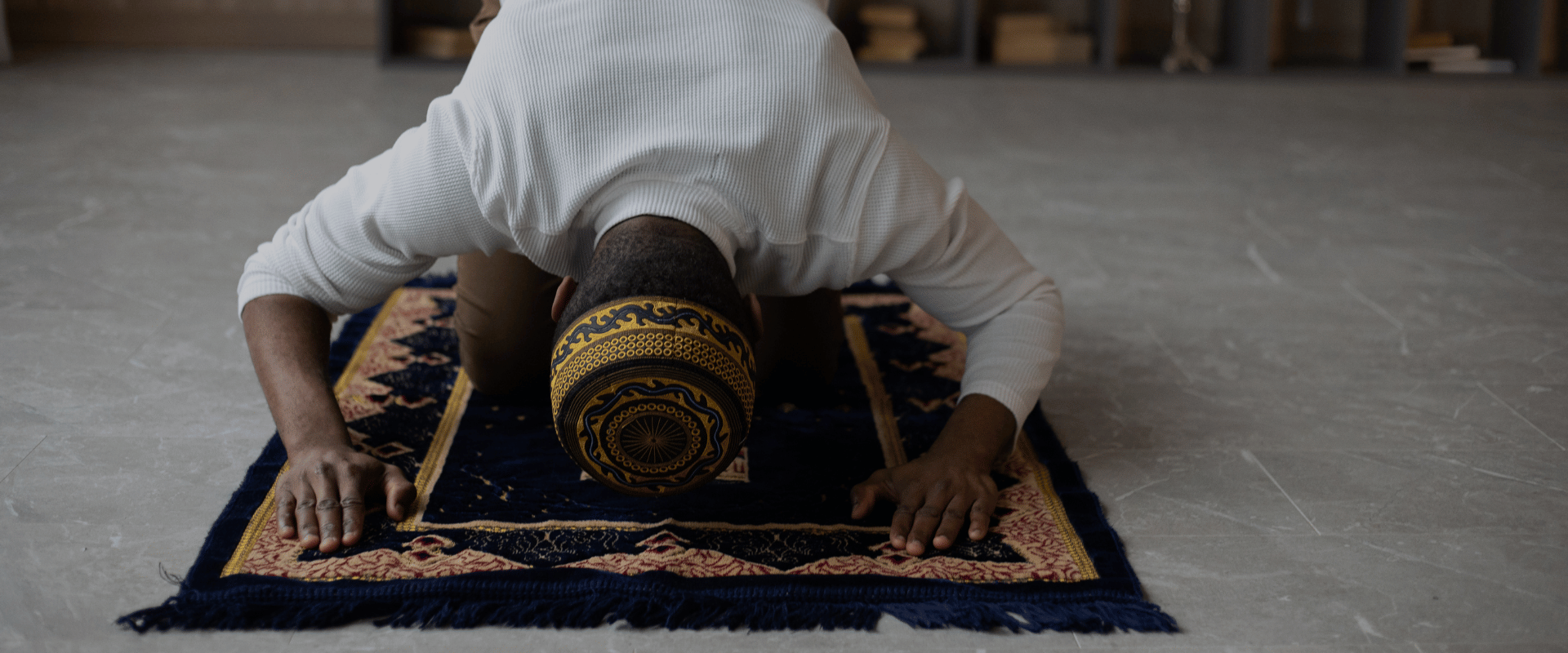
Esposito notes that the prayers consist of Quranic recitations in Arabic and verbal glorification of God, accompanied by a sequence of bodily movements: standing, bowing, kneeling, prostrating with the forehead touching the ground, and sitting.
These recitations and movements together express humility, obedience, and reverence toward God.
Muslims may perform Salat in any clean place, alone or in a group, at home, in a mosque, at work, or while traveling. Although individual prayer is fully valid, communal prayer is generally considered preferable, since it visibly enacts discipline, equality, solidarity, and a sense of brotherhood among worshippers united in a single act of devotion.
Interestingly enough, at the beginning of Muhammad’s public mission and during the early years in Medina, Muslims prayed facing Jerusalem. This orientation changed around 624 C.E., approximately two years after the Hijra, when Muhammad instructed his followers to turn instead toward Mecca, specifically toward the Kaaba.
NOW AVAILABLE!
Did Jesus Think He Was God? - A Closer Look at the Evidence
Soon after Jesus’ death, his disciples claimed that he was God. What did they mean by that? Was he the One and Only God, Yahweh? Did he himself think so?
Pillars of Islam: Zakat
The third Pillar of Islam is Zakat, the obligatory almsgiving required of Muslims who possess wealth above a defined minimum threshold.
Unlike voluntary charity, Zakat constitutes a formal religious duty, calculated according to specific rules and directed toward designated categories of recipients. As such, it functions both as an act of worship and as a mechanism for social redistribution. In that way, Zakat links personal piety with communal responsibility.
As Tilman Nagel observes in his book Muhammed: Leben und Legende (Muhammad: Life and Legend), Zakat, understood as a “purifying gift,” has its origins in the Quran itself.
Already in Surah (the Arabic word for “chapter”) 92 (one of the earliest surahs of the Quran) the individual who is destined for Hellfire is contrasted with the God-fearing person who is spared because he gives of his wealth in order to purify himself.
Additionally, the term "zakat" appears some 32 times in the Quran which underscores its centrality within Islamic religious life. Also, for Zakat to be properly fulfilled, Nagel rightly points out, it must “be done without ulterior motives” (“ohne Hintergedanken geschehen”), highlighting that its religious value lies not merely in the act of giving, but in the intention that underlies it.
Pillars of Islam: Sawm
When I visited my grandmother in Bosnia and Herzegovina as a child, I would sometimes see people cutting grass or performing hard physical labor on hot summer days without taking even a sip of water. At the time, this made little sense to me, until my father explained the reason.
In short, Sawm (the fourth Pillar of Islam) stood behind this striking display of discipline. Sawm refers to the obligatory fasting observed during the month of Ramadan, during which adult Muslims abstain from food, drink, and sexual relations from dawn until sunset.
Far from being a mere act of deprivation, fasting serves as a structured form of worship that cultivates self-restraint, attentiveness to God, and solidarity with those who experience hunger and hardship.
As David Waines explains,
The rigors of Ramadan may best be appreciated by recalling that the Islamic calendar is lunar and hence the fasting month shifts eleven days forward each year and is therefore observed in all seasons of the year, summer and winter. Fasting may be interrupted on a journey, and menstruating women do not fast. A pregnant woman likewise is excused from fasting if she fears harm may come to the unborn child… Ramadan begins and ends with the sighting of the crescent moon, and the month concludes with one of the two major religious celebrations of the Muslim calendar, the feast of the breaking of the fast.
These provisions illustrate that Sawm balances rigor with accommodation, combining demanding ritual discipline with legal and ethical flexibility. Through this annual cycle of fasting and communal celebration, Sawm reinforces both personal piety and collective religious identity within the Islamic tradition.
Pillars of Islam: Hajj
The fifth Pillar of Islam is Hajj, the pilgrimage to Mecca that every adult Muslim is required to perform once in a lifetime, provided they possess the physical and financial means to do so.
Hajj takes place during a specific period of the Islamic lunar calendar and centers on a prescribed sequence of rites carried out in and around Mecca, anchoring Muslim religious life to a sacred geography.
Sabrina Mervin notes that Hajj is characterized above all by its collective dimension. In her own words:
“The hajj consists primarily of collective rites that the crowd of pilgrims performs at the same time, and whose unfolding other Muslims can now follow through the media. The departure for and return from Mecca have nevertheless long constituted, in all Muslim societies, occasions of exceptional celebration, consecrating the pilgrim’s new status, that of hajj.” (my translation)
The pilgrimage thus extends beyond the ritual acts themselves, reshaping social identity and communal recognition within Muslim societies. But Hajj is also a rigorously regulated religious event.
As Bernard Lewis, in his book Islam: The Religion and the People, explains:
The pilgrimage in the holy cities of Mecca and Medina involves a series of rituals and observances, usually with the participation of great numbers of pilgrims. Non-Muslims are not permitted to be present or to set foot at any time in the holy cities or, more generally, in the Hijaz in the northwestern part of the Arabian peninsula… The pilgrimage has had an enormous impact on Islam, from medieval times until the present day. Every year, it brings great numbers of Muslims from every part of the vast Muslim world and beyond, of widely differing national, ethnic, social, and cultural backgrounds, to travel, often over vast distances, and join with others in a common sequence of ritual and worship.
Beyond the Pillars: The Eight Principles of Islam
Needless to say, there is more than just the list of 5 pillars of Islam. One of the most frequently discussed ways of capturing the broader ethical and spiritual orientation of the Islamic tradition is through what are often called the Eight Principles of Islam.
These principles point beyond formal ritual obligations to the values that inform Muslim belief, conduct, and communal life. At the same time, it’s important to note from the outset that the “Eight Principles” don’t constitute a universally fixed or canonical list recognized across all Islamic schools and traditions.
Rather, they represent a pedagogical and interpretive framework commonly used in modern presentations of Islam to summarize core religious and moral emphases.
Although the wording and enumeration may vary, these principles typically include belief in God, prayer, charity, fasting, pilgrimage, justice, compassion, and responsibility toward the community.
Taken together, they highlight that Islamic religiosity encompasses both acts of worship and ethical commitments governing social relations.
To put it more bluntly, the Pillars of Islam articulate the minimum ritual requirements of the faith, while these broader principles underscore Islam’s concern with moral accountability, social justice, and communal solidarity.
Appendix: Top Four Books on the Five Pillars of Islam
The study of the Five Pillars of Islam spans both academic scholarship and religious reflection. The recommendations below are therefore divided into two broad categories.
The first two titles approach Islam (and the Five Pillars in particular) from a scholarly, non-confessional perspective, aimed at historical understanding and analytical clarity.
The latter two are written from within the Islamic tradition and will be of interest to readers who wish to explore how the Five Pillars are understood and interpreted by contemporary Muslim thinkers and educators.
#1 – The Five Pillars of Islam: Oxford Bibliographies Online Research Guide, edited by Natana J. Delong-Bas
Among strictly academic resources, this one represents, in my opinion, the most valuable starting point! As it turns out, there are relatively few scholarly books devoted exclusively and systematically to the Five Pillars themselves and, for that reason, this research guide stands at the top of the list.
Rather than offering a single narrative, it maps the field by directing readers to key academic studies, primary sources, and debates.
For example, under the topic of Zakat, the guide recommends works such as Sakkal Mamoun’s Zakat Handbook, which examines almsgiving both as a religious obligation and as a social institution, while grounding its historical development in Quranic teachings. This volume is especially useful for scholars and informed lay readers seeking reliable entry points into serious academic discussion.
#2 – What Everybody Needs to Know About Islam by John L. Esposito
Although the book isn’t devoted exclusively to the Five Pillars, it offers one of the most widely accepted academic introductions to Islam as a religious tradition. Esposito devotes sustained attention to Islamic beliefs and practices, explaining each of the Five Pillars clearly and in historical context.
His work strikes a careful balance between accessibility and scholarly rigor, making it a standard reference for students, educators, and general readers interested in the foundations of Islam.
#3 – The Five Pillars of Islam: Laying the Foundations of Divine Love and Service to Humanity by Musharraf Hussain
Readers seeking a religious or confessional perspective may turn to this book. Written from within the Islamic tradition, this book aims to explain the Five Pillars in a straightforward and devotional manner.
Although I have not personally read the volume, reader reviews are largely positive. One reviewer notes, “This is a good book. It breaks down the Five Pillars in simplistic terms,” while another writes, “If someone wants to study the basics of Islam then this is where you should start; it has got everything you need about Islam and is really good.”
As such, it appears well suited for readers seeking an introductory, faith-based explanation of Islamic practice.
#4 – Les cinq piliers de l’islam (The Five Pillars of Islam) by Abdennour Bidar
Finally, for French-speaking readers, Bidar offers a distinctive contemporary religious perspective. Although the book, to my knowledge, hasn’t been translated into English, it’s particularly noteworthy for its attempt to situate the Five Pillars within modern debates about freedom, responsibility, and religious identity.
Bidar argues forcefully that Islamic practice must be grounded in individual freedom rather than coercion. As he writes:
No one should be forced to practice the Five Pillars of Islam, nor any other religious prescription. For this reason, it is essential to proclaim and affirm this again and again, with all possible force, until it is recognized by the community as a right: every believer, woman or man, must be left free in their Islam, and equally free to leave Islam if they so wish. As for children and adolescents, it is just as illegitimate to force them to practice Islam; it is up to each family to decide freely whether it wishes to transmit an Islamic education – and if so, nothing should be imposed in matters of spiritual education.
One reviewer wrote:
“In this book, Abdennour Bidar brings to light and reveals the profound meaning of the five great ritual pillars of the Muslim tradition. I am not a Muslim, and yet this book deeply moved me. Perhaps this is because, by probing meaning far enough – or by rising high enough – it reaches what is universal. I feel immense gratitude to Abdennour Bidar and to the great thinkers he cites throughout the book.” (my translation)
Bidar’s work will, therefore, appeal to readers interested in how Islamic foundations can be reinterpreted in dialogue with contemporary values and ethics.
Conclusion
I'm fairly certain that my next discussion about Islam (whether in an academic setting or with friends over a beer) will almost inevitably begin with the Five Pillars.
That instinct isn’t accidental. Few religious traditions articulate their core commitments so clearly through a shared set of practices, and few have maintained them with such continuity across centuries and cultures.
The Five Pillars offer an immediately recognizable framework through which Islam presents itself, not primarily as a system of abstract doctrines, but as a religion structured around embodied acts of worship and ethical obligation.
At the same time, as this article has shown, the Pillars of Islam cannot be understood in isolation from the historical, social, and intellectual contexts in which they emerged and developed.
In other words, they reflect early Islamic responses to questions of belief, community, discipline, and moral responsibility, while remaining adaptable enough to be practiced by Muslims living in vastly different circumstances.
Approached from a scholarly perspective, the Pillars of Islam serve as a reminder that religion, in Islam as elsewhere, is lived as much through practice as through belief.
NOW AVAILABLE!
Did Jesus Think He Was God? - A Closer Look at the Evidence
Soon after Jesus’ death, his disciples claimed that he was God. What did they mean by that? Was he the One and Only God, Yahweh? Did he himself think so?