
Jacob Wrestles with God: Meaning of Angelic Encounter (VERSE)
Written by Marko Marina, Ph.D.
Author | Historian
Author | Historian | BE Contributor
Verified! See our guidelines
Verified! See our editorial guidelines
Date written: January 10th, 2026
Disclaimer: The views and opinions expressed in this article belong to the author and do not necessarily match my own. - Dr. Bart D. Ehrman
In the course of my own religious upbringing, I went through more than one rebellious phase, marked by doubt, questioning, and a fair measure of uncertainty. Looking back, it wouldn’t be an exaggeration to say that I, too, have “wrestled with God,” with the very idea of God’s existence, with inherited beliefs, and with what faith might mean in a modern world.
Only later did I come to appreciate that this evocative phrase has a deeply biblical pedigree. Few stories in the Hebrew Bible capture it more powerfully than the mysterious episode in Genesis where Jacob wrestles with God by the banks of the Jabbok, locked in a nighttime struggle that leaves him wounded, blessed, and forever changed.
The scene is among the most vivid and unsettling in the Book of Genesis. A solitary patriarch, a shadowy opponent, a physical struggle that lasts until dawn, and a declaration that one has seen God “face to face” and lived to tell the tale.
It’s no wonder that the story has long been a favorite in sermons, Sunday school lessons, and devotional reflections, often told as a powerful illustration of perseverance in faith or of the human struggle to cling to God in times of crisis.
Yet the text itself raises far more questions than such retellings usually allow: Who, exactly, is Jacob’s opponent? Is it God or an angel? Why does God (or a divine being) engage in combat with a human?
This article approaches the episode with those questions in mind. We’ll first retell the Jacob wrestles with God story as it appears in Genesis, situating it in its narrative context.
After that, we’ll turn to a close, historically informed analysis, drawing on critical biblical scholarship to explore what this strange encounter may have meant in its ancient setting and how it functions within the larger Jacob cycle.
Finally, we’ll consider how the story was received and reimagined in later Jewish and Islamic traditions.
Even readers who know the story well may find that approaching Jacob’s struggle through a scholarly lens opens new ways of appreciating one of the Bible’s most haunting and enduring narratives.
However, before we dwell on the scene in which Jacob wrestles with the angel (or God? See below), I want to invite you to explore the broader world of Genesis with Bart D. Ehrman’s six-lesson course, In the Beginning: History, Legend, or Myth in Genesis?
In this course, Bart examines the book of Genesis from a critical historical perspective, probing its stories, sources, and meanings, and asking how we can distinguish ancient tradition, literary imagination, and historical memory. If you’d like a deeper scholarly framework for understanding where stories like Jacob’s come from (and why they were told in the first place) this course is an excellent place to begin!
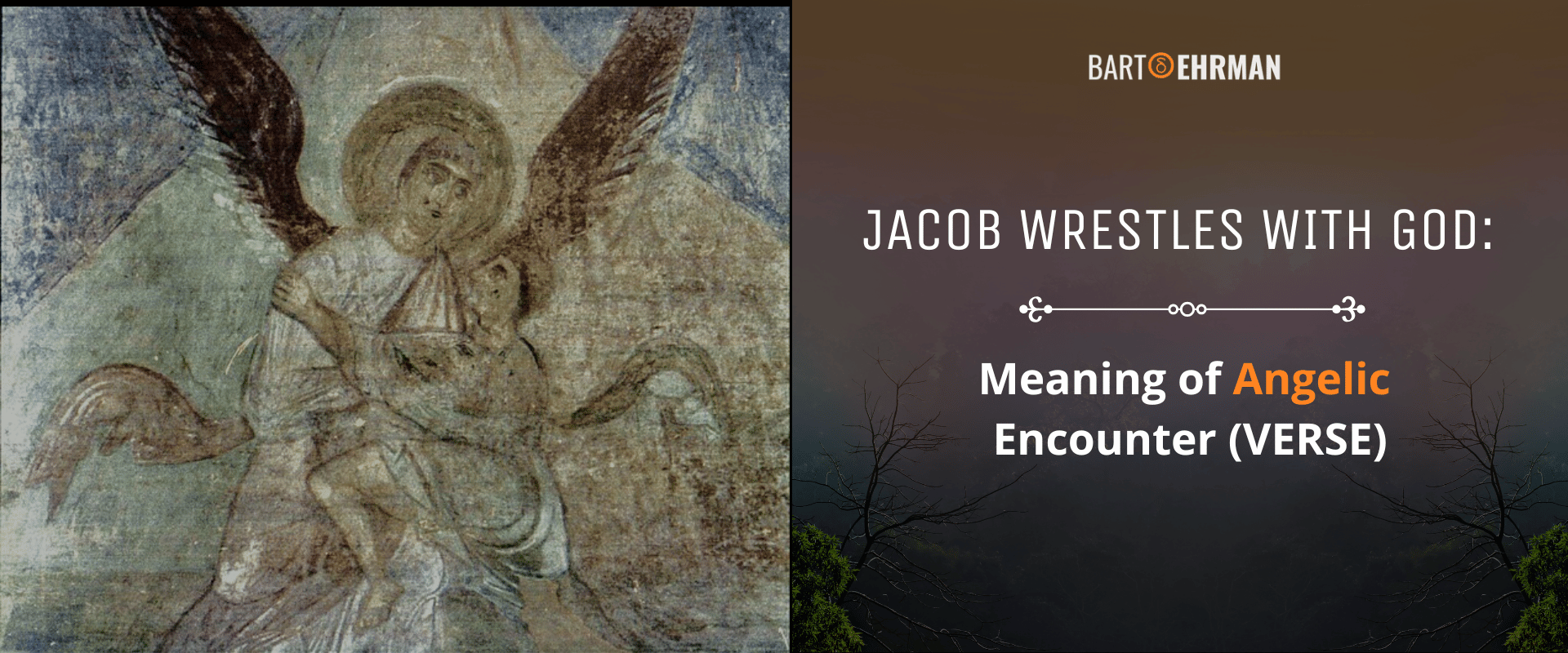
Jacob Wrestles With God: A Summary of the Story
The first Jacob wrestles with God verse occurs in Genesis 32:22, and it concludes in Genesis 32:32. The story belongs to what scholars commonly call the Jacob cycle, stretching from Genesis 25 to 36.
This extended narrative traces Jacob’s life from his birth and rivalry with his brother Esau, through his years in Aram, to his eventual return to the land of Canaan and reconciliation with his brother.
As French scholar Albert de Pury aptly observes:
(Affiliate Disclaimer: We may earn commissions on products you purchase through this page at no additional cost to you. Thank you for supporting our site!)
“The Jacob cycle thus offers a complete story of the origins of Israel, a story that is sufficient unto itself and needs neither a prologue (Noah, Abraham, etc.) nor an epilogue (Moses, etc.). In itself, the Jacob cycle lays the foundations for everything that calls for foundation, explains everything that must be explained: the birth or origins of Israel, Israel’s existence as a tribal ensemble, structured according to its subtle and evolving genealogical configurations, its right to its territory in the mountains of central Palestine, its principal sanctuaries (Shechem, Bethel, Penuel, Mahanaim), its conventions of intermarriage with the Aramean tribes, and its more or less conflictual relations with this neighboring group (Esau) or that city (Shechem).” (my translation)


Within this sweeping account of origins, Genesis 32 marks a decisive moment of transition, as Jacob stands on the threshold between his past and his uncertain future.
Narratively, the scene is set as Jacob prepares to meet Esau for the first time since fleeing Canaan years earlier.
Fearing his brother’s anger, Jacob divides his household and possessions, sends his family and servants across the ford of the Jabbok, and remains behind alone during the night. It’s in this liminal space, between the river and the dawn, that the story unfolds.
The text states simply that “a man” comes and wrestles with him until daybreak. No explanation is given as to where this figure comes from or why the struggle begins.
As the night wears on, the mysterious opponent sees that he cannot prevail and strikes Jacob on the hip, dislocating it. Yet even wounded, Jacob refuses to release him without a blessing. The stranger asks Jacob’s name and declares that it will no longer be Jacob, but Israel, “for you have striven with God and with humans, and have prevailed.”
Jacob, in turn, asks the name of his opponent, but receives no answer, only the blessing he demanded. The text then shifts in perspective: Jacob names the place Penuel, explaining, “For I have seen God face to face, and yet my life is preserved.”
In the narrative itself, the opponent is first a “man,” yet, by the end, Jacob speaks of God;
later retellings would sometimes describe the figure as an angel, but Genesis leaves the identity deliberately undefined.
With the coming of dawn, the encounter ends. Jacob crosses the Jabbok to rejoin his family, limping because of his injured hip, and the story concludes by noting an Israelite custom: not eating the sinew of the thigh because of what happened to Jacob at Penuel. Thus the episode closes as it began, rooted in movement, geography, and memory.
Jacob Wrestles With God: Meaning and Scholarly Exegesis
From the standpoint of historical-critical scholarship, the episode of Jacob’s nocturnal struggle is best read as a carefully positioned narrative pivot within the Jacob cycle rather than as an isolated miracle tale.
Coming on the eve of Jacob’s feared encounter with Esau, the scene interrupts his anxious preparations and relocates the true crisis from a human confrontation to a divine one.
The narrative thus reframes Jacob’s return to the land as something more than a family reunion or political negotiation: before Jacob can face his brother, he must pass through an encounter that tests him at the deepest level.
Since Hermann von Gunkel, scholars have long noted that this placement isn’t accidental. It’s precisely here, at a geographical threshold and at a moment of existential tension, that Jacob wrestles with God and emerges marked for what lies ahead.
This deeper narrative logic has been captured well by de Pury, who, reflecting on the function of the great patriarchal crises within Genesis, draws an explicit analogy between the Akedah and Jacob’s struggle at the Jabbok. As he puts it:
“It is as though the rejection of the Other entailed the loss of the Same, the loss of oneself. The problem of the chosen one is that the abandonment of the excluded will never be forgiven him. In certain respects, the story of Abraham’s sacrifice plays a function analogous to that of Jacob’s struggle at the Jabbok (Gen 32:23-33): it is at the very moment when Jacob thinks he has only to face Esau, the brother he deceived, that he finds himself confronted with his own God – or with himself, with the abyss, with the ultimate. It is stories such as these that save the patriarchal traditions from their tendency toward entropy and that restore to the canonical text its universality.” (my translation)
One of the most striking features of the story is its deliberate ambiguity concerning Jacob’s opponent. The narrative voice speaks first of “a man,” while Jacob himself later declares that he has seen God “face to face,” and other biblical texts, such as Hosea 12:3-5, reinterpret the figure as an angel.
This layered presentation suggests that the story preserves older narrative traditions in which a nocturnal divine or semi-divine being confronts a human at a dangerous boundary, even as later Israelite theology increasingly preferred to speak of divine encounters through mediating figures.
The refusal of the opponent to give his name, coupled with his power to wound and to bless, reinforces the sense that Jacob is facing a numinous presence whose identity cannot be neatly circumscribed.
The story doesn’t resolve the tension. Rather, it allows the reader to inhabit it, holding together the categories of man, angel, and God without forcing a single definition.
Attention to the story’s form also reveals its roots in ancient narrative patterns. The struggle unfolds at night and must end at daybreak, a motif widely attested in ancient traditions in which supernatural beings lose their power with the coming of light.
The sudden crippling of Jacob’s hip by a mere touch likewise belongs to a world in which divine power is conceived as immediate and overwhelming.
Yet these archaic features are integrated into a narrative that now serves a theological function within Genesis.
As Gerhard von Rad observes in his Commentary, Israel didn’t hesitate to take up such “crude” and ancient imaginative material and reuse it to speak of Yahweh’s direct action in the life of its ancestor.
In its present form, the story insists that behind the shadowy “man” stands Israel’s God, whose engagement with Jacob is both perilous and purposeful.
The exchange of names at the heart of the episode brings this purpose into focus. When asked to identify himself, Jacob answers simply, “Jacob,” a name long associated in the narrative with grasping and deception.
In this moment, the name functions less as a label than as a disclosure of identity. The renaming that follows (“Your name shall no longer be Jacob, but Israel, for you have striven with God and with humans and have prevailed” signals a transformation that is at once personal and collective.
In biblical tradition, the conferring of a new name marks a decisive change of status or destiny. But this instance has a particularly strong meaning. As Robert Alter explains:
Abraham’s change of name was a mere rhetorical flourish compared to this one, for of all the patriarchs Jacob is the one whose life is entangled in moral ambiguities. Rashi beautifully catches the resonance of the name change: 'It will no longer be said that the blessings came to you through deviousness [ʿoqbah', a word suggested by the radical of 'crookedness' in the name Jacob] but instead through 'lordliness' [serarah, a root that can be extracted from the name Israel] and openness.' It is nevertheless noteworthy – and to my knowledge has not been noted – that the pronouncement about the new name is not completely fulfilled. Whereas Abraham is invariably called 'Abraham' once the name is changed from 'Abram,' the narrative continues to refer to this patriarch in most instances as 'Jacob.' Thus, 'Israel' does not really replace his name but becomes a synonym for it – a practice reflected in the parallelism of biblical poetry, where 'Jacob' is always used in the first half of the line and 'Israel,' the poetic variation, in the second half.
At the same time, scholars note that the text’s etymology of “Israel” is more theological than philological, pressing the name into the service of the story’s meaning: Jacob is the one whose identity is now defined by struggle with the divine.
The narrative thus turns an intensely personal ordeal into an origin story for Israel itself.
Equally important is the tension between victory and vulnerability that runs through the scene. Jacob is said to have “prevailed,” yet he does so only by clinging to his opponent and demanding a blessing, even after being wounded.
The result is paradoxical: he receives the blessing he seeks, but he also leaves the encounter limping. This physical mark in this story isn’t incidental. Rather, it inscribes the struggle onto Jacob’s body and ensures that the encounter can’t be reduced to a purely symbolic experience.
As Bill T. Arnold, in his Commentary on Genesis, notes, Jacob doesn’t simply move on, spiritually renewed. Instead, he moves on as a changed man, bearing a lasting sign of the cost of encountering the divine and narratively prepared to meet Esau in a new way.
To put it more bluntly, the story refuses to separate blessing from brokenness!
Finally, the naming of the place, Penuel (“face of God”) draws together the episode’s central themes. Jacob’s astonishment lies in the conviction, widespread in biblical tradition, that no one can see God and live. Yet he has survived, even as he carries away a wound.
The narrative thus balances danger and grace, judgment and preservation. Moreover, some scholars providing Jacob wrestles with God interpretations have suggested that the story may once have served to explain the name of a sanctuary or a local custom, but in its present form, its significance reaches beyond such etiological interests.
It articulates a conception of the divine-human relationship in which God’s engagement is neither safe nor distant, but immediate, risky, and transformative. To say that Jacob wrestles with God, in this sense, means to name a moment in which identity, destiny, and blessing are forged in the very tension between resistance and dependence.
NOW AVAILABLE!
Finding Moses: What Scholars Know About The Exodus & The Jewish Law
Riveting and controversial, the "FINDING MOSES" lecture series takes you on a deep dive into the stories of Moses, the exodus, and a whole lot more...
Jacob Wrestles With God: Reception in Judaism and Islam
Within Jewish tradition, the story of Jacob’s struggle at the Jabbok was remembered as a foundational moment for understanding Israel’s identity and vocation.
Already in the biblical interpretations, most clearly in Hosea 12:3-5, Jacob’s opponent is identified as an angel, a move that both clarifies the narrative ambiguity of Genesis and safeguards the conviction that God himself remains transcendent.
“Such a reading keeps Jacob,” writes David H. Hubbard in his Commentary on Hosea, “as the constant subject and God (or his angel) as the object and avoids much of the emendation involved in other ways of handling the verse.”
Rabbinic literature develops this trajectory further. In the Talmud and Midrash, Jacob’s adversary is most often understood as the sar shel Esav, the guardian angel of Esau, so that the nocturnal struggle becomes a symbolic anticipation of Israel’s historical conflicts with Edom and, by extension, with hostile powers throughout the ages.
Read this way, the episode in which Jacob wrestles with God is simultaneously a cosmic and a national drama: a moment in which the ancestor’s personal ordeal mirrors the future struggles of his descendants.
At the same time, rabbinic interpreters were deeply attentive to the moral and spiritual dimensions of the encounter.
Jacob’s refusal to release the angel without a blessing is frequently praised as an expression of tenacity in prayer and devotion, even when wounded. The rabbis also linger over the name change from Jacob to Israel, understanding it as a transformation from a figure associated with deception and vulnerability to one marked by dignity and divine favor.
To be called “Israel” is to bear a name that signals both struggle and election, and later tradition often reads this as a paradigm for Jewish existence itself: a life lived in persistent engagement with God, marked by suffering yet sustained by blessing.
These interpretive moves show how the story was continually re-appropriated within Judaism as more than a remote patriarchal legend. What about Islam? Does Islam have a tradition of exegesis when it comes to the story in which Jacob wrestles with God? Let’s take a close look.
Jacob Wrestles With God: Islamic Tradition
Any discussion of Jacob in Islamic tradition must begin with an important methodological clarification.
As Carol Bakhos has emphasized, in Islam, Genesis as a book doesn’t exist, nor is the Quran approached as a collection of alternative “versions” of biblical stories.
Rather, figures known from the Hebrew Bible appear in the Quran within a distinct scriptural and theological framework, shaped by the conviction that earlier revelations were subject to distortion (taḥrīf) and that the Quran alone preserves the final and uncorrupted word of God.
Stories about Adam, Noah, Abraham, Joseph and Jacob thus serve to articulate central Quranic themes of prophecy, guidance, divine mercy, and human accountability. So, it doesn’t come as a surprise that the story in which Jacob wrestles with God doesn’t appear in the Quran.
There is no scene in which Jacob wrestles with God, nor any narrative of a mysterious combat that leaves him wounded and renamed. Instead, the Quranic portrait presents Jacob primarily as a righteous messenger and devoted servant of God.
It’s therefore in later Muslim exegetical tradition, rather than in the Quran itself, that echoes of the biblical Jacob narratives reappear.
As Scott B. Noegel and Brannon M. Wheeler note in The A to Z of Prophets in Islam and Judaism:
Jacob appears 16 times in the Quran, and most of these apart from the Joseph story are references to his prophethood and his descendency from Abraham and Abraham’s son Isaac. Genesis 25 contains the account of the birth of Jacob and Esau, and Esau’s selling of his birthright to Jacob for some stew, and in Genesis 27 Jacob cheats Esau out of their father’s blessing. This also appears in Muslim exegesis, but not in the Quran... According to Gen 32:23-33, Jacob wrestled with a being whom he identified as God... Muslim exegesis explains that Jacob prohibited the eating of sinews or the eating of camel meat and milk in fulfillment of a vow he made to God since God cured him of the injury of his thigh.
The focus here is telling: rather than dwelling on the struggle itself, Muslim interpreters connect the episode to questions of vow, healing, and religious observance.
This reception highlights a characteristic pattern in Islamic engagement with biblical tradition.
The dramatic and anthropomorphic features of the Genesis account are not taken up as such; instead, they are reframed in ways that preserve Jacob’s prophetic dignity and underscore his obedience to God.
In this sense, the story of Jacob’s struggle isn’t denied, but transformed. Where Jewish tradition could embrace the paradox of a patriarch who wrestles with God and is marked by that encounter, Islamic tradition reshapes the memory into one in which Jacob’s relationship to God is expressed above all through piety, gratitude, and lawful practice, in keeping with broader Islamic conceptions of prophetic integrity.
Conclusion
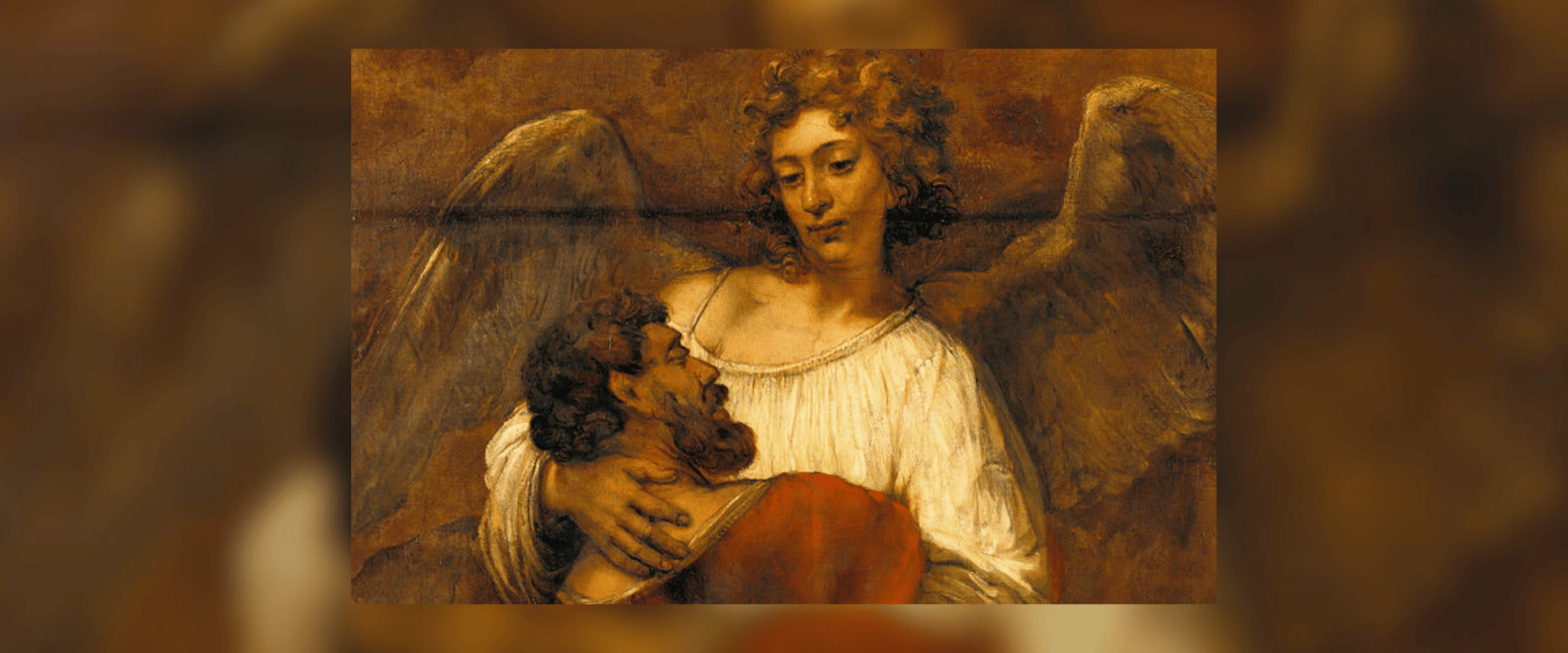
Read within its narrative setting, probed through historical-critical analysis, and traced through its later receptions, the scene in which Jacob wrestles with God reveals itself as a dense theological and literary construction: a story that dares to imagine the human encounter with the divine as dangerous, transformative, and indelibly marked on both name and body.
Jacob’s struggle gathers into a single night the tensions that run through the patriarchal traditions as a whole (election and exclusion, blessing and brokenness, promise and peril) and articulates them in a narrative that resists easy resolution.
In that sense, the ancient story of Jacob at the Jabbok continues to invite readers to recognize in it a narrative mirror of their own encounters with doubt, faith, and the search for meaning before God.
NOW AVAILABLE!
Finding Moses: What Scholars Know About The Exodus & The Jewish Law
Riveting and controversial, the "FINDING MOSES" lecture series takes you on a deep dive into the stories of Moses, the exodus, and a whole lot more...