
Tower of Babel: Story Summary, Bible Verse, & Meaning

Written by Marko Marina, Ph.D.
Author | Historian
Author | Historian | BE Contributor
Verified! See our guidelines
Verified! See our editorial guidelines
Date written: January 4th, 2026
Disclaimer: The views and opinions expressed in this article belong to the author and do not necessarily match my own. - Dr. Bart D. Ehrman
When I was twelve, I received my first illustrated children’s Bible. I still remember flipping through its colorful pages, moving from Adam and Eve in the garden to Noah’s ark, from Moses parting the sea to Jesus and his disciples.
Yet, one image stayed with me more vividly than any other: a vast tower rising into the sky, stretching across two full pages, crowded with tiny figures hauling stones upward. It was the story of the Tower of Babel.
I recall pausing there, staring at the picture, and thinking with a mix of awe and curiosity: this must have been an enormous building. Even as a child, long before I could articulate any historical or scholarly questions, the image itself made an impression, one that would stick with me all these years!
That childhood memory isn’t unique. For many readers, the Tower of Babel is one of those biblical stories that lingers in the imagination, whether first encountered in a children’s book, a sermon, a classroom, or a work of art.
The tale is brief, but its imagery is powerful: a single structure meant to reach the heavens, a moment of divine intervention, and a world suddenly fractured by difference.
Over the centuries, this short passage from the book of Genesis has inspired painters, theologians, poets, and skeptics alike. It has become a symbol invoked whenever people speak about human pride, unity and division, or the mystery of why we do not all speak the same language.
In this article, we’ll take a closer look at the Tower of Babel story from a scholarly and historical perspective.
Rather than assuming what the story means or why it was told, we’ll ask how biblical scholars and historians approach it today, what questions they raise about its origins and purpose, and how it fits within the larger world of ancient literature and thought.
By doing so, we can begin to see this familiar story as a window into how ancient authors tried to make sense of their world, and how modern readers can better understand what they were trying to say.
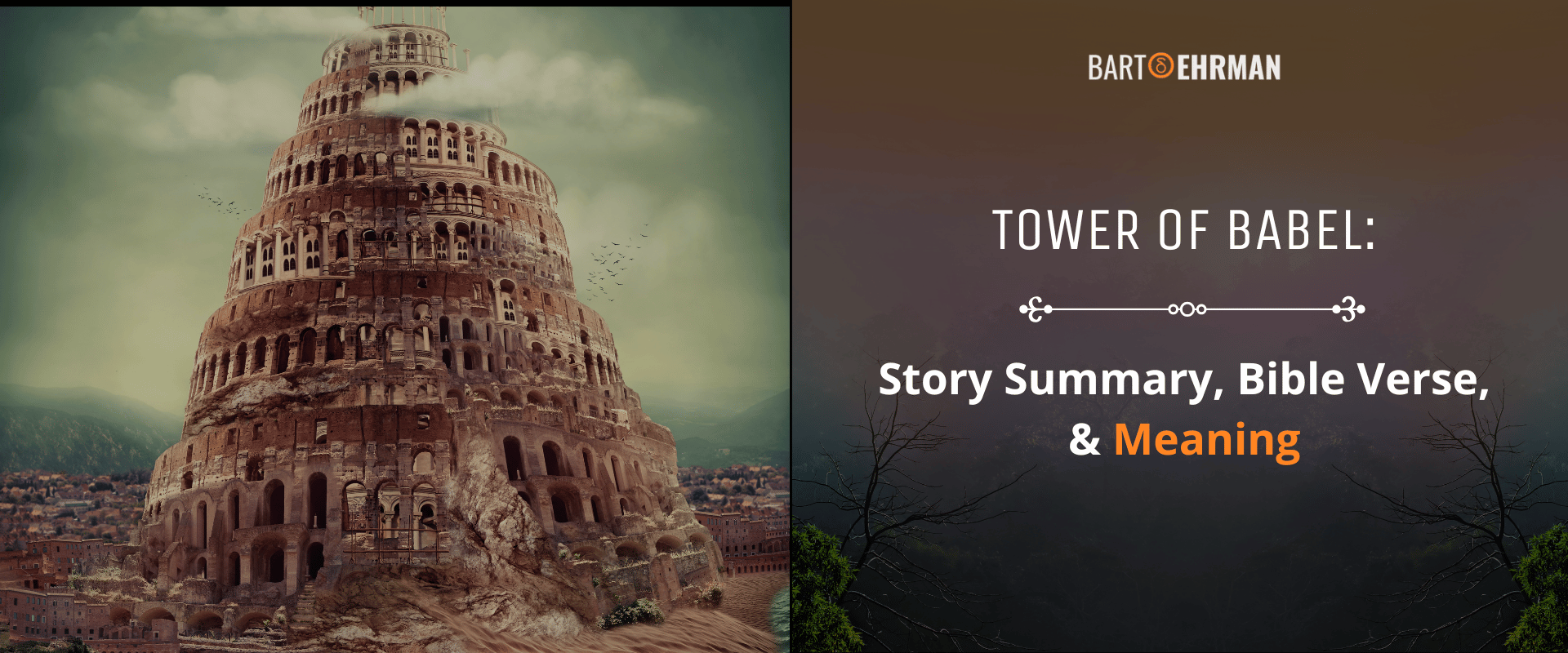
The Tower of Babel Story in the Bible: Summary
Before we enter into the scholarly realm, asking serious questions about this story, we first must situate it within the Bible itself. As many readers know, the Tower of Babel story is found in the Book of Genesis, the opening book of the Pentateuch, long thought in Jewish and Christian tradition to have been written by Moses. Modern biblical scholarship, however, has shown that this picture is far too simple.
Genesis is best understood not as the work of a single author, but as a collection of ancient traditions drawn from different sources, composed and edited over centuries and eventually woven together into the book we have today.
As R. Norman Whybray asserts in The Introduction to the Pentateuch:
(Affiliate Disclaimer: We may earn commissions on products you purchase through this page at no additional cost to you. Thank you for supporting our site!)
There is at the present moment no consensus whatever about when, why, how, and through whom the Pentateuch reached its present form, and opinions about the dates of composition of its various parts differ by more than five hundred years.


Seen from this perspective, the story of the Tower of Babel belongs to what scholars often call the “primeval history” of Genesis (chapters 1-11), a series of narratives about the earliest times, dealing with creation, human disobedience, violence, the flood, and the spread of peoples across the earth.
Regarding the origins of these chapters, Christoph Uehlinger, in Introduction à l'Ancien Testament (Introduction to the Old Testament) notes:
“In Genesis 1-11, one finds literary materials of a very diverse nature: mythological narratives of a cosmogonic and/or anthropogonic type, to which the counter-theme of the flood responds; fragments of euhemeristic traditions, better known from Greek epic and Hellenistic historians, which link mythology and historiography by inserting, between theogony and the history of humankind, phases dominated by minor gods, Titans, giants, and other heroes; etiological narratives, some of which define the essential framework of the human condition, while others more modestly recount a particular invention or foundation (“X was the first to do Y…”); narratives that culminate in exemplary blessings or curses whose significance could be verified even in the narrator’s present, or beyond; programmatic statements embedded within expansive divine speeches; and finally, a large number of genealogical lists and cosmographic tables. Quite evidently, these materials do not stem from the genius of a single author.” (my translation)
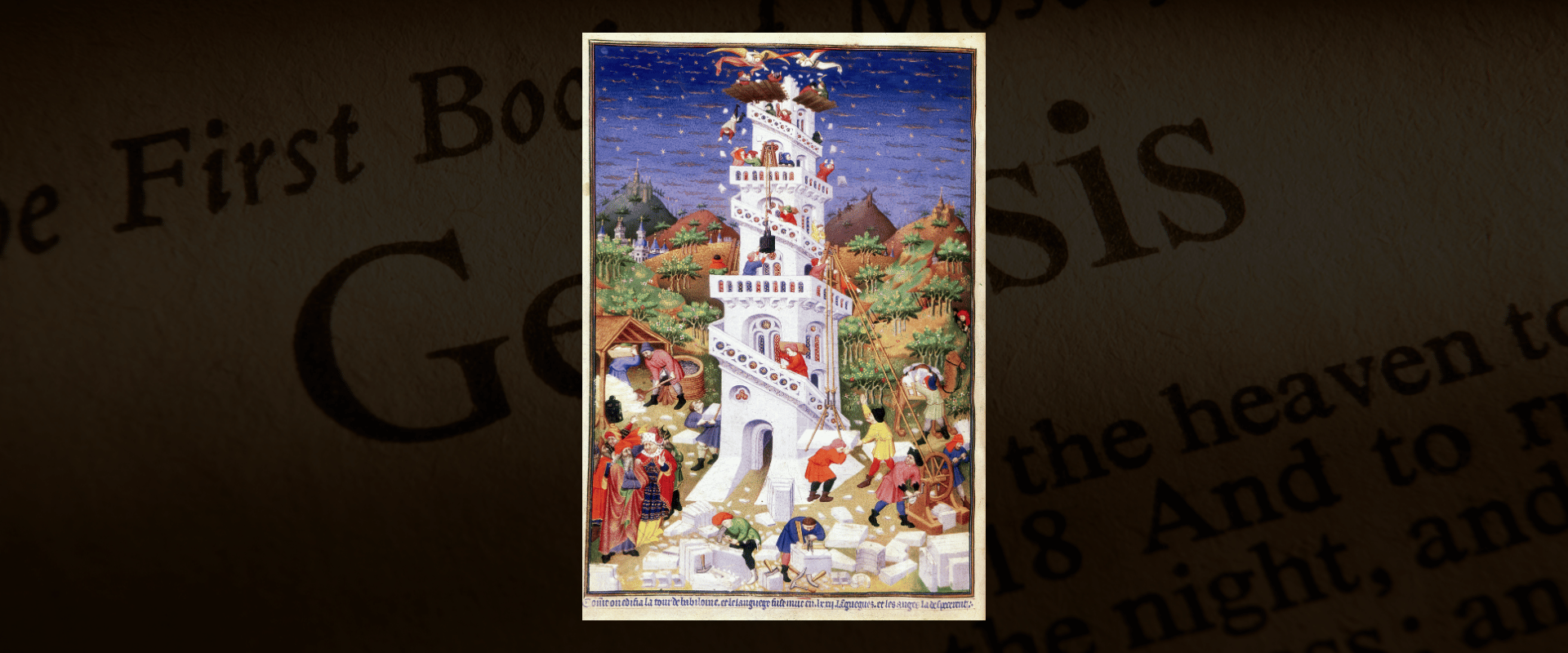
Within that larger and complex framework, the Tower of Babel appears in Genesis 11:1-9, immediately after the Table of Nations in chapter 10 and just after the flood story of Noah and his family. The narrative itself is brief and tightly crafted. It tells of a time when all people shared one language and settled together in the land of Shinar.
There they decided to build a city and a tower “with its top in the heavens,” hoping to make a name for themselves and avoid being scattered across the earth.
God, seeing what they were doing, comes down to observe their work and declares that their unified speech makes anything they plan possible. In response, God confuses their language so that they can no longer understand one another, and then scatters them over the face of the earth.
The city is called Babel, the story concludes, because there the Lord confused the language of all the earth.
It’s a story many of us first encountered as children, and one detail often sticks in the imagination: that enormous tower rising toward the sky. And that leads naturally to a question I remember asking myself even then: is the Tower of Babel still standing? Can we point to its ruins on a map, or walk among its remains?
The short answer is that we cannot. No identifiable archaeological site can be shown to be “the” Tower of Babel, and no ancient ruin can be securely linked to this story.
That simple fact already pushes us beyond the realm of colorful pictures and into the territory of historical inquiry. If the Tower cannot be found, what kind of story is this, and what was it meant to convey?
Those are the kinds of questions that lead us directly into serious scholarship and exegesis, to which we now turn.
Tower of Babel: Scholarly Interpretation (Exegesis)
From a scholarly perspective, the story of the Tower of Babel in Genesis 11:1-9 shouldn’t be read as a literal report of an ancient building project whose remains await rediscovery.
Instead, historians and biblical scholars understand it as part of Israel’s primeval history, a carefully crafted narrative meant to explain enduring features of the human condition.
As Bill T. Arnold explains in his Commentary on Genesis, the Babel episode forms the literary conclusion to the Table of Nations in Genesis 10, showing that the rebellious tendencies of humanity didn’t end with the flood, but now characterize the postdiluvian world as a whole.
Read in this canonical setting, the story highlights that the problem is humanity itself. The narrative is therefore best described as etiological: it seeks to account for why the world is divided into many peoples and languages, while at the same time offering a theological diagnosis of human pride and resistance to divine purpose.
This brings us to the issue of origins. Where did this question originate from? As it turns out, most scholars today agree that the story of the Tower of Babel didn’t arise in isolation, but took shape within the broader cultural and literary world of the ancient Near East, especially Mesopotamia. How did they come to that conclusion?
One of the most striking features of the story is its vivid Mesopotamian coloring. The land of Shinar points to southern Mesopotamia, and the reference to fired bricks and bitumen reflects building techniques typical of Babylonia, not of the stone-based architecture familiar in the Levant.
The “tower with its top in the heavens” is widely understood against the background of ziggurats, massive temple towers that symbolically linked heaven and earth.
Here Ronald Hendel, in his Anchor Yale Bible Commentary, draws particular attention to the great Babylonian ziggurat Etemenanki known as the “House of the Foundation of Heaven and Earth,” whose name and ideology closely parallel the biblical description.
In this light, the Babel story doesn’t arise in a cultural vacuum but engages critically with the monumental religious architecture of Mesopotamian cities. What imperial ideology could celebrate as a cosmic meeting point between gods and humans is recast in Genesis as a symbol of misguided human aspiration.
Scholarly Insights
How Words Remember What People Forgot
While linguistic science has little or nothing to do with the Tower of Babel story in the Bible (see below), linguistic experts can help us understand other major things, such as the origin of entire groups of people known as the Slavs (my own Croats included!).
By comparing shared words across Slavic languages, scholars can reconstruct features of an older, common stage (often called Proto-Slavic) and even sketch the kind of environment in which its speakers once lived.
One intriguing line of evidence comes from ancient Slavic terms for trees and forest life: words for beech, oak, linden, hornbeam, maple, and similar species are inherited across Slavic languages and point to a homeland in a temperate, forested zone north of the Carpathians, in parts of what are today southern Poland and western Ukraine.
The logic is simple: if a speech community has ancient, inherited words for particular tree species, those species were likely part of their everyday environment when the language was still unified.
When combined with historical references to “White Croats” in that region and with archaeological patterns of early Slavic settlement, linguistics helps illuminate how groups that later became Croats, Poles, Ukrainians, and others may once have shared a common past.
Moreover, at the heart of the narrative lies a tension between human unity and divine limitation. The builders speak with one voice, share one language, and act with remarkable coordination.
As Genesis puts it, they urge one another, “Come, let us make bricks, and burn them thoroughly” (Gen 11:3), and then resolve, “Come, let us build ourselves a city, and a tower with its top in the heavens” (Gen 11:4).
These Tower of Babel Bible verses already highlight the collective determination that drives the project forward.
Also, their desire to “make a name for ourselves” (Gen 11:4) expresses more than civic pride. It reflects a quest for lasting renown and security in a world still shadowed by the memory of the flood (“otherwise we shall be scattered abroad upon the face of the whole earth.”)
Yet, as Hendel observes, the story’s literary artistry underscores how language itself becomes both the instrument of human power and the target of divine response. God doesn’t topple the tower but undermines the basis of collective human ambition by confusing speech.
This is where the narrative’s mirroring speeches come fully into view. Just as the builders had said, “Come, let us…” in launching their project, God now declares, “Come, let us go down, and confuse their language there, so that they will not understand one another’s speech” (Gen 11:7).
The echo is deliberate. The same words that expressed human resolve now introduce divine counteraction, creating a dramatic confrontation between human initiative and divine limitation.
The result is a form of poetic justice: “So the LORD scattered them abroad from there over the face of all the earth” (Gen 11:8). In other words, the very scattering the builders feared became their fate.
Arnold’s analysis further sharpens the story’s theological point by situating it within the broader arc of Genesis 1-11. The placement of Babel after the Table of Nations means that human dispersion can be read in two ways at once.
In Genesis 10, it appears as the fulfillment of God’s blessing to “be fruitful and fill the earth,” while in Genesis 11, it becomes the consequence of human rebellion against that same divine will.
The primeval history thus ends in ambivalence! Humanity stands under both blessing and curse, and the narrative presses forward toward a new beginning. Significantly, the very next chapter promises Abraham: “I will make your name great.” This could be understood as presenting a divine gift as the alternative to Babel’s self-made quest for a name.
Finally, scholars have long noted the story’s polemical edge, especially in its explanation of the name “Babel.” In Babylonian tradition, the city’s name was popularly understood as “Gate of God,” a title of prestige and cosmic significance.
Genesis deliberately overturns this claim by linking Babel instead to the Hebrew verb balal, “to confuse.” As both Hendel and Arnold point out, this wordplay is more than clever etymology. Rather, it functions as a subtle critique of imperial ideology.
The city that claimed to be heaven’s gateway is reimagined as the place of confusion and dispersal. From this perspective, the Tower of Babel story reflects Israel’s historical experience in the shadow of Mesopotamian power, recasting the symbols of empire into a narrative about the limits of human ambition.
David M. Carr, in The Formation of Genesis 1-11: Biblical and Other Precursors, concludes:
The preceding analysis takes Gen 11:1-9 as a non-P text [that is, not part of the Priestly source traditionally identified in the Pentateuch], probably composed sometime in the Neo-Assyrian period, that mocks Babylon and its (unfinished brick) tower, depicting them not as the divinely constructed context where a temple bridges to heaven (so, e.g., the Enuma Elish Epic), but as the locus where primeval humanity themselves tried and failed to build a city and heaven-touching tower. A central aspect of its presentation is the idea that primeval humankind was a unity (“one people”) defined by a common speech (Gen 11:1, 6), such that Yhwh’s disruption of this linguistic unity through confusing their speech (Gen 11:7, 9b) caused humans to disperse (Gen 11:8, 9a). Ironically, this story – so focused on how human speech got mixed/confused (Gen 11:7, 9a) – is a showpiece of literary elegance – both in its overall intricate compositional patterns and its saturation with sound and word plays.
Taken together, these scholarly readings show why Genesis 11 is best understood as a rich theological narrative: one that draws on Mesopotamian imagery, probes the dangers of unchecked human unity, explains the fractured state of humanity, and prepares the transition from universal history to the particular story of Abraham and his descendants.
NOW AVAILABLE!
Finding Moses: What Scholars Know About The Exodus & The Jewish Law
Riveting and controversial, the "FINDING MOSES" lecture series takes you on a deep dive into the stories of Moses, the exodus, and a whole lot more...
The Linguistic Question: Did All Languages Come from One at Babel?
The story of the Tower of Babel opens up another area of inquiry that leads us directly to the history of languages. As the story goes, humanity once had only “one language,” and the diversity of speech we experience today is the result of a sudden divine intervention.
But is that a plausible way to think about the origins of human languages? Could we imagine that all human beings once spoke a single tongue, from which every language in the world later emerged?
From the perspective of historical linguistics, languages do not arise or change through abrupt, universal events, but through long, gradual processes of divergence. As communities spread out, lose contact with one another, and adapt to new social and cultural settings, their ways of speaking slowly shift.
Over generations, these shifts accumulate until mutually unintelligible languages emerge. Linguists can often trace such developments within known language families (such as Indo-European, Afro-Asiatic, or Sino-Tibetan) by comparing shared vocabulary and grammatical structures and reconstructing earlier stages of speech.
What this comparative method reveals is multiple deep family trees, each with its own long and complex history.
This picture is powerfully illustrated by Tore Janson in his book The History of Languages, where he emphasizes just how ancient and diverse human language already was in prehistory:
It seems certain that the kind of languages we use have existed for at least 40,000 years. Even in the Upper Palaeolithic period, when all human beings lived as gatherers and hunters and used tools made of bone and stone, languages were fully developed and could have large vocabularies, complex sentences, and all other features found in languages today… Although it is possible to dispute whether the Khoisan languages [languages of the 'San people' in Southern Africa] are ten or twenty, or whether the Australian languages are 250 or 700, there is no question that there are many very different languages… One has to conclude that at that time there was hardly less than one language for every thousand or two thousand people.
Janson’s point is striking! Far from beginning with a single tongue, early human societies were already characterized by remarkable linguistic diversity, even when populations were small and technologically simple.
From this perspective, the Tower of Babel story shouldn’t be considered a scientific account of how languages actually emerged. It would only lead to a serious distortion of a story whose real meaning is found within the theological world of early Israel.
Conclusion
While my first encounter with the Tower of Babel story in the Bible was met with a child-like astonishment at the imagined size of the tower itself, a more scholarly approach that developed years later didn’t erase that fascination with Genesis 11:1-9. It simply transformed it.
What once appeared as a vivid tale about a colossal building came to be understood as a carefully shaped narrative, embedded in the primeval history of Genesis and deeply engaged with the world of ancient Mesopotamia.
Read in this way, the story no longer asks us to look for ruined bricks in the plains of Iraq, but to attend to the questions it raises about human ambition, unity, and the limits that ancient authors believed belonged to the human condition.
Approached in this way, the story remains worth reading because it opens a window into how ancient people made sense of their world, and how careful scholarship today can help us appreciate both the power of their imagination and the historical realities that shaped it.
NOW AVAILABLE!
Finding Moses: What Scholars Know About The Exodus & The Jewish Law
Riveting and controversial, the "FINDING MOSES" lecture series takes you on a deep dive into the stories of Moses, the exodus, and a whole lot more...