
Shahada: The Words, Meaning, and Conditions (Full Text)

Written by Marko Marina, Ph.D.
Author | Historian
Author | Historian | BE Contributor
Verified! See our guidelines
Verified! See our editorial guidelines
Date written: December 17th, 2025
Disclaimer: The views and opinions expressed in this article belong to the author and do not necessarily match my own. - Dr. Bart D. Ehrman
I often remember my childhood trips to my late grandmother’s village in Bosnia and Herzegovina, a place where Muslims and Catholics lived side by side. On the playground, I would occasionally hear other children reciting words that sounded unfamiliar and mysterious to me.
When I asked my father what they were saying, he explained that it was something called the Shahada (a religious confession central to their tradition), adding that I shouldn’t repeat it lightly but should respect it just as they were expected to respect our customs.
That moment marked the first time I encountered the term, long before I had any sense of its weight or complexity.
Years later, while studying the early history of Islam, I returned to that childhood memory with a very different understanding. What once sounded like a strange chant had become recognizable as one of the most meaningful expressions in the Muslim world.
The Shahada is brief enough for a child to overhear on a playground, yet it carries centuries of theological reflection, communal identity, and historical development.
It’s both deeply personal and profoundly communal, an entry point into a global religious tradition and a window into the values that have shaped it.
In this article, we’ll explore how this declaration came to occupy such a central place in Islamic faith and practice. Before turning to the meaning, emergence, and conditions associated with the Shahada itself, we’ll first look at the broader ritual framework in which it is situated.
That context will help illuminate how a short phrase evolved into one of the most recognizable features of Islam.
Each exploration into the historical origins and development of Islam brings up the question of how its earliest texts compare with those of other great religious traditions.
If you’ve ever wondered how the Quran’s historical challenges line up with those of the Bible, Dr. Bart Ehrman and Dr. Javad Hashmi offer a fascinating guide. In their eight-lesson course, The Bible and the Quran: Comparing Their Historical Problems, they walk you through the origins of Islam, the formation of the Quran, and the historical issues surrounding both scriptures.
It’s an illuminating deep dive for anyone interested in how these two sacred texts emerged and evolved.
The Five Pillars of Islam: Context and Historical Emergence
To talk meaningfully about the Shahada, we first need to set the broader context of Islamic belief and practice. Even the term Islam offers an early glimpse into the foundations of this rich and complex tradition.
As Christopher Partridge explains in A Brief Introduction to Islam:
(Affiliate Disclaimer: We may earn commissions on products you purchase through this page at no additional cost to you. Thank you for supporting our site!)
Islam understands itself fundamentally as being ‘natural religion’, in that every created thing exists in dependence upon God, in obedience to his creative and sustaining power, and with the purpose of expressing adoration to God. For the human, this should lead to a conscious commitment to a life of thankful and praise-giving obedience to God. The word muslim means one who lives his life according to God’s will; Islam means ‘submission to God.’


How, then, does one submit to God in a properly ordered way? For Muslims, everything is anchored in the central ritual and ethical practices known collectively as the Five Pillars of Islam.
As Abdennour Bidar observes in his book Les Cinq piliers de l'Islam et leur sens initiatique (The Five Pillars of Islam and Their Initiatory Meaning), these pillars stand “at the heart of the One and Infinite Reality of God.” Their role isn’t merely to prescribe duties but to shape a way of life grounded in gratitude, discipline, and communal belonging.
Historically, the Five Pillars didn’t emerge as a fully formed list at the beginning of Islam. Qur’anic passages lay out a variety of religious obligations (prayer, almsgiving, fasting, pilgrimage, and affirming faith in God and His messenger), yet the structured, fivefold framework developed gradually within the early Muslim community.
Over the first few centuries, jurists and scholars clarified and organized these practices into the standard formulation familiar today: the Shahada (the declaration of faith), salat (ritual prayer), zakat (almsgiving), sawm (fasting during Ramadan), and hajj (pilgrimage to Mecca).
Readers interested in a fuller, dedicated treatment of these practices can consult our separate article about Muslim beliefs!
By understanding how these foundational practices emerged and took shape, we can more clearly appreciate why the Shahada came to stand at the very threshold of Muslim identity. With this framework in place, we can now turn to the meaning, history, and significance of this brief but powerful declaration.
What Is the Shahada? Meaning, Emergence, and Significance
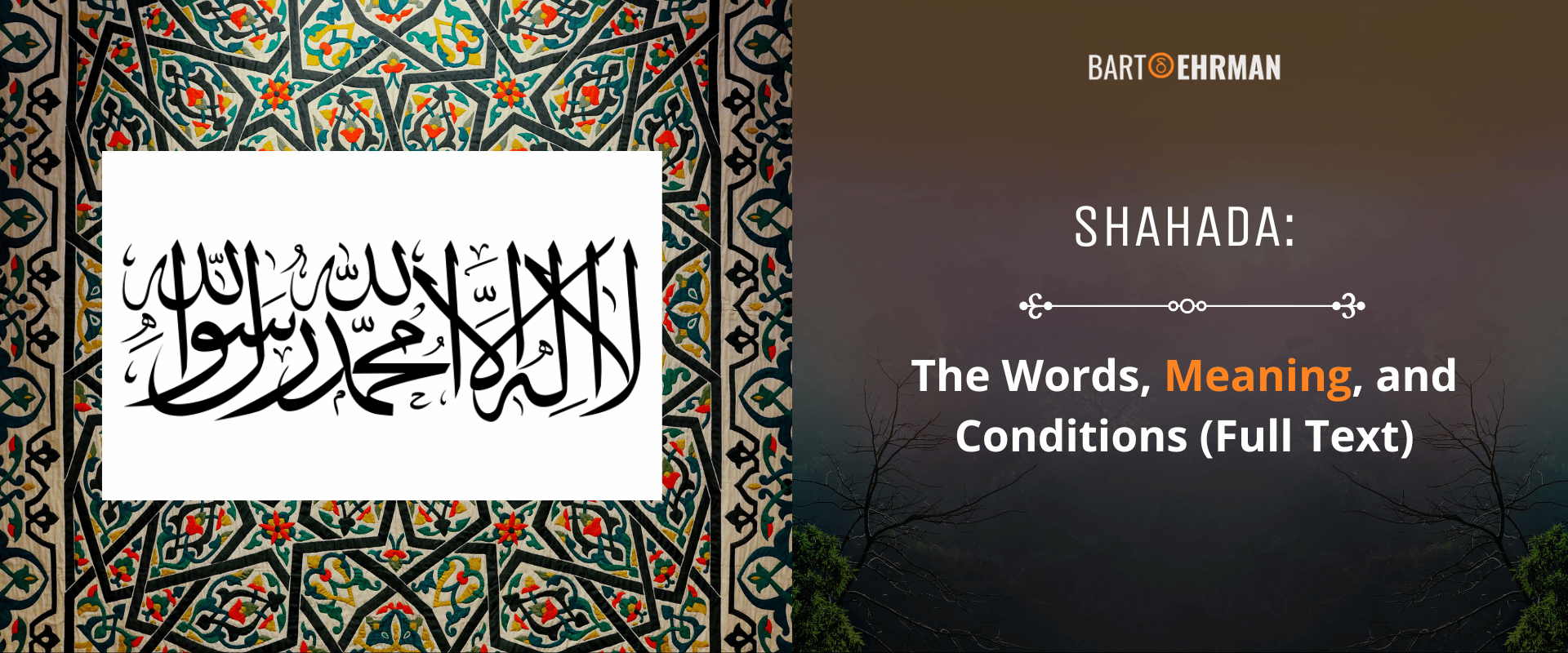
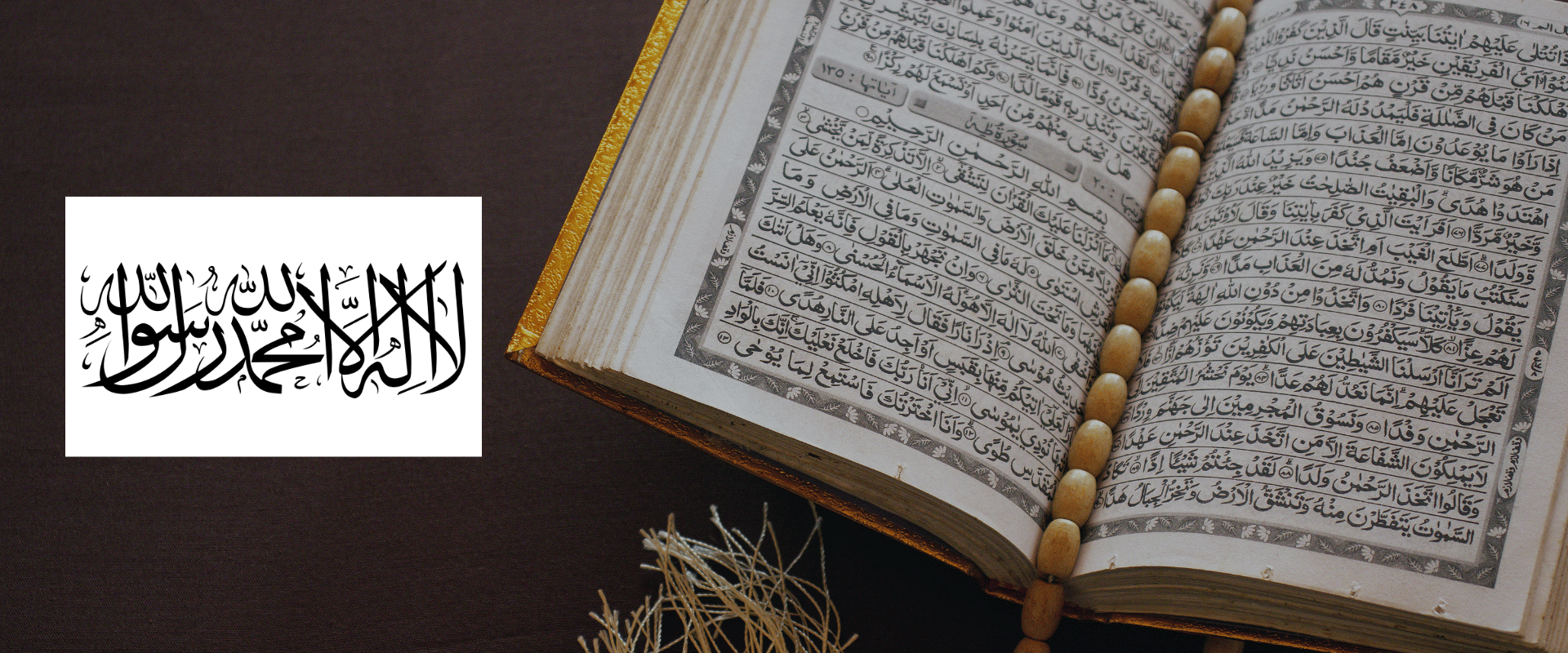
The Shahada (full text: “I testify that there is no god but God, and I testify that Muhammad is the Messenger of God”) is the concise and defining declaration of Islamic faith.
Although brief in wording, these two sentences encapsulate central themes of Islamic theology: the affirmation of absolute divine unity and the recognition of Muhammad’s prophetic mission.
Together, they form the first of the Five Pillars of Islam and mark the formal boundary between belonging and not belonging to the Muslim community. As Bernard Lewis notes in Islam: The Religion and the People, acceptance or rejection of this creed historically determined one’s status as a Muslim or a non-Muslim.
The first clause, (“there is no god but God”) expresses tawḥīd, the uncompromising monotheism that lies at the heart of Islamic belief. Its meaning reaches beyond the rejection of multiple deities; for Muslims, it affirms the fundamental truth that all existence depends upon a single, sovereign Creator.
As an Egyptian Sufi scholar, jurist, and mystic al-Sharani explains:
“According to Islam, every human being carries within themselves the fitrat Allâh, the primordial nature that God has bestowed upon humankind. Human nature is intrinsically connected to its Creator. The human heart possesses, in fact, a natural inclination to seek and to recognize Truth. To have faith therefore means to reconnect with this primordial nature and to remain faithful to the original Covenant with God, by following the path of the unchanging Religion (al-dîn al-qayyim) devoted to the One and to none other.” (my translation)
In the Qur’an and later Islamic thought, divine unity shapes the way believers understand creation, human purpose, and ethical responsibility.
Tariq Ramadan, in his book Introduction to Islam, explains the theological significance of Shahada's first clause:
All the other pillars of faith and ritual practice revolve around this central axis: they are either consequences of a faith in God or the means by which human beings can experience faith as it should ideally be experienced, by attaching themselves to His being and by gaining access to the refuge of peace and security born of their gift of their selves to God. The Arabic expression al-imān thus means not only faith expressed by an act of belief in God, but its root, a-ma-na, evokes the idea of a place of security, of peace, and of fulfillment. To believe in God thus means to enter into His peace.
Scholarly Insights
Is Monotheism a Path to Peace, or a Recipe for Trouble?
Our exploration of the Shahada naturally raises broader questions about monotheism itself. The declaration that “there is no god but God” asserts a strong and exclusive claim about divine reality, and some historians (most famously Edward Gibbon in the 18th century) interpreted such exclusivity as inherently prone to intolerance.
In The History of the Decline and Fall of the Roman Empire, Gibbon argued that monotheistic religions, by insisting on a single truth, leave little room for compromise and therefore tend toward conflict with those who reject or misunderstand that truth.
More recent scholarship, however, has challenged this deterministic view. Charles Kimball, in When Religion Becomes Evil, offers a more nuanced explanation: he doesn’t see monotheism itself as the source of violence, but rather points to specific warning signs (such as absolute truth claims used to suppress dissent, blind obedience to leaders, and sanctifying warfare) that can corrupt any religious tradition.
In Kimball’s framework, violence arises not from the belief in one God but from the ways human communities use (or misuse!) their religious convictions within particular social and political contexts. This approach emphasizes the complexity of religious life and cautions against sweeping generalizations.
Both perspectives invite a bit of reflection, especially when we consider how a monotheistic declaration like the Shahada shapes identity and community. If this discussion sparks your curiosity, you might enjoy dipping into Gibbon’s classic argument and then opening Kimball’s very different take on what makes religion go wrong.
Spend some time with both voices, compare their insights, and see which one speaks more convincingly to you. After all, part of understanding religion (any religion) is exploring the questions for yourself.
The second clause (“Muhammad is the Messenger of God”) adds a historical and revelatory dimension because it recognizes Muhammad as the vehicle of God’s final guidance to humanity. Over time, Muslim tradition came to emphasize that Muhammad isn’t only a prophet but the last prophet, a belief that helped solidify the Shahada as a succinct formulation of faith.
The significance of the Shahada extends well beyond its use as a doctrinal statement. For Muslims, the declaration functions as the “gateway” into religious life. Those who are converting to Islam traditionally recite it in the presence of witnesses, and it accompanies many moments of ritual and personal significance throughout a believer’s life.
In daily prayer, legal testimony, devotional practice, and even in naming rituals for newborns, the Shahada serves as a continual reminder of the central claims of Islam.
Although the two-part formulation of the Shahada is now universally recognized, its emergence was gradual.
The Qur’an contains many verses that assert God’s oneness and acknowledge Muhammad’s role as messenger, yet the precise pairing seen today doesn’t appear as a single, fixed sentence in the earliest Islamic scripture.
Instead, it seems to have developed organically within the first generations of the Muslim community, shaped by preaching, liturgy, and the need for a clear communal identifier in a religiously diverse environment.
In 7th-century Arabia (a context in which polytheism, Judaism, Christianity, and smaller monotheistic movements coexisted) the Shahada offered both a theological statement and a marker of group identity. Lewis highlights that Jews and Christians readily affirmed divine unity, but the recognition of Muhammad’s prophethood distinguished Islam decisively from neighboring traditions.
Fred M. Donner notes that the distinctive Islamic identity emerged gradually, culminating in the late 7th and early 8th century.
It doesn’t come as a surprise that, by that time, Shahada had become firmly established as a central feature of Islamic life. It appeared in legal documents, on early Islamic coinage, and in the inscriptions of prominent structures, such as the Dome of the Rock in Jerusalem.
These developments signal how the creed moved from oral declaration to a visible expression of communal identity and political authority.
As Islam expanded geographically and culturally, the Shahada’s function as a shared statement of belief helped unify diverse populations under a common religious framework. Its conciseness proved particularly effective in communicating the essential claims of Islam to new communities across the Middle East, Africa, and beyond.
Today, the Shahada remains one of the most recognizable expressions of Muslim faith. Its two clauses continue to shape Muslim theology, ritual practice, and personal devotion, while also serving as a historical link to the formative period of Islam. And despite its brevity, the declaration embodies centuries of religious reflection and communal life.
NOW AVAILABLE!
Did Jesus Think He Was God? - A Closer Look at the Evidence
Soon after Jesus’ death, his disciples claimed that he was God. What did they mean by that? Was he the One and Only God, Yahweh? Did he himself think so?
FAQ: How to Perform the Shahada
Before diving into the practical questions surrounding the Shahada, it’s worth acknowledging something: there is no shortage of curiosity about Islam.
People encounter Muslim communities, traditions, and cultural influences everywhere (from global politics to the coffee shop down the street) and, naturally, questions follow. So, to make things a little easier (and to spare your search engine), we’ve put together a brief FAQ that tackles some of the most common questions about Shahada with clarity, accuracy, and maybe even a smile.
Do you close your eyes or get down on your knees?
Islamic tradition doesn’t prescribe a special posture for reciting the Shahada. A person may stand, sit, or simply remain in a calm, attentive state. In cases of formal conversion, witnesses are usually present, but the physical position itself has no bearing on the validity of the declaration. What matters is the intention and sincere affirmation of the words, not the body’s posture.
Do you whisper it or yell it?
The Shahada can be spoken in a normal, audible voice. In other words, neither whispering nor shouting is required by Islamic law.
Classical jurists simply emphasize that the person should articulate the words clearly enough for themselves — and, in the case of conversion, for witnesses — to hear. No tradition encourages dramatic delivery. The focus is sincerity, not volume.
Do you say it every day or just once to convert to Islam?
A person entering Islam traditionally recites the Shahada once, with understanding and intention, which marks their formal conversion. Practicing Muslims, however, repeat the Shahada daily because it appears within the five ritual prayers and in other devotional contexts.
Scholars, however, often distinguish between its once-in-a-lifetime legal function and its ongoing devotional function. So, while one recitation establishes membership in the community, regular recitation expresses continued faith.
What are the 7 conditions of the Shahada?
In later Sunni theological teaching (particularly within Hanbali/Athari circles) the Shahada is often described as having seven conditions:
#1 – Knowledge of what the words mean
#2 – Certainty without doubt
#3 – Submission to God’s guidance
#4 – Acceptance of their implications
#5 – Sincerity of intention
#6 – Truthfulness in speech
#7 – Love for this core affirmation of faith
A short doctrinal treatise by Abd al-Razzāq al-Jabrī is among the earliest clear sources presenting these seven conditions in their now-familiar list, drawing on broader medieval discussions of faith and intention.
While this framework isn’t universal across all periods of Islamic theology, it remains influential in some contemporary teaching traditions.
Conclusion
Looking back on that childhood moment in Bosnia, when unfamiliar words echoed across a village playground, it is easier now to understand why they carried such meaning for the children who recited them. What once sounded mysterious has, through the study of history and religion, revealed itself as a declaration woven into the fabric of Muslim identity.
The words of the Shahada are simple enough for a child to memorize, yet they encapsulate the theological commitments and communal boundaries that shaped the earliest Muslim community and continue to inform Islamic life today.
Examining the Shahada within its broader historical and ritual setting allows us to appreciate its complexity without losing sight of its brevity.
From its emergence in the first generations of Islam to its role in contemporary devotional practice, the declaration serves as both a summary of belief and a gateway into a global religious tradition.
Finally, understanding how it functions helps clarify why those few words have endured across centuries and cultures, and why they remain central to the self-understanding of more than a billion people around the world.
NOW AVAILABLE!
Did Jesus Think He Was God? - A Closer Look at the Evidence
Soon after Jesus’ death, his disciples claimed that he was God. What did they mean by that? Was he the One and Only God, Yahweh? Did he himself think so?