
Massacre of the Innocents: History vs Myth

Written by Marko Marina, Ph.D.
Author | Historian
Author | Historian | BE Contributor
Verified! See our guidelines
Verified! See our editorial guidelines
Date written: November 20th, 2025
Disclaimer: The views and opinions expressed in this article belong to the author and do not necessarily match my own. - Dr. Bart D. Ehrman
Going to a Catholic church during the Christmas season brings feelings of warmth, renewal, and hope.
Surrounded by carols, candlelight, and nativity scenes, believers around the world are reminded of the comforting message of God entering the world as a child. The Christmas story evokes peace and joy, shepherds rejoicing, angels singing, and a newborn lying in a manger.
Yet, tucked within the same Gospel that tells of this wondrous birth lies a very different kind of story, one that darkens the edges of the celebration. It’s the episode known as the Massacre of the Innocents: the account of King Herod ordering the slaughter of Bethlehem’s infant boys.
I remember when I first learned about it as a child. The idea that such cruelty could be part of the Christmas narrative was deeply unsettling.
I couldn’t understand how violence, fear, and murder could coexist with a story meant to bring joy and light. And yet, as the Gospel of Matthew presents it, this grim scene isn’t an accidental addition. It’s an integral part of the story of Jesus’ birth, however disturbing it may be.
Years later, as I began studying the Bible more seriously, I found myself asking different questions, not just about its emotional impact, but about its historical reality. Did this horrific event really take place? If it did, why is it mentioned only in one Gospel and nowhere else in our ancient sources? Could it be that Matthew included it for reasons beyond the merely historical?
In the pages that follow, we’ll look more closely at this striking episode, first recalling what the Bible actually says, then exploring what we know about Herod the Great, and finally asking what purpose such a story might have served within Matthew’s Gospel.
Whether history or myth, the Massacre of the Innocents remains one of the most haunting episodes ever linked to the Christmas story.
But before we embark on our journey, I want to invite you to check out Bart D. Ehrman’s excellent course The Unknown Gospels. In eight 30-minute lessons, Dr. Ehrman presents a historically grounded analysis of the documents that form the basis of the Christian religion! If you think everything in the Gospels is accurate history, this course is for you!
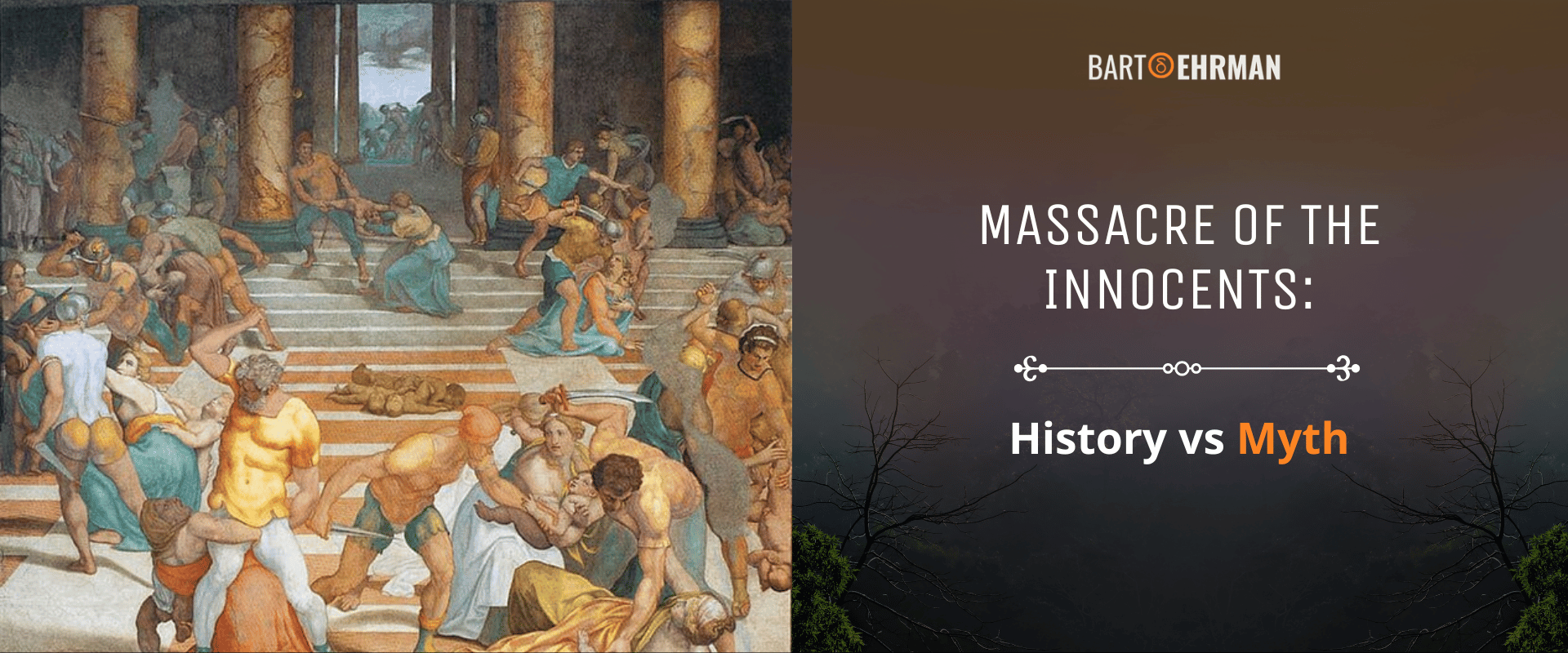
What Was the Massacre of the Innocents? Overview of the Biblical Story
What was the Massacre of the Innocents? To answer that question, we need to get back to the pages of the New Testament!
Writing approximately 50 years after Jesus’ death, the author of Matthew’s Gospel presents an account of events surrounding Jesus’ birth that differs notably from those in the other Gospels. Following the visit of the Magi from the East, Matthew recounts that an angel appeared to Joseph in a dream, warning him that King Herod sought to destroy the child.
Obeying the divine message, Joseph took Mary and the infant Jesus and fled by night to Egypt, where they remained until Herod’s death. When Herod realized that the Magi hadn’t returned to inform him of the child’s location, Matthew says he became enraged.
In response, he ordered the killing of all male children in Bethlehem and its surrounding region who were two years old and under, the age he had inferred from the Magi’s (wise men that came to visit baby Jesus after following a star) report about the time of the star’s appearance. The act, meant to eliminate a potential rival to his throne, is presented in the Gospel as a calculated political measure driven by fear and suspicion.
According to Matthew, this episode fulfilled a prophecy from the Hebrew Scriptures. He cites the words of the prophet Jeremiah: “A voice was heard in Ramah, wailing and loud lamentation, Rachel weeping for her children; she refused to be comforted, because they are no more.”
In the Gospel narrative, this verse serves to frame the event within Israel’s broader story of suffering and loss. It’s significant that this episode (referred to as the Massacre of the Innocents) appears only in the Gospel of Matthew. The other canonical Gospels, including Luke’s detailed infancy narrative, make no mention of it.
However, before we can address the question of its historical authenticity, we need to take a closer look at the main figure driving the story: King Herod himself.
By the way, to learn more about the boundaries between the history, myth, and tradition in the stories of Jesus’ birth, check out Bart’s course Did the Christmas Story Really Happen? The Birth of Jesus in History & Legend.
King Herod: The Portrayal of the Client King
To understand the Massacre of the Innocents and its central figure, we must first situate Herod the Great within the broader historical context of the late Roman Republic and the early Empire.
Herod lived through one of the most turbulent eras in Roman history, a time of civil wars and shifting allegiances that reshaped the Mediterranean world. In 44 B.C.E., Julius Caesar was assassinated, and the following year, the Second Triumvirate (composed of Mark Antony, Octavian, and Lepidus) emerged to fill the power vacuum.
Herod, then a young ruler in Palestine, initially allied himself with Antony, whose influence extended across the eastern provinces. When Antony was defeated by Octavian at the Battle of Actium in 31 BCE, Herod shrewdly realigned himself with the victor.
Peter Richardson and Amy Marie Fisher describe the shifting of the political tides and the capability of Herod to anticipate possible problems and find the suitable solutions:
(Affiliate Disclaimer: We may earn commissions on products you purchase through this page at no additional cost to you. Thank you for supporting our site!)
For a full decade, from 40 bce - when Antony and Octavian and Herod had spent a week together in Rome - until Actium, Antony had been the lynchpin in Herod’s position, and Herod had justified Antony’s trust. Octavian knew Herod and had followed his career, but he had little idea how Herod would respond now. He had, however, some reasons for thinking well of Herod, beginning with the ties between Antipater and Julius Caesar, Herod’s father and Octavian’s adoptive father... Antony’s cause was obviously hopeless, so Herod risked everything on a single throw: he would go to Octavian to offer his support. He appointed his younger brother Pheroras to manage affairs in his absence, and then sent his children, with Salome his sister and Cypros his mother, to Masada. Relations within the family were sufficiently tense that he sent Mariamne and her mother Alexandra to Alexandreion, with his steward, another Joseph, and Soemus, an Iturean, in charge... Herod, now about forty-three years old, met the decade-younger Octavian at Rhodes, without crown or other signs of royal status. Herod stressed his integrity, saying he would be as loyal to Octavian as he had been to Antony. The transfer from one patron to another was duly concluded; Octavian expressed thanks that Herod did not have to share Antony’s defeat. The accounts can best be understood as patronage operating at the highest levels of society. Octavian received Herod more enthusiastically than Herod had any right to expect, promising he would reign “more securely than before,” confirming Herod as “friend and ally,” and bestowing additional honors.


So, accompanying Octavian/Augustus from Egypt and pledging loyalty, Herod secured his position and was confirmed as Rome’s client king in Judea.
Augustus is said to have later remarked that he would rather be Herod’s pig than his son (melius est Herodis porcum esse quam filium), an ironic comment on Herod’s Jewish adherence to dietary laws and his notorious record of executing members of his own family.
Herod’s lineage reflected the complex ethnic and political landscape of the region. His grandfather, Antipater, was an Idumean (a descendant of the Edomites) who had converted to Judaism and was appointed strategos (military governor) of Idumea by the Hasmonean ruler Alexander Jannaeus.
Herod’s father, also named Antipater, rose to prominence during Rome’s campaigns in the East. Aligning himself with Pompey during the Roman capture of Jerusalem in 63 B.C.E., Antipater helped restore Hyrcanus II to the throne.
When Julius Caesar later defeated Pompey, he rewarded Antipater for his loyalty by appointing him procurator of Judea and granting him Roman citizenship. Herod’s mother, Cypros, came from Nabatean aristocracy and was related to King Aretas of Petra, further tying the family to both Jewish and Arabian elite networks.
Herod’s early political career was marked by decisive (and often ruthless) action. Appointed governor of Galilee in 47 B.C.E., he swiftly crushed a local uprising led by Hezekiah, executing many of the rebels.
His efficiency impressed Roman authorities but alarmed the Jewish leadership, and the Sanhedrin sought to try him for overstepping his authority. Herod escaped condemnation, likely due to the intervention of the Syrian governor, who recognized his potential as a stabilizing force in the volatile region.
From this point onward, Herod proved a capable, pragmatic, and, at times, brutal ruler who secured Roman interests while consolidating his own power base.
Everett Ferguson, in his book Backgrounds of Early Christianity, describes Herod’s rule in the following way:
Herod proved to be an able king. His firm rule brought peace and order to his realm and successfully put down brigandage. He brought great wealth to his kingdom through agricultural and commercial enterprises. He spent these funds in a lavish building program – not only in his own realm but in other cities as well. Most notable for Jewish history was his massive rebuilding of the temple, planned so that the building of the sanctuary was done by trained priests without the interruption of the worship… He also built a theatre and amphitheatre in Jerusalem; and on the site of Strato’s Tower he built the city of Caesarea as the port of entry to his realm.
Despite his reputation for violence, Herod generally avoided direct confrontation with Jewish religious sentiment. He refrained from placing imperial symbols within the Temple precincts and supported Jerusalem’s infrastructure, including improving the city’s water supply.
At the same time, Herod actively cultivated loyalty in Rome and abroad. He contributed funds to public works and temples throughout the Mediterranean, sponsored the Olympic Games (in either 12 or 8 B.C.E.), and supported both Roman and Samaritan cults.
For over three decades, Judea remained relatively peaceful, its borders restored to something resembling the territorial scope of ancient Israel under David.
Herod’s long reign, however, ended in paranoia, intrigue, and family tragedy. In his later years, he executed several of his sons and his beloved wife, Mariamne, under charges of conspiracy, actions that contributed to his reputation for cruelty in both Jewish and Roman sources.
In his study Hérode le Grand (Herod the Great), Christian-Georges Schwentzel explains the outcome of Herod’s paranoia:
“Political assassinations multiplied in the years following Herod’s confirmation by Octavian. The first to be executed, in 28 B.C.E., was Alexandra [the Hasmonean princess, mother of Mariamne and grandmother of Herod’s sons]. Then followed a series of Herod’s close associates, accused – rightly or wrongly – of conspiracy: Sohaimos, Lysimachus, Antipater Gadias, and Dositheus. All these condemnations had one thing in common: they were based on accusations made by Salome [Herod’s sister, a powerful and influential figure at court]. The king’s sister and confidante effectively dominated court life; she spent her time spying on courtiers and continually reporting to her brother any real or imagined plots directed against him. It was she herself who uncovered the conspiracy of her second husband, Costobarus, whom she denounced and had executed – just as she had earlier done to Joseph, her first husband.” (my translation)
It appears that dinner invitations from Herod came with no guarantee of making it to dessert. But again, with relatives like these, he hardly needed enemies!
When he died in 4 B.C.E., the kingdom was divided among his surviving sons, bringing to a close a reign of nearly 40 years. With that historical context set, we can now turn our attention to the infamous episode known as the Massacre of the Innocents!

Did the Massacre of Innocents Really Happen?
Most critical scholars today, as exemplified by Michael Grant’s book, hold that the Massacre of the Innocents cannot be taken as something that really happened. He writes:
The Massacre of the Innocents is all that most people have heard about Herod the Great… As will become clear, however, when we come to this last phrase of Herod’s long life, the tale is not history but myth or folk-lore: a portentous symbol of the grip which one man’s formidable personality exerted upon the imagination of his contemporaries.
As it turns out, when Matthew’s account is examined in light of the available historical evidence, it stands apart as an isolated and unsupported tradition.
The problem isn’t that Herod was incapable of such an atrocity (as we saw, his reign offers many examples of ruthlessness) but that every other source from the period remains entirely silent about it.
Scholarly Insights
From History to Memory: The Afterlife of Herod the Great in Christian Imagination.
As a historian of early and late antique Christianity with a special interest in collective memory and reception history, I like to look beyond the first centuries to see how New Testament figures continued to live on in the imagination of later generations.
Following the insights of post-linguistic-turn historiography, what matters is not only what happened but how it was remembered, represented, and re-narrated across time. Few examples illustrate this more vividly than the evolving image of Herod the Great.
As it turns out, the massacre of the innocents scene inspired one of the earliest surviving depictions of royal evil: a 5th-century mosaic in Santa Maria Maggiore in Rome. There, the artist (too modest to portray the slaughter itself) shows Herod enthroned, receiving mothers who do not yet know their children’s fate.
The viewer’s awareness of the impending tragedy renders the scene all the more haunting. This early image set the pattern: Herod, the false king who turned against the divine child, became the Christian symbol par excellence of political power corrupted by fear.
Throughout the Middle Ages the motif flourished. Giovanni Pisano’s sculpted Massacres in Pisa and Pistoia, and Giotto’s frescoes in Assisi and Padua, placed Herod’s cruelty at the heart of Christian visual storytelling.
Over time, the historical king of Judea faded, replaced by an archetype: the persecutor of innocence, the ruler blinded by insecurity. Thus the memory of Herod, rooted in Matthew’s narrative of the Massacre of the Innocents, endured for centuries as a mirror through which Christian culture contemplated the moral dangers of authority itself.
The first and most striking fact is that Josephus, our principal historical source for Herod’s life and times, says nothing about any such massacre. Josephus was a 1st-century Jewish historian who chronicled in extraordinary detail the political and social turbulence of Roman Judea.
His works, The Jewish War and Antiquities of the Jews, preserve accounts of Herod’s political maneuvering, his architectural achievements, and his acts of violence, including the execution of his wife Mariamne, three of his sons, and several members of his extended family.
Josephus also recounts lesser uprisings, such as those led by charismatic prophets and insurgents, including one “Egyptian” prophet who stirred up revolt during the Roman procuratorship. In short, he wasn’t inclined to omit the darker aspects of Herod’s rule or the unrest of the age.
That he never mentions a mass killing of infants makes it exceedingly difficult to treat Matthew’s report as a historical event.
It should be noted that Everett Ferguson, for instance, has argued that the massacre might have been too small in scale to attract Josephus’ attention.
Bethlehem was a modest village, perhaps with only a few hundred inhabitants; the number of male children under the age of two could have been fewer than twenty. It’s conceivable, therefore, that the slaughter of a few infants in an obscure hamlet might have gone unrecorded.
Yet this explanation isn't fully convincing. As Raymond E. Brown explains in his masterpiece The Birth of the Messiah, Josephus’ interest in Herod’s character and the political psychology of his reign was such that even a minor atrocity revealing his paranoia or cruelty would have suited his narrative perfectly.
Moreover, no other contemporary writer, Jewish or Roman, ever refers to this event, not Philo of Alexandria, not Tacitus, not Suetonius. The silence of all independent sources suggests that Matthew’s account doesn’t rest on historical memory but on something else entirely.
Further reasons reinforce this conclusion. Matthew’s infancy narrative is filled with elements that mirror well-known biblical patterns and ancient story motifs. Herod’s fear of a rival king, the consultation of learned men, the deceit of the ruler, and the slaughter of children all echo scenes from the story of Pharaoh and Moses in the Book of Exodus.
Additionally, in ancient literature, especially within Jewish and Greco-Roman traditions, the birth of a great figure was often surrounded by omens, prophecies, and threats from a jealous tyrant. Such patterns can be found in legends about the births of Sargon of Akkad, Cyrus the Great, and even the Roman emperor Augustus.
Gilbert Picard, in his article ”La date de naissance de Jésus du point de vue romain” (“The Birth of Jesus from the Roman Perspective”), notes:
“It’s easy to understand the reasons that led Matthew to present the birth of Jesus in the version he fashioned. The hatred that almost all Jews felt toward Herod made it desirable to portray the Savior as being persecuted by the worst of tyrants. Certainly, the king’s successors – beginning with Archelaus – were no better than he; but they were less well known and, in practice, deprived by Rome of any real autonomy and therefore of true responsibility. Moreover, as we have seen, Matthew is entirely lacking in historical sense. His testimony becomes reliable only from the moment when he finally encounters the personality of Jesus himself, whose first author was probably the apostle.” (my translation)
The Massacre of the Innocents, therefore, fits this literary and symbolic framework far more naturally than it does the historical record of 1st-century Palestine.
Moreover, Mireille Hadas-Lebel points out that Herod, “toward the end of the year 29 BCE, (…) had executed the woman he cherished, his Hasmonean wife Mariamne. From that moment on, he was no longer the same man: (…) executions multiplied, among the people as well as at court, and even within the royal family. Thus there was formed for posterity the image of a Herod as a ‘slayer [massacrer] of innocents.’” (my translation)
In other words, the memory of Herod’s historical brutality helped create the later image of a ruler capable of any atrocity, providing fertile ground for the development of the Gospel story of the Massacre of the Innocents.
In light of this evidence, the consensus among historians is clear: the massacre of the innocents is almost certainly a legendary episode. Schwentzel even asserts that “it seems pointless [il paraît vain] to look for any historical basis” of this story.
Peter Richardson and Amy Marie Fisher summarize the arguments against the historicity:
The story includes several indications that Matthew constructed it, more or less of whole cloth: (1) it is absent from the other gospels; (2) there are major differences between Matthew’s and Luke’s birth accounts; (3) Josephus and other first-century sources are silent concerning the event; (4) rather obvious theological concerns account for the story’s development; (5) it relies on Old Testament motifs to develop the story."
But if this episode never happened, why would Matthew include it in his Gospel? What is the meaning of that story? To this question we now turn.
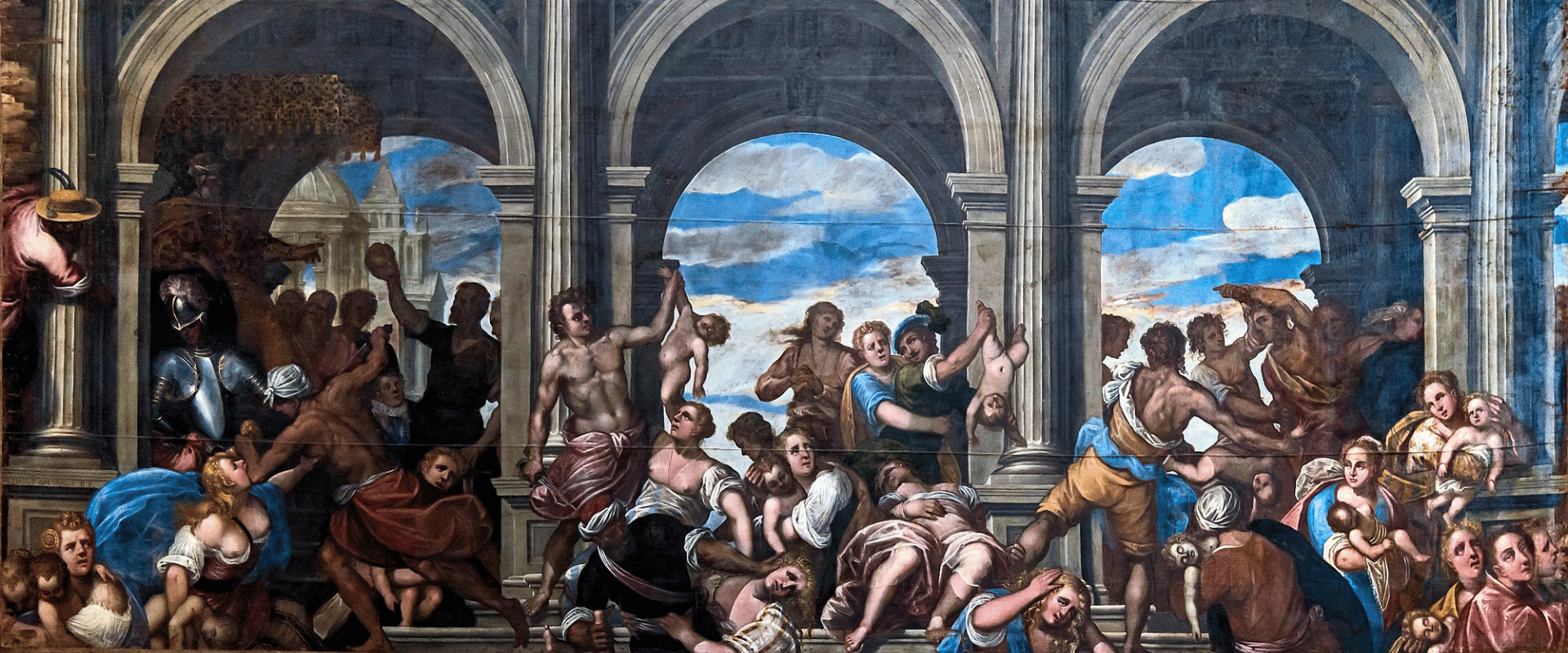
Massacre of the Innocents: A Brief Exegesis
If the Massacre of the Innocents didn’t happen, why did Matthew include it? What was he trying to achieve from both a rhetorical and a theological perspective? Read within 2:13-23, the scene is the center panel of a tightly composed triptych:
#1 – The flight to Egypt with a fulfillment from Hosea;
#2 – The killings at Bethlehem with a fulfillment from Jeremiah;
#3 – The divinely guided return that ends in Nazareth;
Rhetorically, the sequence sharpens the Gospel’s programmatic contrast: Gentiles (the magi) recognize and honor the child, while the Judean ruler and his advisers respond with hostility. The episode therefore functions less as archival reportage than as a literary hinge that moves the story from homage to persecution, all under the rubric of “fulfillment.”
William A. Davies and Dale C. Allison, in their Commentary, note that, thematically, Matthew casts Herod as a new Pharaoh and Jesus as both “new Moses” and “true Israel.” The child’s descent to Egypt, preservation from a tyrant, and return to the land recapitulate Israel’s national story.
That is why the narrative is framed by fulfillment formulae: Scripture originally applied to Israel can be truthfully applied to Israel’s Messiah who gathers up Israel’s vocation in himself. Joseph’s repeated dreams and exact obedience underline that the plot is governed by divine initiative; human power rages, but the child is preserved because God’s design is at work.
In this way, the narrative is doing Christology by means of Israel’s Scriptures. In other words, it situated Jesus inside the Exodus arc-threat, preservation, and return.
Furthermore, the Jeremiah citation (31:15) shows how Matthew’s exegesis operates. In Jeremiah, “Rachel weeping” laments the catastrophe of exile at Ramah, a deportation point north of Jerusalem; in later Jewish memory Rachel is also linked to a tomb near Bethlehem.
Matthew fuses these memories so that Bethlehem’s tragedy can be heard through Israel’s archetypal lament. Notably, he quotes only the verse of weeping and leaves aside the following words of comfort and restoration precisely because the accent is on acknowledged grief.
Even his fulfillment formula is carefully phrased (“Then was fulfilled…”) without the purpose conjunction, avoiding the suggestion that God intended the children’s deaths in order to meet a prophecy.
The exegetical move isn’t a proof-text for Bethlehem but a theological overlay: Israel’s ancient sorrow is re-voiced to frame the new episode within the larger saga of exile and promised deliverance.
At the same time, the scene advances inside the Gospel’s plot. Herod doesn’t act in isolation. Rather, he is inquiring with “all the chief priests and scribes,” and “all Jerusalem” is disturbed with him.
The hostility of the ruler and establishment, therefore, foreshadows the opposition that will surface again in Jesus’ public ministry and culminate in the Passion.
Set against the reverence of the foreigners, the Massacre marks a second, darker response to the same revelation.
For Matthew’s audience, this pattern explains their own experience: allegiance to Jesus brings both worship and resistance. Yet the dreams, the timely departures and returns, and the relocation to Galilee all insist that divine guidance is effective. To put it more bluntly, human schemes fail to derail the mission.
Finally, the conclusion of the unit (settling in Nazareth “so that he will be called a Nazorean”) gathers its Christological claims into identity.
The child preserved from the tyrant isn’t simply a survivor. Instead, he is the one whose life recapitulates Israel’s Scriptures and who will bring light from Galilee.
Read this way, the Massacre of the Innocents is the narrative’s necessary middle movement: it binds Jesus’ birth to Israel’s deepest wounds, signals the pattern of opposition his mission will face, and prepares the reader for the Exodus-shaped return that follows.
Schwentzel concludes:
“The combination of the two themes – the massacre and the flight into Egypt – serves to create a parallel between Jesus and Moses, as well as between Herod and Pharaoh: on one side the saviors, on the other the persecuting tyrants. Matthew draws inspiration from the opening of Exodus (Exod 1:22), where Pharaoh orders the Egyptians to put to death the newborn sons of the Hebrews by throwing them into the Nile. The episode of the massacre also allows Matthew to have Jesus flee to Egypt; this, in turn, strengthens the parallel between the Messiah and Moses according to an inverted pattern, since Jesus finds refuge in Egypt while Moses departs from it, notably when he goes to settle in the land of Midian – in what would later become Idumea. Yet the massacre is not simply a fable invented out of whole cloth: the evangelist echoes both the messianic propaganda surrounding Herod and the historical reality of the king’s tyranny. A first-century reader would undoubtedly have remembered that Herod had put his own sons – Alexander, Aristobulus, and then Antipater – to death. By situating the ‘massacre of the innocents’ at the very end of Herod’s reign, that is, at the time of Antipater’s execution, the author of the Gospel provides a historically plausible backdrop for the episode he invents. (my translation)
Conclusion
When I think back to that childhood Christmas Mass (to the candlelight, the carols, and the priest’s voice recounting the story of Herod’s fury) I can still feel the same unease that first struck me all those years ago.
The Massacre of the Innocents seemed so out of place amid wise men and angels. Decades later, studying the text with the tools of history and critical scholarship, I now understand that Matthew’s story wasn’t meant to be a journalistic report of a crime in Bethlehem but a theological drama.
By framing Jesus’ early life through patterns drawn from Israel’s Scriptures (exile, peril, deliverance) Matthew sought to show that even from birth, the Messiah’s destiny was intertwined with both suffering and redemption.
Recognizing that the Massacre of the Innocents never happened as history doesn’t diminish its power as a story. On the contrary, it reveals how early Christians sought to interpret the meaning of Jesus’ life in the idiom of Scripture and memory.
André Gounelle, who accepts that Matthew's account of Jesus' birth is a theological exegesis, parallel to that of Moses' birth, still maintains that one shouldn't "accuse the evangelists of fraud or dishonesty, for they use methods of writing and composition that were common in their time and widely accepted." (my translation)
In any case, the tale of the murdered kids still echoes because it exposes the tension at the heart of the Christmas story itself: divine light breaking into a dark and violent world.
Even as a historian who no longer reads Matthew’s account as literal fact, I have to admit: whenever that passage is read during Christmas Mass, it still sends a chill down my spine.