
Herod the Great: His Rise, Rule, and Brutal Legacy

Written by Joshua Schachterle, Ph.D
Author | Professor | Scholar
Author | Professor | BE Contributor
Verified! See our editorial guidelines
Verified! See our guidelines
Date written: November 13th, 2025
Disclaimer: The views and opinions expressed in this article belong to the author and do not necessarily match my own. - Dr. Bart D. Ehrman
Few figures in ancient history evoke as much fascination and villainy as Herod the Great, the Roman-appointed “King of the Jews.” Drawing heavily from the works of the 1st-century historian Flavius Josephus, historians have pieced together the portrait of Herod, a man who was as much a master politician as he was a feared despot.
In this article, I’ll explore the life, reign, and enduring legacy of Herod the Great—a ruler whose greatness was measured not by virtue, but by vision, power, and fear.
All These Herods!
While Herod the Great has a small but pivotal role in the New Testament (more on that later), we really only have exhaustive information about him from one other principle source, the 1st-century Jewish historian Flavius Josephus. Basing his Herod history on the historical work of Herod’s personal secretary Nicolaus of Damascus—a work of which we only have fragments—Josephus writes about Herod’s life in The Antiquities of the Jews, specifically in books 15, 16, and 17. He also writes a bit about Herod’s military and political exploits in The Jewish War, books 1 and 2.
(Affiliate Disclaimer: We may earn commissions on products you purchase through this page at no additional cost to you. Thank you for supporting our site!)
According to Josephus— and scholars such as Andrew Steinmann in Ancient Israel: From Abraham to the Roman Destruction of the Temple generally agree with him—Herod was born in 72 BCE in Idumea, a land south of Judea which had previously been called Edom, while its people were known as the Edomites. In Genesis 36, the Edomites are said to be descendants of Esau, the son of Isaac and brother of Jacob. “Idumea,” then, was the Greek version of the name Edom, while the people, including Herod, were referred to in Greek as Idumeans.
Herod’s father, Antipater, had some type of official, high-status position in the court of the Hasmonean king Hyrcanus II. The Hasmoneans were the ruling Jewish dynasty of Judea, (although within the Greek Seleucid Empire) from 141 BCE to 37 BCE. So, while Antipater was not, properly speaking, a Hasmonean, he was closely connected with them.
Herod’s mother, Cypros, was a princess of the Nabatean people from the city of Petra (modern-day Jordan). The Nabateans were an ancient Arab people. While Josephus doesn’t tell us anything significant about Herod’s childhood, we can infer that, as the child of a princess and a high official in the royal court, he lived a very privileged life. However, even though neither of Herod’s parents were technically Jewish, we know that a previous Hasmonean leader and High Priest, John Hyrcanus, had conquered Idumea and forced its citizens to convert to Judaism. For this reason, Herod was raised as a Jew.
In 63 BCE, the Roman general Pompey had conquered Jerusalem and made it a client state. That is, Rome allowed local Jewish rulers to run the day-to-day affairs of state in Judea, but Rome remained the controlling military and political authority. Hyrcanus II, under whom Herod’s father served, was briefly the first client king of Judea on Rome’s behalf. Therefore, Herod’s family also had connections to Rome.
Josephus picks up the story of Herod’s life when Herod was about 25. According to the Jewish Antiquities, Herod’s father was particularly well-connected to the Roman dictator Julius Caesar who ruled from 44-49 BCE. Antipater was thus put in charge of Judean political affairs for Hyrcanus II. Because of this connection with Caesar, in 47 BCE, the young Herod was appointed governor of Galilee, the northernmost region of Palestine and the home region of Jesus and his disciples. Josephus acknowledges that Herod was young for the job (he actually claims that Herod was only 15, but most scholars doubt this).
But that youth of his was no impediment to him: but as he was a youth of great mind, he presently met with an opportunity of signaling his courage. For finding that there was one Hezekias, a captain of a band of robbers, who overran the neighboring parts of Syria, with a great troop of them: he seized him, and slew him: as well as a great number of the other robbers that were with him.
(Antiquities of the Jews, 14.9.2)


Josephus goes on to write that vanquishing these bandits made Herod popular, not only in the region he was governing but also with his Roman masters. So it was then that Herod, always the great networker, developed a good relationship with the governor of Syria, who then appointed him as governor of two regions of Roman Syria, Coele-Syria and Samaria.
In 41 BCE, Herod and his brother Phasael were appointed tetrarchs, co-rulers under the current king of Judea Hyrcanus II. However, just a year later, Hyrcanus’ nephew Antigonus staged a coup and took over the throne, ousting not only Hyrcanus II, but Herod and his brother as well. Herod fled to Rome and appealed for Roman help in reinstating Hyrcanus II as king. However, while he was there, Herod, who was known to have served Rome well in Judea, was appointed King of the Jews by the Roman senate. This all but assured that he would have the Roman backing needed to oust Antigonus and take the throne himself.
Thus began a war for the throne of Judea, which lasted several years. During this campaign, Herod, who had already been married and had a child, married Hyrcanus II’s granddaughter, Mariamne. This was clearly a political marriage, done purely to legitimize his claim to the throne. He thus had his first wife and son banished.
Josephus writes that in 37 BCE, Herod and the governor of Syria at the time gathered a large army, apparently at the urging of the Roman general and politician Mark Antony, and entered Jerusalem. They conquered the city and captured Antigonus, whom they sent to Mark Antony, to be put to death.
This marked a major turning point in Herod’s life and Jewish history: the end of the Hasmonean dynasty and the beginning of the Herodian dynasty. King Herod the Great would rule Judea as Rome’s client king for more than three decades. Afterwards, members of his family, including his son Herod Antipas and his grandson Herod Agrippa, would go on to rule in Israel as well.
Herod, King of Judea (37 BCE-4 CE)
Through his appointment as King of the Jews by the Romans and his conquest of the usurper Antigonus of the Hasmonean dynasty, Herod became the sole client king of the province of Judea for Rome. However, like all kings, Herod faced some difficult challenges.
One major challenge would come from his mother-in-law Alexandra. Her daughter Mariamne had been given to Herod in marriage with the understanding that Herod would help reinstate the Hasmonean dynasty. However, soon after Herod’s conquest of Jerusalem, it became apparent to Alexandra that Herod had no intention of doing that.
Mark Antony, soon to be engaged in a civil war over the rule of the Roman Empire after the assassination of Julius Caesar, had recently married Cleopatra of Egypt in order to join forces with her and become the next Roman ruler. Alexandra, therefore, approached Cleopatra, asking her for help in installing her son, Mariamne’s brother Aristobulus III, who was only 17 at the time, as the High Priest in Jerusalem. While High Priest was obviously a religious position, it also was a position of power which often led to the throne. Hyrcanus II had initially been High Priest, for example, before becoming king.
Cleopatra instead told Alexandra to take Aristobulus to Mark Antony and ask for his help directly. Herod, hearing about this and fearing that Mark Antony would place Aristobulus on the throne of Judea, began sending spies to follow Alexandra and Aristobulus. Soon after, while Aristobulus was bathing in the palace at Jericho, Herod had him drowned. He would later have his wife Mariamne and Alexandra killed as well.
Meanwhile, the Roman civil war between Mark Antony and Octavian had begun, and Herod had to choose a side. Having had a previous connection with Mark Antony, he chose to support him, only to see Mark Antony lose the final battle at Actium in 31 BCE. Herod had backed the wrong horse.
Octavian now became Caesar Augustus, the first true Roman Emperor. Herod desperately sought to forge a connection to him in order to maintain his throne. He was eventually able to convince Augustus that if he were to be allowed to remain as King of Judea, he would remain loyal to Rome. With Augustus’ acceptance of this agreement, Herod became a (mostly) autonomous ruler of Judea. As long as nothing happened to challenge Rome’s wealth or power, Herod could rule as he pleased.
Interestingly, Josephus depicts Herod’s rule as generally good, glossing over the brutalities he inflicted on his subjects and even his own family. Nevertheless, in Ancient Israel: From Abraham to the Roman Destruction of the Temple, Shaye Cohen notes that, in the Jewish Antiquities, Josephus clearly writes about oppressive tactics that many today believe characterized Herod’s reign.
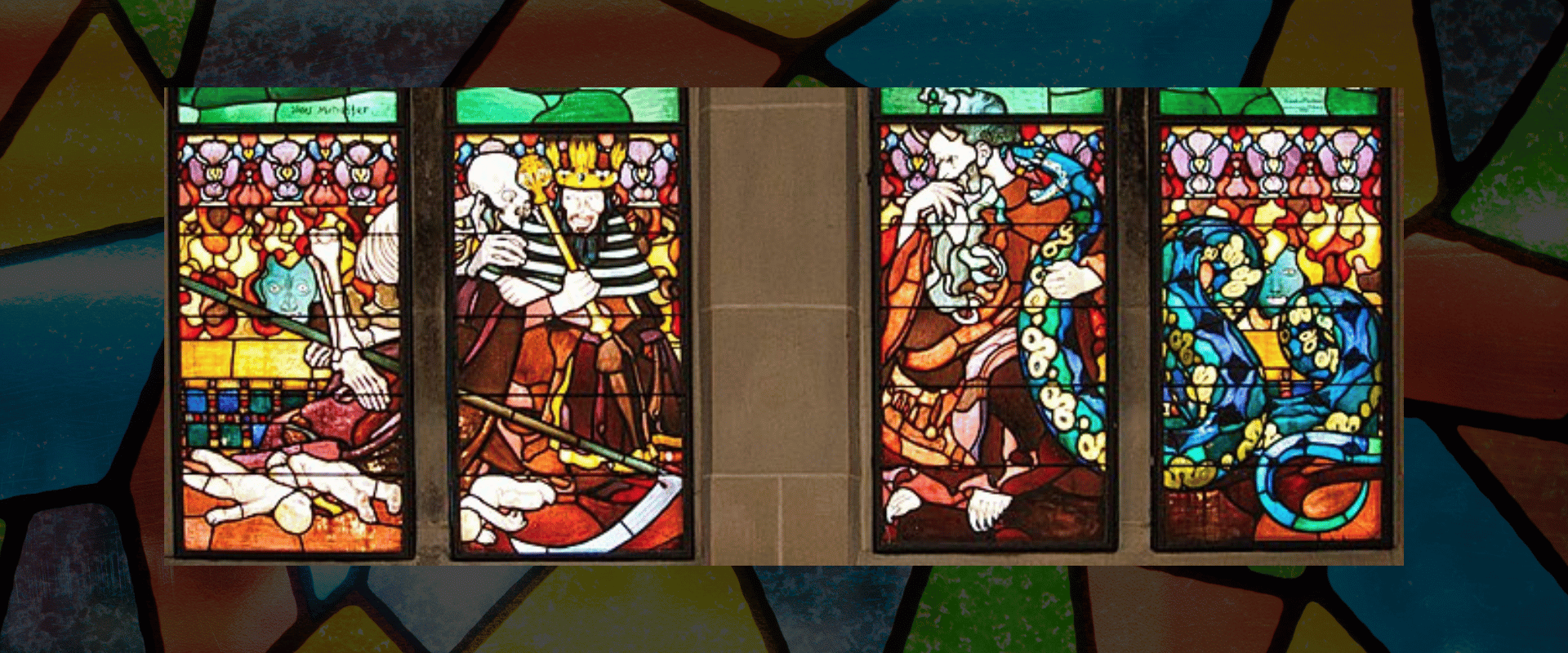
Cohen goes on to write that Herod aggressively suppressed dissent by forbidding protest and often killing any who opposed him. In The Army of Herod the Great, Samuel Rocca writes that Herod was known to be highly paranoid, at one time using 2,000 soldiers as his personal bodyguards. This paranoia and cruelty fit well with the story of Herod in the New Testament usually called the Massacre of the Innocents.

King Herod in the New Testament
In Matthew 2, after the magi visited his court and asked him for the whereabouts of the newborn “King of the Jews”—the very title given to him by Rome—Herod lies to them, telling them to find the child and report back to him so that he, too, can worship him. However, when the wise men don’t return to him, Herod flies into a rage:
When Herod saw that he had been tricked by the magi, he was infuriated, and he sent and killed all the children in and around Bethlehem who were two years old or under, according to the time that he had learned from the magi.
(Matt 2:16)
While Herod’s brutality makes this story seem plausible, scholars have long doubted its historical validity for a few reasons. First and foremost, if Herod had done this horrible thing, why wouldn’t anyone else have mentioned it? Not only do the other Gospels say nothing about this incident, but Josephus doesn’t either. Such a monumental cruelty would surely have been noted by multiple sources.
In addition, the story fits a bit too well with the underlying purpose behind Matthew’s depiction of Jesus. L. Michael White in his book Scripting Jesus writes that in Matthew, Jesus is portrayed as “the new Moses, clarifying and even modifying the law of Moses.” Knowing that, the story of the Massacre of the Innocents bears more than a passing resemblance to the story of Moses’ infancy in Exodus 1, when Pharaoh commands that every Israelite male baby be killed, while Moses miraculously escapes.
By the way, this is the only instance of Herod the Great’s involvement in the Bible. All the rest of the Herod references in the NT refer to his son, Herod Antipas, who ruled during Jesus’ lifetime.
Herod the Great’s Building Projects
King Herod was not given the title “Herod the Great” because he was friendly. Instead, his “greatness” stems from the monumental construction projects he accomplished. Here are a few of them.
In about 19 BCE, Herod initiated a massive expansion of the Temple Complex in Jerusalem, eventually doubling it in size until it took up around 450 acres. Shaye Cohen points out that Herod’s buildings, such as his palace at Caesarea Maritima, were built with impressive technology for the time, including the use of hydraulic cement and even underwater construction.
Herod also built several impressive fortresses, including Masada, Herodium, Alexandrium, Hyrcania, and Machaerus. While these were monumental sites, some of which, like Masada, can still be seen today, he actually built them mostly for himself and his family in case of mass insurrection against him. He even built an entire city, Sebaste, designed specifically to appeal to the Greek-speaking pagans of Judea.
Unfortunately, to cover the costs of such massive building projects, Herod taxed the people of Judea mercilessly. However, in A History of Israel to Bar Kochba, Henk Jagersma also points out that, during a severe famine in 25 CE, Herod used his own resources to feed his people.
Herod died in 4 BCE, around the time of Jesus’ birth, in the city of Jericho. He contracted some kind of disease which, according to Josephus, made his body begin to rot. There is not enough information for scholars to know what it could have been, but Josephus tells us that, ever after, it was called “Herod’s Evil.”
He also says that the pain of the disease was so terrible that Herod attempted to commit suicide but was prevented by a relative. Finally, Josephus says that Herod was worried that no one would mourn for him, a valid concern. He therefore ordered his family members to kill a large number of his well-known subjects after his death, believing that the widespread mourning for them would compensate for the lack of mourners for himself. Fortunately, we’re told that his family did not do this.
Conclusion
Herod the Great was an impactful, if not always benevolent, ruler. Born in the 1st century BCE into a high-ranking Idumean family, he became the governor of Galilee while still in his 20s. Through networking and a successful campaign against bandits, Rome expanded his powers to include other territories. He then became tetrarch of Judea, ranking just below King Hyrcanus II in status and power.
Through a series of twists and turns, Herod was then appointed as King of Judea by Rome. After conquering Jerusalem, he went on to rule Judea for decades. However, his rule was a mix of brutal suppression of dissent and impressive building projects. He will never be forgotten, which was surely the goal of his manifold constructions, but he will also never know how terrible he looks to history.