
Nicodemus in the Bible: Who Was He? (Chapter & Verses)

Written by Marko Marina, Ph.D.
Author | Historian
Author | Historian | BE Contributor
Verified! See our guidelines
Verified! See our editorial guidelines
Date written: October 10th, 2025
Disclaimer: The views and opinions expressed in this article belong to the author and do not necessarily match my own. - Dr. Bart D. Ehrman
Nicodemus in the Bible is both a side character and mysterious figure, giving a stark reminder that the origins of Christianity don’t revolve solely around key individuals such as Jesus, Peter, and Paul. When we look closely at the New Testament, we begin to see a host of “hidden” individuals who appear briefly and then vanish, yet whose presence leaves a lasting impression.
Some of these figures are mentioned only once, others surface a handful of times, but together they remind us that the story of early Christianity was more crowded and complex than it might first appear.
Nicodemus is one of the most intriguing among them. He doesn’t dominate the stage, yet his encounters with Jesus raise profound theological questions and have inspired centuries of interpretation.
Readers of the Gospel of John quickly realize that his appearances are carefully placed within the narrative, each time adding another layer of depth to his character and additional dimension to the unfolding story.
Who was this man, and what does his role tell us about the earliest Christians’ understanding of Jesus and his mission?
In what follows, we’ll explore Nicodemus’ place in the Gospel of John, consider the historical question of whether his story reflects real events or theological imagination, and trace how later Christians remembered and reshaped his identity.
By doing so, we can better appreciate both the mystery of this elusive figure and the ways his story has echoed across Christian tradition.
But before we step into our journey exploring Nicodemus in the Bible and beyond, I’d like to invite you to check out Bart D. Ehrman’s eight-part course The Unknown Gospels.
In these engaging 30-minute lectures, Dr. Ehrman unpacks the New Testament Gospels, showing how historians distinguish between authentic memories of Jesus and later legendary embellishments. If you’ve ever wondered how scholars sort history from theology in the Gospel narratives, this course is the perfect next step.
Who Was Nicodemus in the Bible? A Brief Look at His Story
When we turn to the New Testament, one of the first things to notice is that Nicodemus doesn’t appear in the Synoptic Gospels of Matthew, Mark, or Luke.
His name is entirely absent from those accounts. Instead, he features only in the Gospel of John, the latest of the four Gospels and the one most often considered to present a theologically elaborate portrait of Jesus, with a strong emphasis on his divine identity.
That makes Nicodemus in the Bible a uniquely Johannine figure!
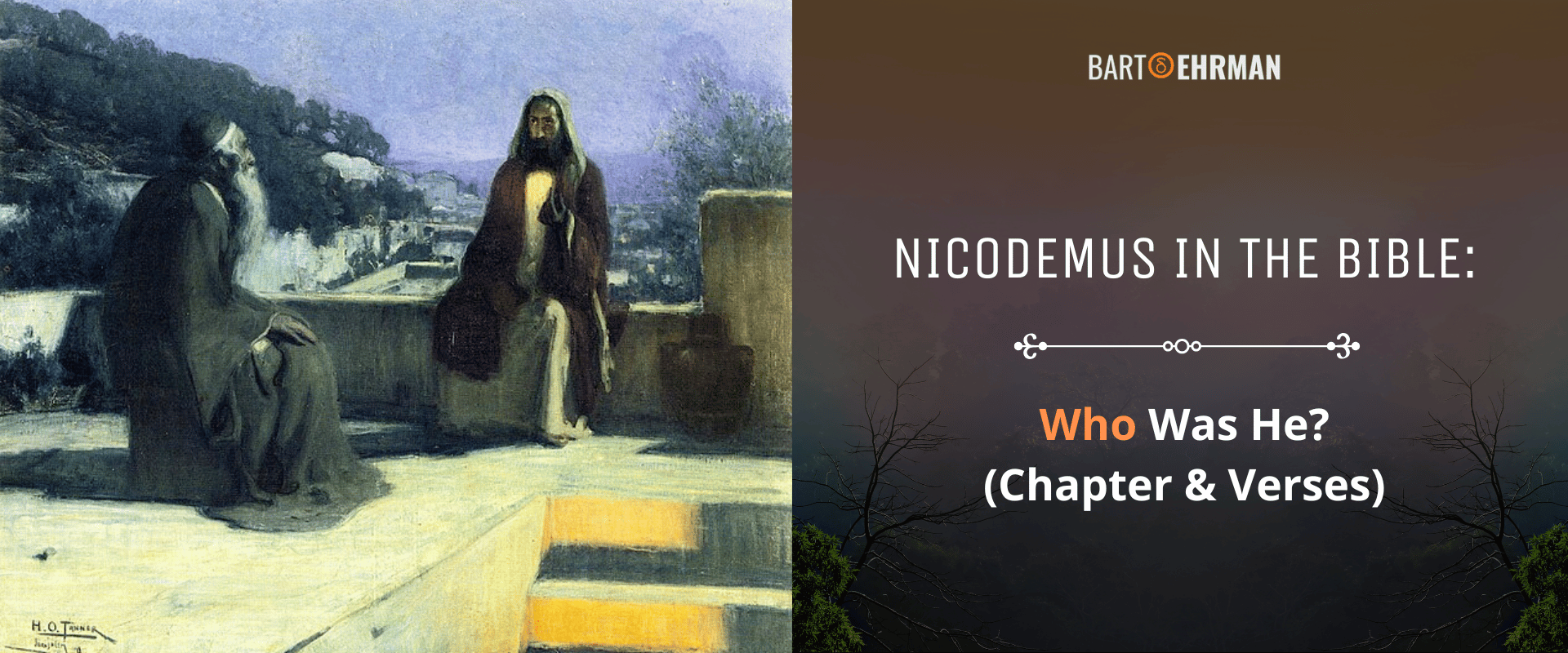
The first and most famous appearance of Nicodemus occurs in John 3:1-21. He is introduced as “a Pharisee” and “a leader of the Jews” who comes to Jesus by night. In the conversation that follows, Nicodemus acknowledges that Jesus must be a teacher from God, given the signs he performs, but quickly becomes confused when Jesus speaks of the need to be “born from above” or “born again.”
This dialogue leads into one of the best-known passages of the New Testament, culminating in the statement that God so loved the world that he gave his only Son. Nicodemus, though intrigued, departs without showing a full understanding of what Jesus has said.
The second reference to Nicodemus comes later, in John 7:45-52. Here, during a heated debate among the chief priests and Pharisees about Jesus’ growing influence, Nicodemus speaks up in his defense.
He doesn’t openly declare himself a follower, but he appeals to the law, reminding his colleagues that a person should not be judged before being given a fair hearing.
His intervention is met with ridicule, and the exchange ends without resolution. This episode portrays him as a cautious figure, willing to speak but not yet to risk open identification with Jesus.
Nicodemus appears for the final time after the crucifixion, in John 19:38-42. Together with Joseph of Arimathea, he assists in Jesus’ burial. Nicodemus brings an extraordinary mixture of myrrh and aloes, an amount far beyond normal usage.
The two men wrap Jesus’ body with the spices in linen cloth, laying him in a tomb near the site of the crucifixion.
This act is presented as a gesture of honor and devotion, contrasting with his earlier hesitancy. By this point, Nicodemus has moved from nighttime curiosity to a more tangible, though still discreet, involvement in Jesus’ story.
Taken together, these three episodes form the complete biblical record of Nicodemus. He enters John’s narrative suddenly, converses with Jesus at length, reappears briefly in a moment of tension, and finally steps onto the stage once more in a scene of quiet reverence at the end of the Gospel.
But are these stories historically accurate? Can we trust the accounts found in our latest Gospel of the New Testament? Let’s check that out!
Nicodemus in the Bible: Historical Analysis
Since Nicodemus in the Bible appears on three separate occasions, it makes sense to take each one in turn and ask whether there are elements that point to the authenticity of his existence, and if the stories themselves reflect genuine historical events.
The Story of Nicodemus: John 3:1-29
The first episode, found in John 3:1-21, is also the most elaborate. Here Nicodemus, as we mentioned, comes to Jesus by night, acknowledges him as a teacher sent from God, and quickly finds himself in a long and complex discussion about the need to be “born from above.”
Before turning to the question of historicity, it’s worth pausing to consider what the story itself is trying to communicate.
Ernst Haenchen, in his Commentary on John, argues that the dialogue is carefully crafted to highlight the incomprehension of sign-based faith, with Nicodemus serving as a literary foil for the evangelist’s theological agenda.
Later editorial layers, such as the reference to baptismal rebirth and the church’s voice breaking into the speech, further suggest that the story as we now have it is the product of reflection within the Johannine community rather than a simple record of remembered conversation.
This means that before we can even ask if the encounter “really happened,” we must recognize that the text itself isn’t simply reporting but interpreting. It conveys the evangelist’s convictions about the nature of new birth, the role of the Spirit, and the judgment that comes through belief or unbelief in Jesus.
From a literary standpoint, the episode succeeds in presenting Nicodemus as the representative of those who are drawn to Jesus but remain unable to understand him fully.
While Marc Michel, in an interesting literary study, agrees that we shouldn’t read Jesus’ encounter with Nicodemus as a straightforward historical (authentic) dialogue, he offers a slightly different interpretation of the meaning behind this amazing story.
For him, the encounter dramatizes the problem of interpreting Jesus’ “signs”: Nicodemus embodies “le non-lieu de la vérité” (“non-place of truth”), a figure standing outside the proper locus from which Jesus can be rightly understood.
Baptism, in this view, is the passage that relocates the believer into the sphere of light, where true vision and knowledge become possible.
As Michel himself concludes:
“Beginning from the traditional use of John 3:5 in baptismal theology, we have sought to set this passage back within the broader context of John 3:1-21, from which it derives its distinctive coloration. The narrative, the dialogue, and the discourse belong to a theological and symbolic problematic primarily concerned with interpreting the signs performed by Jesus, rather than with the intention of providing a primary teaching on baptism. In this essential respect… lies the originality of the Fourth Gospel, whose composition bears witness to the Church’s confrontation with Jewish exegesis as well as with gnostic currents; the historical characters recede before what they represent. Faith in the person and work of Jesus of Nazareth effects a reversal of knowledge by relocating the very place of interpretation that it constitutes.” (my translation)


From a historical standpoint the question whether such a conversation between Jesus and a Pharisee could ever have taken place in this form remains.
To answer questions of this kind, contemporary scholars turn to what are often called the “criteria of authenticity.” These aren’t mechanical rules that can provide certainty, but rather tools for assessing the probability that a given tradition goes back to the historical Jesus.
Among the most frequently used are the criterion of multiple attestation (is the tradition found in more than one independent source?), the criterion of dissimilarity (does the tradition differ from what Christians later would have wanted to say, or from what we know of contemporary Judaism?), and the criterion of contextual credibility (does the tradition fit into the historical and linguistic context of 1st-century Palestine?).
None of these criteria are foolproof, but, together, they help scholars weigh the evidence and distinguish between traditions that may plausibly trace back to Jesus and those that are more likely products of later reflection.
When these criteria are applied to John 3:1-21, the story of Nicodemus fares poorly. It’s found only in the Gospel of John, with no parallel in earlier or independent traditions. It’s entirely in keeping with Johannine theological themes rather than standing apart from them, and most significantly, it fails the test of contextual credibility.
As Bart Ehrman and Hugo Méndez point out in The New Testament: A Historical Introduction, the entire dialogue hinges on a play on words in Greek: Jesus says one must be born anōthen, which can mean both “from above” and “again.”
Nicodemus mistakes the one sense for the other, prompting Jesus to explain further.
This pun works in Greek, the language of the Gospel, but it can’t be reproduced in Aramaic, the language that Jesus and Nicodemus would have spoken. In Aramaic, “from above” and “again” aren’t expressed by the same word.
This linguistic fact makes it highly improbable that the conversation unfolded in history as John narrates it.
Raymond E. Brown, in his Commentary on John, summarizes the arguments against the historical authenticity of this pericope:
We have pointed out the numerous difficulties: in vss. 3-4 a play on words possible only in Greek; in vs. 11 Jesus speaks in the plural as if the Church were speaking; in vs. 13 it seems as if the Son of Man has already ascended. These problems lead some to regard the whole discourse as a Johannine creation, or else to regard only the introduction as showing signs of origin in earlier tradition... Many scholars suggest that at least some part of vss. 12-21 is a homily by the evangelist himself rather than the words of Jesus.
Similarly, Hugo Mendez, in his recent book The Gospel of John: A New History, concludes:
Symbolism is a central feature of these scenes. But the above episodes also contain a second important element, namely, details that contradict earlier Jesus traditions, dubious details, and anachronisms. It is the combination of these features—the presence of both symbolism and dubious historical details—that suggests the episodes surveyed above are or contain inventions. Evidently, the author felt free to significantly modify, tailor, reshape, or outright invent to suit his ideological aims.
So, even if there were once some kind of dialogue between Jesus and a Jewish leader about new birth or spiritual transformation, the form in which it appears in John is thoroughly shaped by the evangelist’s own theological imagination.
Scholarly Insights
Was Nicodemus the Legendary Naqdimon b. Gurion?
At the beginning of the 20th century, some biblical scholars suggested that Nicodemus mentioned in the Bible was the same person as a later rabbinic teacher known as Naqdimon b. Gurion. According to Jewish tradition, Naqdimon was one of the three wealthiest men in Jerusalem before the destruction of the Temple in 70 C.E., remembered for his immense generosity and legendary acts. Could our Nicodemus really be this famous rabbinic figure?
Most critical scholars today think not. The main difficulty is one of timing and memory: the rabbinic Naqdimon is portrayed as a wealthy, pious supporter of Jerusalem, not a follower of Jesus. Moreover, the rabbinic traditions remember him positively within Judaism, while the Gospel of John presents Nicodemus as a figure caught in the tension of understanding Jesus.
It’s possible that John’s Nicodemus reflects the same aristocratic family (the Gurions of Jerusalem) who were known for their wealth and prominence. His extravagant gift of burial spices in John 19, for instance, mirrors the legendary wealth attributed to that clan. Still, identifying the two men as the same person stretches the evidence too far.
What seems more likely is that the evangelist drew upon knowledge of a real historical family and used Nicodemus as a literary character through whom to explore themes of hesitation, faith, and misunderstanding.

Nicodemus in the Bible: John 7:45-52
The second occasion where Nicodemus appears is in John 7:45-52, during a heated scene among the chief priests and Pharisees. The officers who had been sent to arrest Jesus return empty-handed, reporting that “no one ever spoke like this man.”
The religious leaders react angrily, dismissing both the officers and the crowds who support Jesus. At this point Nicodemus, who is identified again as “one of them,” speaks up: “Our law does not judge people without first giving them a hearing to find out what they are doing, does it?”
His intervention is cautious but noteworthy. He doesn’t openly profess faith in Jesus, but he appeals to the principle of due process. The other Pharisees, however, immediately ridicule him, asking whether he too is from Galilee and insisting that no prophet arises from that region.
Brown notes:
In vss. 45-52 John gives us a dramatic vignette of the frustration and helplessness of the Sanhedrin authorities when faced with Jesus. Jesus has won a following among the crowds; the temple police are impressed; and even one of the members of the Sanhedrin raises his voice in Jesus’ defense. The only refuge of the authorities is in the argumentum ad hominem and the sarcasm (52) that closes the scene… It is interesting to note that, while the NT authors are hostile to the Sanhedrin, from time to time they do point out the presence of calm and honest men in this assembly, for example, Nicodemus here, and Gamaliel in Acts 5:34.
From a historical standpoint, of course, the question is whether this episode can be traced back to an actual event or whether it serves primarily a literary function in John’s narrative.
Again, several observations can be made. First, this episode is found only in the Gospel of John and is absent from the Synoptic accounts. That in itself doesn’t prove it to be unhistorical, but it does mean we lack the support of multiple independent witnesses.
Second, the story strongly emphasizes the frustration and helplessness of the Sanhedrin authorities, a portrayal that may reflect post-Easter Christian perceptions of the Jewish leadership more than the actual situation in Jesus’ lifetime.
The sharp dismissal (“no prophet arises from Galilee”) seems more like a rhetorical flourish than a carefully reasoned legal statement, particularly since at least one prophet, Jonah, did in fact come from that region.
When measured by the usual criteria of authenticity, the passage doesn’t yield strong results. It’s singly attested, and the content fits comfortably within John’s broader theological narrative of mounting hostility toward Jesus rather than standing apart from it.
Unlike the Nicodemus dialogue in John 3, however, this passage doesn’t depend on a linguistic pun or any feature that clearly rules out historicity.
It’s therefore harder to dismiss outright. What can be said with some confidence is that the scene, as presented, reflects Johannine literary and theological interests, especially the contrast between the openness of some and the hostility of others.
Whether there lies behind it a historical reminiscence of a Jewish leader who spoke a cautious word in Jesus’ defense remains uncertain, though it seems less likely that we are dealing with a straightforward historical report.
Nicodemus in the Bible: 19:38-42
The final appearance of Nicodemus comes in John 19:38-42, at the burial of Jesus. After the crucifixion, Joseph of Arimathea asks Pilate for permission to remove the body, and together with Nicodemus he prepares it for burial.
Nicodemus brings an extravagant mixture of myrrh and aloes (weighing about one hundred pounds), and the two men wrap the body with spices in linen cloth before placing it in a nearby tomb.
While this episode rounds out Nicodemus’ arc in John’s narrative, moving from nighttime seeker to public participant, the question remains whether such a scene reflects historical memory or Johannine theology.
Some critical scholars have questioned the historicity of Jesus’ burial altogether. Bart D. Ehrman, for example, has argued, among other things, that Roman practice with crucifixion victims usually excluded honorable burials.
Condemned criminals, especially those executed for sedition, were often left to decompose on the cross as a warning to others or else thrown into shallow graves or common pits.
Still, this view hasn’t persuaded the majority of scholars. Many (including Dale C. Allison and John P. Meier) maintain that, while details may have been shaped theologically, the core tradition of Jesus’ burial is historically credible. They argue that Roman governors sometimes allowed bodies to be released to family or sympathizers, particularly in Judea.
Even if we accept that Jesus was in fact buried, the role of Nicodemus in the story raises additional questions. All four Gospels report that Joseph of Arimathea was responsible for the burial, but only John adds Nicodemus into the scene.
Mendez explains the key differences:
In Mark and Luke, Jesus’s body is entombed before it is fully embalmed, so that a group of women must go to the tomb two days later to complete the embalming (Mark 16:1; Luke 23:55–24:1). Not so in John, where Nicodemus brings an excess of spices on the day of Jesus’s death, ensuring that the “body” of Jesus is fully anointed and prepared “in linen cloths and with spices, as is the burial custom of the Jews” (20:39-41). For this reason, John does not have a group of women run to the tomb with spices, though one woman, Mary Magdalene, does go to the tomb on the day of the resurrection, presumably to mourn Jesus.
These changes are significant. They could suggest that his participation may not reflect an independent tradition but instead serves a rhetorical purpose within John’s Gospel.
Considering all the available evidence (or the lack thereof), it seems entirely plausible that Nicodemus is, as Laurence Cantwell notes, merely a symbol or “mere allegorical representation” standing “for Pharisaism and the established Judaism of his day.”

Beyond Nicodemus in the Bible: A Brief Look at Later Tradition
As is the case with many side characters in the Bible, even though we might wish to know more about his life, Nicodemus doesn’t appear in other early sources. Did Nicodemus follow Jesus in his later life?
Consequently, we have no firm evidence about what became of him after the events recorded in the Gospel of John. No reliable information exists about his later life, his death, or whether he continued to follow Jesus.
What we do have are later legends and traditions that filled the gap, but these aren’t grounded in history. They tell us more about the imagination of early and medieval Christians than about the man himself.
One of the most prominent of these traditions is the so-called Gospel of Nicodemus, a work that emerged in the 4th century and was later widely circulated under the title Acts of Pilate.
This text, attributed to Nicodemus in the prologue, presents itself as his eyewitness account of Jesus’ trial before Pilate and the subsequent events, including the descent of Christ into Hades to liberate the righteous dead.
It soon became one of the most popular apocryphal texts in the Christian tradition. Rémi Gounelle and Zbigniew Izydorczyk, in their rigorous translation and commentary explain:
Until the 19th century, the gospel attributed to Nicodemus was continually copied and rewritten in keeping with the development of theological notions and the diverse expectations of the Christian people. Thus, we know of more than five hundred manuscripts of this text in the ancient languages of Christianity (Latin, Greek, Coptic, Syriac, Palestinian Aramaic, Armenian, Georgian), and the medieval vernacular translations are countless: the Gospel of Nicodemus was, in any case, translated into Castilian, Catalan, French, Italian, Occitan, Portuguese, German, English, Danish, Dutch, Norse, Swedish, Welsh, Irish, as well as Bulgarian, Polish, Old Slavonic, and Czech.
While the work proved enormously influential in shaping Christian imagination about Jesus’ Passion and afterlife, virtually no scholar today believes that Nicodemus in the Bible was the real author.
Gounelle and Izydorczyk note:
When reading the Gospel of Nicodemus, the reader may have the impression of being on familiar ground, since the first two parts of this apocryphon (chapters 1 to 16) are based on the framework of events reported in the New Testament and presuppose them as known. Its author, about whom we know nothing, clearly sought to present a new version of the Gospel accounts of the Passion, death, resurrection, and ascension of Christ, without straying too far from the New Testament.
The attribution to Nicodemus reflects a common tendency in apocryphal literature to lend authority to a text by attaching it to a well-known biblical name. If you want to know more about it, I highly recommend Bart Ehrman’s excellent study Forgery and Counterforgery.
Beyond apocryphal writings, Nicodemus also came to be remembered in the liturgy, hagiography, and even art of the medieval church. In certain traditions, he was venerated as a saint. His role in helping to bury Jesus was understood as an act of devotion that revealed his true allegiance.
This development isn’t as unusual as it might seem. Early Christian memory often transformed marginal figures into models of faith.
In fact, even Pontius Pilate was, in some circles, thought to have repented and become a believer. The Coptic Church, for instance, preserved a tradition that Pilate later converted and, remarkably, venerated him as a saint.
Historically, we know next to nothing about Nicodemus’ later life and death. Yet, in the collective memory of the church, he came to stand as a witness to Jesus, whether as the supposed author of an apocryphal gospel or as a saint honored due to his role in Jesus' burial.
Conclusion
Nicodemus in the Bible remains one of the most enigmatic figures of the New Testament. He steps onto the stage of John’s Gospel three times, raising questions that touch both theology and history. His nocturnal dialogue with Jesus conveys profound symbolic meaning, yet fails the historians’ tests of authenticity.
Despite that, his story didn’t end with John’s Gospel. In apocryphal texts like the Gospel of Nicodemus, and in later hagiography and art, this marginal figure became a central witness, even venerated as a saint in some traditions.
Historically elusive but theologically rich, Nicodemus stands as an example of how early Christian memory could transform secondary characters into important symbols of popular piety.