
Gospel of Peter: Why It Was Banned from the Bible (PDF)

Written by Joshua Schachterle, Ph.D
Author | Professor | Scholar
Author | Professor | BE Contributor
Verified! See our editorial guidelines
Verified! See our guidelines
Date written: July 23rd, 2025
Disclaimer: The views and opinions expressed in this article belong to the author and do not necessarily match my own. - Dr. Bart D. Ehrman
Among the many early Christian texts excluded from the New Testament, few have sparked as much intrigue as the gospel of Peter. Discovered in the sands of Egypt in the late 19th century, this gospel fragment offers a dramatic and theologically distinct account of Jesus’ trial, crucifixion, and resurrection.
In this article, I’ll tell you about the discovery, contents, and theological controversy surrounding the gospel of Peter, explaining why it was ultimately banned from the Bible.
Gospel of Peter Date, Discovery, and Significance
The gospel of Peter (the link goes to a free English translation) is a 2nd-century non-canonical text whose name was assumed by later readers since the narrator claims to be Simon Peter. No scholars believe that Peter actually wrote this gospel, dating its creation to long after his death. However, scholars knew of its existence because well-known ancient Christian authors referred to it. For instance, 3rd-century Christian theologian Origen of Alexandria mentions it in his commentary on the Gospel of Matthew, as “the Gospel according to Peter, as it is called.” This may indicate that Origen didn’t believe the book was actually written by Peter, although he never says so explicitly.
(Affiliate Disclaimer: We may earn commissions on products you purchase through this page at no additional cost to you. Thank you for supporting our site!)
Fourth-century historian Eusebius writes in his Church History that a well-known 2nd-century bishop, Serapion of Antioch, initially approved the use of the gospel of Peter in liturgical contexts by a church in a city called Rhosus (modern-day Arsuz, Turkey). However, Serapion never believed that the book was truly written by Peter and he was subsequently told that the book was heretical, favored by a group called the Docetae.
In The Other Gospels: Accounts of Jesus from Outside the New Testament, Bart Ehrman and Zlatko Plese note that we have no idea what the Docetae believed, although it is assumed from their name that they were part of a Christian heresy known as Docetism. The name of this heresy was based on the Greek word dokeo meaning “to seem or to appear.” Generally speaking, Docetists believed that Jesus only appeared to have a physical body but was not, in fact, physical at all.
Serapion claimed there were elements in the Gospel of Peter that leaned toward Docetism. One of the main offenders was a line which said that while Jesus was on the cross, “he was silent as having no pain.” Note that it doesn’t say that he had no pain, only that he was silent. However, Serapion thought this was suggestive of a non-physical Jesus and, thus, condemned the book. Another line Serapion indicated as docetic described the moment of Jesus’ death, saying not that he died but that “he was taken up.” This may have been merely another way to say that he died. However, Serapion saw it as a denial of his physical form, in that his real, spiritual form was simply taken to heaven.
For these reasons, perhaps, the book was never fully accepted as canonical by orthodox Christianity.
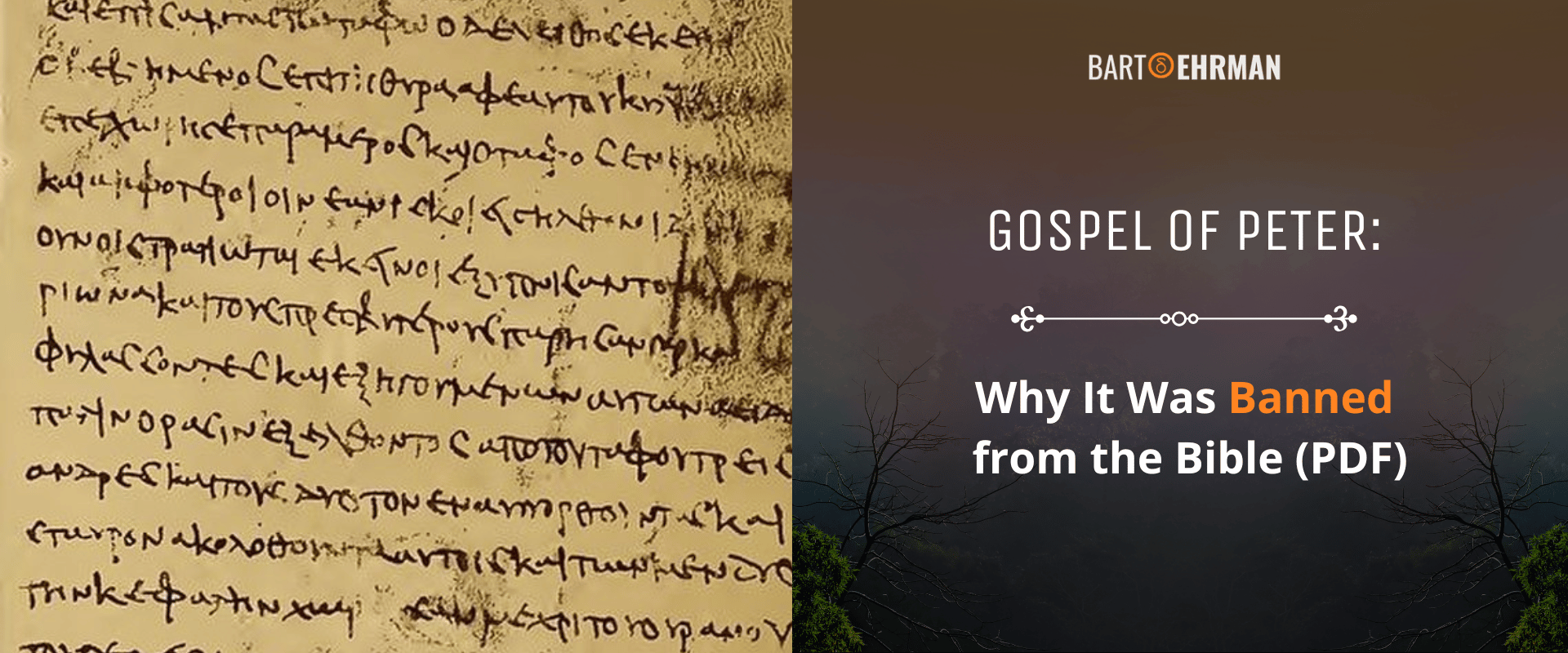
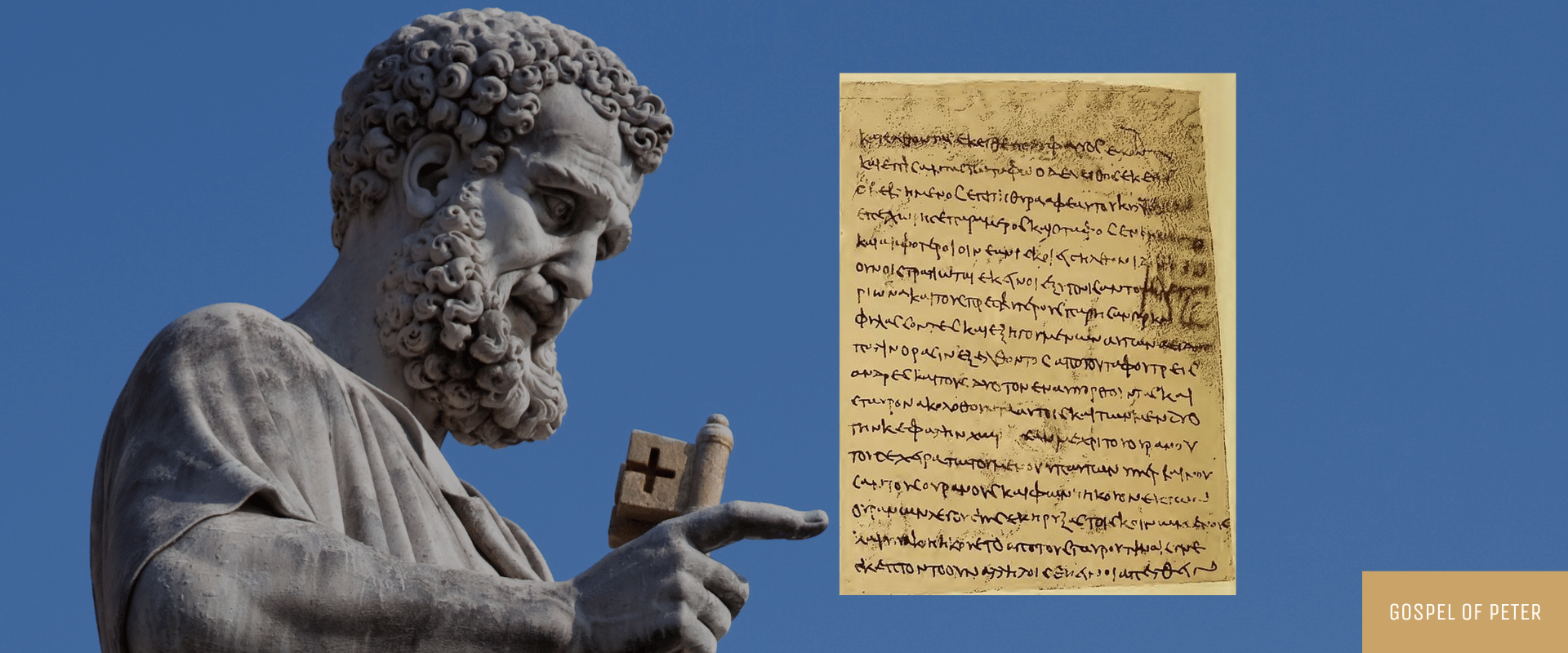
Despite these early references, scholars had no manuscript of the Gospel of Peter until one was discovered in 1886 in Akhmim, Egypt by French archeologist Urbain Bouriant. In fact, what was unearthed was only a fragment of this gospel and remains the extent of what we have of it today. While it’s clear that it was probably, like the canonical Gospels, the story of Jesus’ life, all we have in our manuscript is the story of his trial, death and resurrection.
Scholars continue to debate whether the author of the gospel of Peter drew from the canonical Gospels to write his narrative or if it is based on oral traditions that predate the canonical Gospels. While there is no broad consensus on the answer, Ehrman and Plese write that it was likely based both on oral and written traditions since it has so many similarities to the canonical Gospels. Additionally, in The Gospel of Peter: Introduction, Critical Edition and Commentary, Paul Foster notes that while the Gospel of Peter can certainly tell us something about the beliefs of some early Christians, “the value of the Gospel of Peter for the quest of the historical Jesus is at best marginal.”
Ehrman and Plese note that while the Passion story in the Gospel of Peter is similar to that of the canonical Gospels, there are some notable differences. For example, the gospel claims that Pilate had no responsibility for Jesus’ death, granting that blame entirely to Herod Antipas. Therefore, since Jesus’ death is then blamed entirely on “the Jews,” the book goes on to imply that the destruction of Jerusalem by the Romans in 70 CE was divine punishment for killing Jesus, an idea found in the writings of multiple 2nd and 3rd century Christian authors including Tertullian and Irenaeus.
Another difference between the gospel of Peter’s Passion narrative and those of the canonical Gospels is that while in the gospel of Peter Jesus is crucified between two robbers, neither taunt him, as one does in Luke 23:39. Instead, one of the robbers berates the Roman soldiers for crucifying Jesus.
The final striking difference is the description of the Resurrection of Jesus. This is the only case that describes the process. You’ll recall that in the canonical Gospels, Jesus dies and then appears alive to his followers. The gospel of Peter, however, describes what happens when Jesus is raised in a rather bizarre fashion. Rather than detail it here, however, I’ll discuss it in a summary of the gospel’s contents below.

Gospel of Peter Summary
Readers who peruse a gospel of Peter PDF or another copy will notice it begins in the middle of Jesus’ trial before Pilate. However, unlike the trial scene in the canonical Gospels, this one includes the Jewish King Herod Antipas and other unnamed judges. Pilate has apparently already washed his hands, symbolically refusing to participate in the death of Jesus. According to the gospel, though, Herod and the judges refuse non-participation, voluntarily taking on this guilt. Herod then orders Jesus to be taken away and crucified. In other words, the Romans are entirely absolved.
A man named Joseph (of Arimathea, presumably) asks Pilate for Jesus’ body in advance of his death, another difference between the Gospel of Peter and all four canonical Gospels. Pilate then has to ask Herod to have Jesus’ body sent back to him for Joseph’s sake after Jesus’ death. Herod agrees.
Jesus is then handed over to the unruly crowd who shove and ridicule him, saying “Let us drag along the Son of God now that we have power over him.” They put a purple robe and a crown of thorns on him and mock him, derisively calling him “King of the Jews.”
Jesus is crucified with two criminals crucified on either side of him. While the soldiers at the foot of the cross cast lots for Jesus’ clothes, one of the criminals on the cross berates them, saying “We [criminals] have been made to suffer thus because of the wrong that we have done; but this one, having become Savior of men, what injustice had he done to you?” This makes the soldiers angry so they refuse to break his legs later, thus prolonging his suffering.
At midday, darkness falls over the land, worrying some of the Jews there since they are not to allow the body of one put to death to hang past sunset. However, Jesus soon screams out a phrase that sounds familiar from the New Testament Gospels but also a little different: “My power, O power, you have forsaken me!” This may be simply another way to address God, but Ehrman and Plese note that some readers interpreted this line as saying that the divine Christ was leaving Jesus the man, possibly another offending docetic line. After screaming this phrase, Jesus is “taken up.”
At this point, the veil of the Temple is torn in two. Someone removes the nails from Jesus’ hands and places them on the ground, causing it to shake. Glad to be rid of him, the Jews give Jesus’ body to Joseph, who buries him in his family tomb.
At this point, the Jews suddenly repent, crying “Woe to our sins. The judgment has approached and the end of Jerusalem.” As I noted above, this is likely a reference to the destruction of Jerusalem, which had happened long before the gospel of Peter was written.
After Jesus’ burial, the narrator refers to himself and the other disciples for the first time, saying they were in sorrow and feared for their lives. For this reason they were fasting, praying, and grieving the loss of their teacher.
Meanwhile, the scribes and Pharisees, fearing the result of the Jews’ sudden repentance, go to Pilate and ask for soldiers to guard Jesus’ tomb. Pilate grants this request. Then, the soldiers roll a stone against the opening of the tomb and seal it with wax. The next day, the Sabbath, crowds begin to arrive, wanting to see the tomb for themselves. However, that night, there is a loud, heavenly voice and two radiant men descend from heaven to the tomb. By the time they arrive, the stone has already been rolled away, and the two men (angels?) enter the tomb. They then emerge, supporting the body of Jesus (as the astonished Roman guards watch). In addition, a cross follows behind the three.
As if this sight is not strange enough, we are told that the three have somehow grown, with “the head of the two reaching unto heaven, but that of the one being led out by a hand by them going beyond the heavens.” This is apparently a reference to the heavenly status of all three, with Jesus’ status being higher than that of the other two. A voice then comes from heaven, asking “’Have you made proclamation to the fallen-asleep [the dead]?' And an obeisance was heard from the cross, 'Yes.'” In other words, God speaks with the cross, which answers back.
Next, yet another man descends from heaven and enters the tomb. The bewildered guards rush off to Pilate to tell him what has happened, proclaiming that Jesus must be God’s Son. Pilate, who seems to have already known this, says “I am clean of the blood of the Son of God.” It’s quite clear by this point that the author is intent on blaming the Jews alone and completely exonerating the Romans for Jesus’ death, a historical unlikelihood given what we know about Roman and Jewish methods of execution.
Now the Jewish people approach Pilate, begging him to order the centurions not to speak of Jesus’ resurrection ever again. Why? Because it is better to suffer the consequences of their great sin than to be stoned to death, presumably by the Jews who didn’t participate in Jesus’ death. Pilate agrees and orders the soldiers to remain silent.
At dawn on Sunday, Mary Magdalene and some female friends come to the tomb ready to anoint Jesus’ body. We are told they had meant to come the day before but had been afraid of the anger of the Jews (the text does not acknowledge that Mary and her friends are Jews as well). They worry that they will not be able to roll the stone away and enter the tomb. However, they find the tomb open and, entering it, discover the young man who had descended from heaven after Jesus’ dramatic exit. He tells them that Jesus is risen, and they flee in fear.
In the last paragraph of the fragment (although clearly not the last paragraph of the original text), the narrator again refers to himself and his companions who are returning to their homes.
But we twelve disciples of the Lord were weeping and sorrowful; and each one, sorrowful because of what had come to pass, departed to his home. But I, Simon Peter, and my brother Andrew, having taken our nets, went off to the sea. And there was with us Levi of Alphaeus whom the Lord ...


What follows is anybody’s guess. Is it similar to the last episodes in John where Jesus appears to the disciples as they are fishing? We may never know.
Conclusion
The gospel of Peter is an apocryphal text written sometime in the 2nd century. Scholars knew there were references to it in the writings of Christian authors such as Origen and Eusebius, but no real document had been found in the modern era until a large fragment was discovered in Egypt in the late 19th century.
While this fragment is clearly not the entire original gospel, it does contain the whole Passion narrative which allows scholars to compare it with the Passion narratives of canonical Gospels. Notable differences between it and New Testament versions include the total exoneration of Pilate for Jesus’ death and the concomitant blaming of the execution entirely on the Jews. In fact, the book implies that the later destruction of Jerusalem is the Jews’ punishment for killing Jesus.
Perhaps the most striking difference, however, is that the process of the resurrection is described, something that doesn’t occur in any other written Gospel. While the description is strange — Jesus is led out of the tomb by two men or angels, whereupon their heads reach up to the heavens — it is notable as the only attempt at recounting what actually happened when Jesus was raised from the dead.