
God the Father: Origin, Meaning, & Bible Verses

Written by Marko Marina, Ph.D.
Author | Historian
Author | Historian | BE Contributor
Verified! See our guidelines
Verified! See our editorial guidelines
Date written: July 21st, 2025
Disclaimer: The views and opinions expressed in this article belong to the author and do not necessarily match my own. - Dr. Bart D. Ehrman
It was the summer of 2014, and I was in Germany visiting my brothers when a worn paperback of Carl Gustav Jung’s Antwort auf Hiob (Answer to Job) found its way into my suitcase. Late evenings in Munich became a crash course in Jungian psychology, and the most arresting idea in those pages was his treatment of “God the Father.”
(Affiliate Disclaimer: We may earn commissions on products you purchase through this page at no additional cost to you. Thank you for supporting our site!)
For Jung, the phrase didn’t point to a literal, external patriarch enthroned above the clouds. Rather, it signified a potent archetype arising from the collective unconscious, a living symbol through which the human mind strives for wholeness and orientation.
That sophisticated, inward-looking approach of a 20th-century psychiatrist stands centuries apart from the traditional portraits of God the Father that dominate Jewish and Christian Scripture.
Yet the gap between Jung’s archetype and the biblical Father invites a deeper question: how (and why) did these ancient communities begin calling the one God their “Father” in the first place?
In this article, we’ll trace the idea from its earliest flickers in the Hebrew Bible, through the intimate “Abba” language of the New Testament, to its resonances (and silences) in post-biblical Judaism and Islam.
Along the way, we’ll ask how “Father”, in the New Testament writings, differs from other divine titles (especially “Spirit”) and why the term has proven both comforting and controversial for two millennia.
Buckle up because the journey from ancient covenant texts to modern depth psychology promises a fresh look at an age-old name.
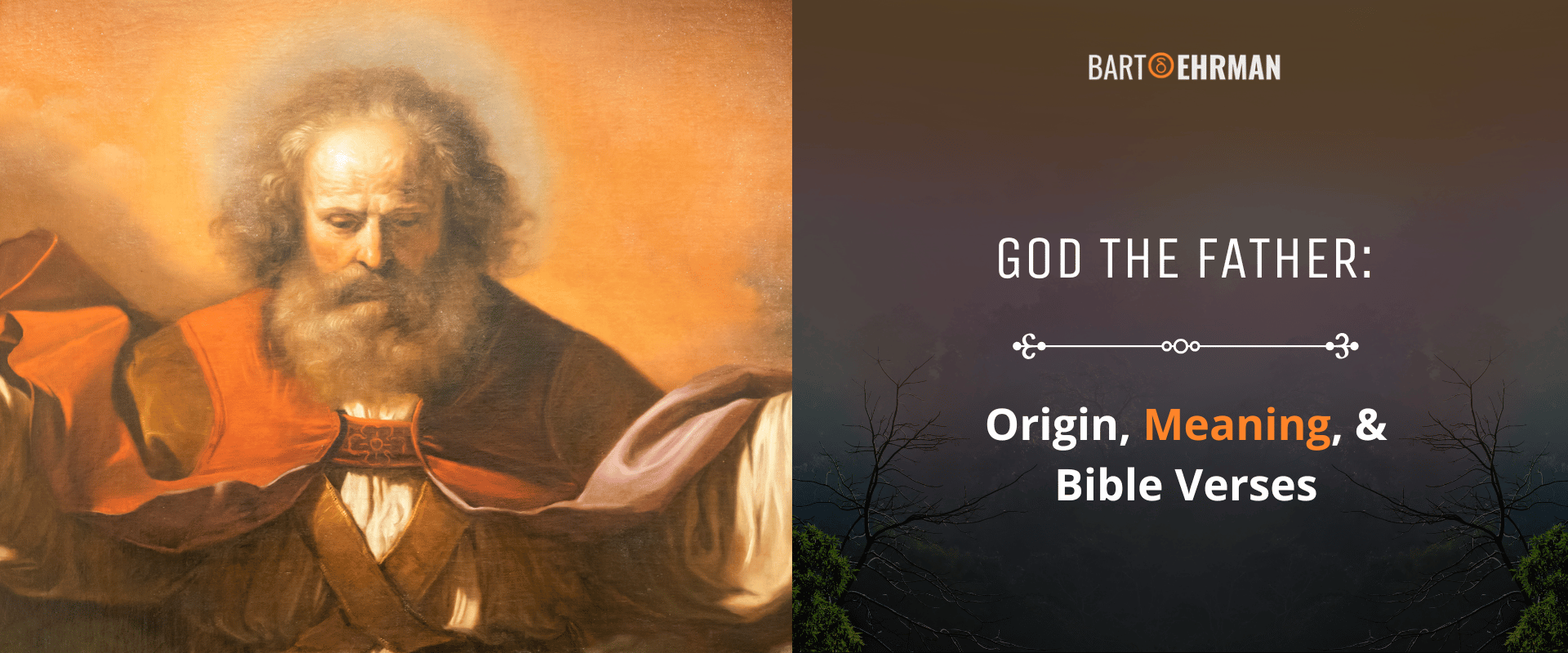
What Does the Bible Say About God the Father: Old Testament
Deuteronomy 32:6 drops us straight into the drama of Israel’s self-understanding: “Is he not your Father, who created you, who made and established you?” The word “Father” here is anything but incidental.
It appears at key covenant junctures. Exodus 4:22 (“Israel is my firstborn son”) and Hosea 11:1 (“Out of Egypt I called my son”), among other verses, framed Israel’s election as a family bond: the one God adopts to a single people and pledges loyal care.
For readers unfamiliar with the Hebrew Bible, it helps to see that this father-language never floats free of covenant. In other words, it’s a relational metaphor underscoring Israel’s status as God’s “firstborn” among the nations, not a blanket claim that God fathers all humanity in the Old Testament.
Alon Goshen-Gottstein captures the point crisply:
God [in the Hebrew Bible] is not presented as Father of the world, and…God’s fatherhood is not a consequence of God’s creative acts. God is presented as Father to Israel, and I am not aware of a single biblical text that applies the notion of father-son relations outside the scope of Israel. ‘Father’ thus functions within the context of election…There is nothing privileged about ‘Father’ as a form of expression, and one might also add that ‘Father’ is not a proper name for God. Rather, it is one of numerous metaphors by means of which Israel speaks of and speaks to God.


Read against that backdrop, divine fatherhood comes into focus as a covenant metaphor rather than a literal description. Similarly, Israel’s prophets and poets reach for a family image to express two linked convictions: God protects and disciplines like a parent (Deut. 8:5; Prov. 3:12), and Israel owes filial loyalty in return.
Yet the same texts freely mix other metaphors—potter, shepherd, rock, husband—reminding us that “Father” never monopolizes Israel’s language for the divine.
We should note that this idea also resonated with Israel’s neighbors. In Ugaritic myth (13th century B.C.E.), the high god El bears the title “Father of gods and men,” and Mesopotamian hymns hail Marduk as “father” of his city. Furthermore, Egyptian pharaohs called the creator-sun god Atum their “father” to legitimize royal authority.
As Mark S. Smith notes in The Origins of Biblical Monotheism, Israel inherited a shared Near-Eastern vocabulary of divine kinship and recast it within its own covenant theology. He writes:
El is the father of deities and humanity. Accordingly, El’s capacity as ruler of the pantheon expresses his function as patriarch of the family. His wife Athirat (biblical Asherah) is the mother of deities and humanity. El and Athirat are the divine royal parents of the pantheon, and the dominant deities are generally regarded as their royal children.
What makes the Hebrew Bible distinctive isn’t the metaphor itself but the way it narrows fatherhood to a single, historical people bound by particular law and promise.
But more than that, John W. Miller highlights other key differences, summarizing the concept of God in the Hebrew Bible:
Three characteristics of the god so revealed are highlighted in almost all the stories about him. There is, first of all, the fact that he is 'he'(and not 'she'). This 'he,' of course, is a divine father (Dt 32:6; Jer 3:19; Is 63:16; Mal 2:10; Lk 11:2 Eph 3:14f.), not a son, and one who in some sense is like the god of the fathers (Ex 3:15) and 'El,' the father of the gods (Gn 33:20; Jos 22:22)... secondly, that those who serve him shall serve him exclusively and alone (Ex 20:3; Dt 5:7). This unique attribute is explained in several texts as resulting from his jealousy... A third characteristic of this god is his goodness. This was unforgettably demonstrated by the very way he created a people in the first place: his liberating them from slavery (Ex 15) and his gracious covenant involving stipulations (Ex 20), all of which were seen to be for the well-being of the community (Ps 15:7-11).
Thus, from its first appearances, the phrase “God the Father” in the Old Testament signals relationship, election, and obligation. This image proved to be a theological basis for later developments, particularly within the early Christian context that looked at the Old Testament from the perspective of Jesus' life with emerging beliefs in his messianic identity and resurrection.
God the Father in the New Testament
In The Westminster Dictionary of Christian Theology, Alan Richardson and John Bowden assert that the earliest form of the Apostles’ Creed, the phrase “God the Father” probably means “the Father of all people, the Father of our Lord Jesus Christ, and indeed the Father-Creator of the universe.”
This succinct contrast captures what happens as we move from the Hebrew Bible, where “Father” is a national metaphor for Israel’s covenantal God, to the New Testament, to where the term suddenly crowns the opening line of the Lord’s Prayer and permeates early Christian speech about God.
In what follows, I am not entering the historical-Jesus debate. Rather, my aim is simply to trace how the New Testament portrays Jesus and the first Christian writers using, reshaping, and amplifying the title “God the Father.”
Jesus stands at the center of the shift. As Gilles Emery observes:
In the New Testament, the name Father, attributed to God, is characterized by the union of two aspects: (1) the name Father is understood in reference to the one God of the Jewish faith; (2) the Father is the Father of Jesus.
James Barr’s linguistic work reminds us that Jesus’ Aramaic abba was a respectful adult address, not the childish “Daddy” so often claimed. Goshen-Gottstein, in turn, shows that calling God Father was intensified rather than invented by Jesus.
The novelty lies in its frequency and theological reach, not in the word itself. The Synoptic Gospels place the term on Jesus’ lips at climactic moments: “Abba, Father, all things are possible for you” (Mk. 14:36), “Our Father who art in heaven” (Mt. 6:9), and “Father, into your hands I commend my spirit” (Lk. 23:46), while the Fourth Gospel layers it into Jesus’ self-revelation (Jn. 5:17-18; 17:1-5).
A pattern emerges: Jesus invokes Father to express intimacy (“Abba”), authority (“the Father has sent me”), and benevolence (“your Father knows what you need”). Yet, as Barr notes, the term still carries dignity; it’s the standard honorific for God, not an informal nickname.
Goshen-Gottstein, therefore, speaks of a “personalizing” rather than a “radically new” usage. By teaching disciples to pray to our Father, Jesus widens family language beyond himself and embeds it in communal devotion.
The rest of the New Testament follows suit, and no writer develops the theme more purposefully than Paul. Steeped in Jewish Scripture, Paul can still say, “for us there is one God, the Father, from whom are all things” (1 Cor. 8:6). Yet he also declares that believers have received “the Spirit of adoption, crying ‘Abba, Father’” (Rom. 8:15; Gal. 4:6).
For Paul, whose theology hinges on the Damascus experience, sonship is shared. To put it more bluntly, Gentiles as well as Jews are welcomed into the household, and God’s fatherhood underwrites a new ethos of grace, inheritance, and moral transformation (2 Cor 1:3; Eph 4:6).
Crucially, Paul’s talk of the Father never abandons Jewish monotheism. As Larry Hurtado points out, early Christians affirmed a single God even while giving Jesus unprecedented devotion. Paula Fredriksen aptly calls this stance Christ-shaped monolatry.
Father-language thus becomes a theological hinge. It safeguards continuity with Israel’s God while making room for the risen Son and the indwelling Spirit.
That hinge eventually swung open onto the doctrine of the Trinity, which refers to God the Father, the Son, and the Holy Spirit. The earliest believers experienced the one God in three distinct ways (Father, risen Lord, and empowering Spirit) and, over centuries, hammered out conceptual language to match.
The Catechism of the Catholic Church sums up the result:
The Trinity is a mystery of faith… God’s inmost being as Holy Trinity is inaccessible to reason alone or even to Israel’s faith before the incarnation of the Son and the sending of the Spirit.” The Father is not the Son, nor is either identical with the Spirit; yet none is a second deity. Instead, Fatherhood becomes the fountainhead within a single, eternal life shared by three persons.
In short, the New Testament moves the title “God the Father” from a covenant metaphor to the beating heart of Christian prayer and theology. Jesus deploys it with striking frequency; Paul extends it to adopted children of God; and later Christians, still anchored in Jewish monotheism, articulate its relationship to the Son and the Holy Spirit.
The journey from metaphor to mystery sets the stage for the next section, where we will compare this Christian vision with the Islamic idea of divine fatherhood.
God the Father in Islamic Tradition?
In his work on Abrahamic Religions, Charles L. Cohen notes:
Conceiving of Judaism, Christianity, and Islam as the Abrahamic religions calls attention to just how linked they are. … All of them celebrate their bonds with Father Abraham, but, in reconstructing family ties, remembrances of his lineage clash frequently. The stakes, after all, are high: sole possession of his legacy against the interests of competing heirs. Small wonder, then, that each party insists, ‘Dad always loved me best.
Cohen’s wry observation reminds us that the three sibling traditions share deep historical roots yet defend sharply different theological boundaries. Nowhere is the divergence clearer than in Islam’s insistence that God (Allāh) is never called “Father.”
The Qurʾān addresses the creator with many titles (the Compassionate, the Sustainer, the Lord of the Worlds), but it categorically rejects father-language.
Two verses make the point unmistakable. First, “He begets not, nor is He begotten” (Q 112:3). Second, when Jews and Christians claim, “We are the children of God and His beloved,” the Qurʾān replies, “Say: Why then does He punish you for your sins? You are but human beings among those He has created” (Q 5:18).
In Islam, to speak of divine fatherhood risks collapsing the absolute distinction between Creator and creation that the doctrine of tawḥīd (the belief in an absolute oneness and uniqueness of God) protects.
Why the prohibition? Classical Muslim exegetes argue that calling God “Father” implies generated offspring, physicality, or even sexual partnership. These are the ideas the Qurʾān brands blasphemous. Early polemics against Arabian polytheism (shirk) and against the Christian claim that Jesus is God’s Son, as Fred Donner explains, forged a theological reflex: any hint of divine progeny undermines the transcendent, self-sufficient nature of Allāh.
At the same time, Islam doesn’t forgo paternal qualities. Of the 99 Beautiful Names of God preserved in hadith and devotional practice (Ar-Raḥmān (the All-Merciful), Ar-Raḥīm (the Compassionate), Al-Karīm (the Generous), several evoke the tenderness a father might display, yet none employ the word “father.”
The preferred Qurʾānic term for providential care is rabb (“Lord” or “nurturer”), which conveys sustenance without familial baggage.
Thus, Islam’s theology of God navigates a delicate balance: transcendence without remoteness, mercy without paternity. In other words, Muslims affirm a personal relationship with Allāh through prayer (ṣalāh) and supplication (duʿāʾ), yet they approach the Divine as sovereign Lord rather than familial parent.
Conclusion
While reading Carl Gustav Jung’s reflections on a sweltering 2014 summer, when the World Cup drowned out almost everything else, I was surprised by his claim that God the Father is less a literal being than a formative archetype.
However, the historical record bears him out: across religious traditions, divine fatherhood is not a fixed doctrine but a supple metaphor, molded to fit each community’s needs and beliefs.
As we’ve seen, the Hebrew Bible casts God as Father specifically to Israel, chosen, covenanted, and protected. The New Testament pushes the image to the foreground, making it the keynote of Jesus’ speech and the early Christian sense of adoption into God’s family.
Islam, by contrast, eschews father-language altogether to safeguard divine transcendence, even while stressing God’s mercy and nearness. The “God the Father” phrase, then, is at once theological, metaphorical, cultural, and psychological, revealing as much about those who invoke the name as about the One to whom they pray.