
A 2-Day Live Course · Recordings Included An 8-Lecture Course · On Demand
Through the Eye
of a Needle
Jesus’s Teachings on Wealth and Their Modern Relevance
About the Course
Jesus on Wealth
Understanding what Jesus actually taught about wealth, before deciding what it means for us today

The Camel and the Needle
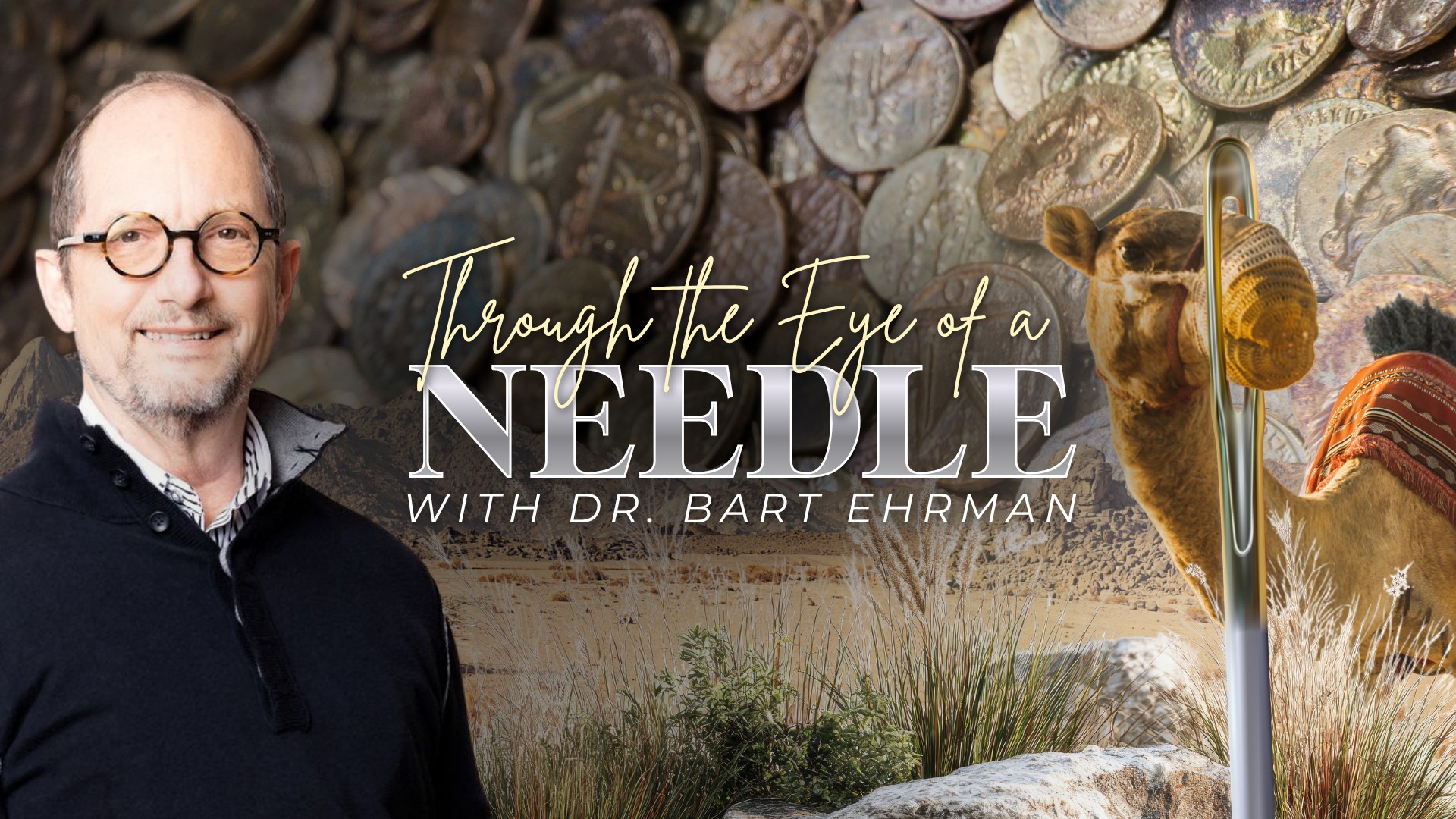
Some devout followers of Jesus insist he was at heart a capitalist. Others, equally devout, insist he was a socialist. Some read his instruction to the rich man literally: “Sell everything and give to the poor.” Others argue he meant it metaphorically, noting that his elaboration, “It is easier for a camel to go through the eye of a needle than for a rich person to enter the kingdom of heaven,” describes a flat impossibility. To which others reply: Jesus himself says it is impossible.
What did Jesus actually say? And what, just as important, did he mean?
In this course we will examine Jesus’s teachings on wealth in their proper historical, cultural, and religious context. We will place his words alongside other moral teachers of his day, Greek, Roman, and Jewish, and consider how an apocalyptic Jew from rural Galilee understood money, poverty, and the obligations of those with more than they needed to survive. And we will ask whether any of it can have relevance for the very different economic systems of our own time.

Your Instructor
Bart Ehrman
James A. Gray Distinguished Professor of Religious Studies Emeritus · University of North Carolina at Chapel Hill
Bart D. Ehrman is the James A. Gray Distinguished Professor of Religious Studies Emeritus at the University of North Carolina at Chapel Hill, where he taught from 1988 until his retirement in 2025. Recognized internationally for his scholarship on the New Testament and early Christianity, Professor Ehrman has written or edited thirty-five books, including six New York Times bestsellers. His college-level textbook The New Testament: A Historical Introduction to the Early Christian Writings has remained the best-selling text in the field for more than twenty-five years. His scholarly works have been published by Oxford, Harvard, Yale, and other premier academic presses, and his books have been translated into twenty-seven languages, reaching millions of readers worldwide.
Beyond the classroom, Professor Ehrman is a widely recognized public scholar. He has produced nine acclaimed courses for The Great Courses, in addition to numerous online courses available through bartehrman.com. His books and courses have sold more than two million copies.
He also writes for his charitable blog, The Bart Ehrman Blog, which has raised millions for organizations addressing poverty, homelessness, and hunger. In addition, he hosts the weekly podcast Misquoting Jesus with Bart Ehrman, available on YouTube and all major podcast platforms, where he brings cutting-edge biblical scholarship to a global audience.
What You’ll Discover
Six Core Themes
Most people have never seriously examined these themes. Most people have never had the tools to explore them. This course changes that.
Theme I
Wealth in Jesus’s World
The economic gap between first-century Palestine and our world is almost impossible to comprehend. Understanding it changes everything about how we read Jesus’s teachings.
1st-century Roman PalestineTheme II
The Camel Explained
Most people don't think Jesus could really mean it when he said it is easier for a camel to pass through the eye of a needle. In this section, we examine what his words actually meant.
The Gospel of MarkTheme III
The Capitalist Jesus?
Many American Christians argue that at heart Jesus endorsed the accumulation of wealth. We examine the parables they use to support this claim, and what those parables actually say.
Matthew 20 & 25Theme IV
The Socialist Jesus?
Others insist Jesus was a socialist. This reading has real problems too, and understanding why reveals the deeper limits of applying any modern economic label to Jesus.
Luke & MatthewTheme V
True Altruism?
Jesus almost always incentivizes doing good for others with promises of future reward for oneself. Is that genuine altruism, or something more complicated?
The Sermon on the MountTheme VI
The Birth of Charity
Hospitals, orphanages, and food banks for the poor all trace their origins to the Christian monastic movement of the 4th and 5th centuries. Most people have no idea.
4th – 5th Century CE8
Lectures
2
Live Q&A Sessions
2,000+
Years of Debate
0
Prior Knowledge Required
What This Course Offers
Why This Course Is Unlike Any Other
Bart Ehrman has spent a career asking the hard questions about what Jesus actually said. Here’s what that means for you.
Directly from the Gospel Texts
Every claim is traced back to the actual words attributed to Jesus in the Gospels. No theology, no preaching. Just the texts themselves, read carefully.
Bart Ehrman’s Historical Method
Rigorous historical-critical analysis applied to separate what Jesus likely said from what later traditions added. This is how historians actually work.
Both Sides, Fairly Examined
Capitalist and socialist readings of Jesus are both examined honestly, with their strongest arguments and their real weaknesses laid out side by side.
Ancient World, Modern Questions
The course doesn’t stop at history. It asks what, if anything, teachings from a very different world might still mean for the economic realities we live in today.
Live Q&A Both Days
Ask Bart your own questions directly, in real time. Each day closes with a 45-minute live Q&A where nothing is off the table.
No Background Required
Built for curious, thoughtful people, not seminarians. If you can read the news and care about ideas, this course is for you.
Course At a Glance
Through the Eye of a Needle
Dates
May 16 & 17, 2026 Watch On Demand
Format
2-Day Live Event Self-Paced Course
Lectures
8 × 50 Minutes
Live Q&A
2 × 45 Minutes
Day 1 Time
1:00 – 5:45 pm EST
Day 2 Time
2:00 – 6:45 pm EST
Instructor
Bart Ehrman
Prepare to Rethink
Common Assumptions This Course Will Challenge
Common Assumption
“Jesus was clearly against wealth”
Jesus’s teachings are more nuanced and more historically specific than a simple anti-wealth message. Setting them in their correct economic and apocalyptic context reveals something quite different from what most people expect.
Common Assumption
“The rich man passage was just for one person”
The encounter with the rich young man is widely treated as a special case, a high bar set for one exceptionally wealthy individual. A close reading of the surrounding text suggests Jesus intended something far more universal.
Common Assumption
“WWJD gives clear economic guidance”
The economic systems of our world (capitalism, socialism, markets, governments) would have made virtually no sense to Jesus or anyone else in his day. Asking what Jesus would do in our economy may be the wrong question entirely.
Common Assumption
“Charitable institutions are just common sense”
Hospitals, orphanages, and organized relief for the hungry and homeless are so familiar that we assume they’ve always existed. In fact, their origins trace directly to the Christian monastic movement and to Jesus’s teachings about wealth.
What You’ll Walk Away With
- A clear picture of what Jesus almost certainly said about wealth and what he probably did not say
- A grasp of just how radically different the ancient economy was from anything we live with today
- An honest assessment of why both capitalist and socialist readings of Jesus are historically problematic
- An understanding of why Jesus usually incentivizes giving with promises of personal gain, and what that means for the idea of altruism
- The story of how the monastic movement translated Jesus’s teachings into lasting institutions of care
- A framework for deciding, for yourself, whether and how any of this matters today
Full Schedule
Eight Lectures, Two Days Eight Lectures on Demand
Four lectures per day, each 50 minutes, with a 45-minute live Q&A to close. Click any lecture to read its description. Eight lectures available on demand, each approximately 50 minutes. Click any lecture to read its description.
1 Economics in the Days of Jesus 1:05 pm
We look at the economic situation of the first-century Roman world: the distribution of rich, poor, and destitute; the possibilities of employment; the burden of taxation. We then narrow the focus to the small towns and villages of rural Galilee where Jesus lived, and ask how understanding those circumstances helps explain his key teachings on money, wealth, and poverty.
2 Is Wealth a Problem? The Greek and Roman Worlds 2:05 pm
We examine how ancient Greek and Roman moral teachers treated wealth as a potential problem, asking: for whom, and why? Where they thought money should be given away, we ask to whom, under what conditions, and for what reasons. This lecture shows how radically different ancient ideas about charitable giving were from what most people assume today, setting the stage for Jesus’s equally distinctive teachings.
3 Problems with Wealth in the Ancient Jewish World 3:05 pm
We move from pagan philosophy to the world of ancient Judaism, starting with the Hebrew Bible’s repeated insistence that those with resources must provide for the poor and needy. We ask why this conviction developed within Judaism, how unusual it was in the ancient world, and how it gave rise to the tradition of almsgiving, including the striking idea that giving away one’s resources could bring atonement for sins.
4 Jesus and Wealth 4:10 pm
We consider Jesus’s own distinctive understanding of wealth and its obligations. His views overlapped with other Jewish teachers of his day, but diverged in significant ways, shaped by his deep conviction that the Day of Judgment was about to arrive. That apocalyptic urgency pushed him toward a radical and universal ethic of giving: no time for half-measures, and no reason to limit generosity to one’s own people.
5 Was Jesus a Capitalist? 2:05 pm
Many American Christians, including prominent public voices, argue that Jesus was at heart a capitalist who saw wealth accumulation as good and godly. Among the passages cited are the Parable of the Workers in the Vineyard (private property and market wages), the Parable of the Talents (capital investment), the Parable of the Sower (investment strategy), and the Parable of the Mustard Seed (compound interest). We examine each to ask whether these readings hold up.
6 Was Jesus a Socialist? 3:05 pm
Other Christians argue just as forcefully that Jesus was a socialist, pointing to his opposition to unequal distribution of wealth and his call for the well-off to give their resources to the poor. We examine this view honestly, asking whether it is coherent to apply Jesus’s words to economic systems that arose only out of the Industrial Revolution, and whether the principles behind his teachings might still carry relevance for today.
7 Difficult Passages and the Troubling Views of Jesus 4:05 pm
Some of Jesus’s sayings about wealth are almost impossible to process: Why would he praise a steward who lied and cheated his employer for personal gain? Why would he commend his disciples for abandoning their jobs, homes, wives, and children? How can he seriously advise people not to worry about having food or clothing? We confront these hard sayings directly, trace their interpretation over the centuries, and see whether any of it can be made sense of.
8 The Real-World Effects of Jesus’s Teachings on Wealth 5:10 pm
After Jesus’s death, thousands of Jerusalem converts reportedly sold everything they owned and gave the proceeds to the apostles for distribution. The practice didn’t last. But the teachings lived on, especially in the monastic movement, where fourth and fifth-century monks built hospitals, orphanages, and institutions for the destitute. We trace this legacy alongside the rival impulse within the church to accumulate wealth, and ask how both streams echo in Christian social and economic debates today.
Exclusive Bonuses
Everything Included with Your Registration
Both Live Q&A Recordings
Recordings of both 45-minute live Q&A sessions, so you can revisit the questions and Bart’s answers anytime.
Lecture Slides
Download Bart’s full slide decks for all eight lectures, ideal for review, note-taking, or sharing with a study group.
Full Transcripts
Searchable transcripts of every lecture, perfect for quoting, deeper study, or following along if English is not your first language.
Audio Downloads
MP3 downloads of every lecture. Listen on your commute, during a walk, or whenever you’re away from a screen.
Bonus Lecture: The Parables of Jesus Lesson 3
Laborers and Management in the Vineyard: How to Assess Kingdom Economics, a lesson by Dr. Amy-Jill Levine.
Questions for Reflection & Recommended Readings
Curated discussion questions and a reading list for each lecture, for going deeper on your own or with a study group.
$1 from every registration is donated to charity: water, bringing clean water to people in need.
2 ways to purchase this course
Stand-Alone Purchase
Enjoy University-level learning at a fraction of the cost
$199.80 Value
$79.95
Included in Your Purchase: Lifetime Access to This University-Level Course With:

Access this Course PLUS Every Course in Our Vault (250+ Hours of Biblical Learning!)
Frequently Asked Questions
Everything You Need to Know
How many lectures are included?
Bart Ehrman will present eight lectures over two days, four per day, each running approximately 50 minutes. Both days also close with a 45-minute live Q&A session where you can ask Bart your own questions directly.
Bart Ehrman presents eight lectures, each running approximately 50 minutes. You also get full access to the recordings of both 45-minute live Q&A sessions from the original event.
Is this course live? Can I watch the recordings afterward?
Yes, this is a live event on May 16 and 17, 2026. Day 1 runs from 1:00 to 5:45 pm EST; Day 2 runs from 2:00 to 6:45 pm EST. All lectures and both Q&A sessions will be recorded. If you can’t watch live, you’ll have access to the full recordings, including the Q&A, after the event.
Do I get instant access to the course?
Yes. As soon as you purchase the course, you will receive an email with login instructions for our online platform, ThriveCart Learn. You can immediately access all eight lectures, the recordings of the live Q&A sessions, and all bonus materials.
How will I join the live sessions?
Once you have purchased the course, you will receive instructions by email to log on to our online course platform, ThriveCart Learn. All joining details and links will be provided there. If you are a member of Biblical Studies Academy (BSA), your access will also be available inside the community.
How long will I have access to the course?
You will have lifetime access to the course materials. You can watch the lectures, download the transcripts, and review the slides as many times as you like, whenever works best for your schedule.
Do I need any prior knowledge of the Bible or early Christianity?
No prior knowledge is required. Bart introduces all the relevant texts, historical background, and scholarly context as the course unfolds. Whether you are coming in fresh or already have some background in biblical studies, you will find the course genuinely rewarding.
Will subtitles or captions be available?
Yes. All lecture recordings include closed captions. Full transcripts are also included with the course, so you can follow along in text, search for specific passages, or review key arguments after watching.
What payment types are accepted?
We accept PayPal and all major credit cards.
Do you offer a money-back guarantee?
Absolutely. If you don’t love the course, send us an email at [email protected] and we will refund 100% of your investment. You will have 30 days from the date of purchase.
Is this budget-friendly?
Comparable in-person weekend intensives and academic workshops with scholars of this caliber regularly run hundreds of dollars per attendee. This course delivers eight full lectures, two live Q&A sessions, and a complete set of study materials, online, at a price that reflects our commitment to making serious biblical scholarship genuinely accessible.
Testimonials

Marvin Conner
Course Participant
This course clarified a great deal for me. I now better understand how deeply the tension between material wealth and spiritual ethics has shaped Western culture. Dr. Ehrman’s explanation of Jesus’ radical teachings about wealth also illuminated their influence across history, from the Reformation and the rise of capitalism to the economic insecurity of our own time.
Bart and Megan, along with the Biblical Studies Academy, have become trusted sources for the historical facts surrounding the Bible and Christian tradition. Bart’s presentations are consistently thoughtful, reasoned, and engaging.
Scott Nelson
Course Participant
Lance Dailey
Course Participant
The course made me more aware of the teachings of Jesus and encouraged me to think about them more carefully.

Contact
1204 Fayetteville Street #1068, Durham, NC, 27707
(602) 529-8162
Social
Copyright 2026 Bart Ehrman Professional Services, all rights reserved.